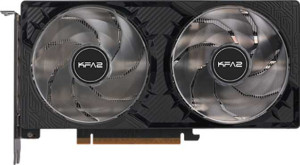
KFA2 GeForce RTX 5050 1-Click OC specifications and in-depth review

KFA2 GeForce RTX 5050 1-Click OC

Manufacturer: KFA2

The KFA2 GeForce RTX 5050 1-Click OC is a graphics card based on NVIDIA's Blackwell architecture, manufactured on a 5 nm process with 16,900 million transistors. It ships with a factory overclock that pushes the GPU boost frequency to 2587 MHz, and its RGB lighting adds a visual element to open-chassis builds. The card draws 130W TDP and measures 234 mm × 129.5 mm, fitting into a range of mid-tower and full-tower systems without issue.

On the memory side, the card carries 8GB of GDDR6 across a 128-bit bus, reaching an effective speed of 20,000 MHz and delivering up to 320 GB/s of bandwidth. Its 2560 shading units, 80 TMUs, and 32 ROPs translate into a floating-point throughput of 13.25 TFLOPS and a texture fill rate of 207 GTexels/s. Feature support includes DirectX 12 Ultimate, OpenGL 4.6, OpenCL 3, ray tracing, DLSS, Intel Resizable BAR, and stereoscopic 3D. Connectivity is handled by two HDMI 2.1b ports and two DisplayPort outputs, enabling up to four simultaneous displays.

Pros
  • Boost clock of 2587 MHz and 13.25 TFLOPS of floating-point throughput indicate solid compute headroom for this GPU tier
  • Ray tracing and DLSS support are both present, enabling hardware-accelerated rendering and AI-based upscaling in compatible titles
  • Four display outputs across two HDMI 2.1b and two DisplayPort connectors allow flexible multi-monitor setups without adapters
  • ECC memory support adds a layer of data integrity useful in compute or content creation workloads
  • Intel Resizable BAR support allows the processor to access the full VRAM pool more efficiently, which can benefit GPU-bound scenarios
  • RGB lighting is built in, catering to users with illuminated builds without requiring separate components
Cons
  • The 128-bit memory bus width limits memory bandwidth scaling compared to wider-bus configurations in the same category
  • 8GB of VRAM may feel restrictive in memory-intensive workloads at higher resolutions or with large texture assets
  • No USB-C output is available, which rules out direct connection to USB-C or Thunderbolt-based displays without an adapter
  • Air cooling only — there is no liquid cooling support, which may limit thermal headroom in confined or high-ambient-temperature cases
  • XeSS (XMX) is not supported, reducing upscaling options to DLSS alone with no cross-vendor alternative
Who is this for?

This card is a reasonable fit for users building compact or mid-range desktop systems who want ray tracing and DLSS support without a high power draw, given its 130W TDP. Content creators and developers working with compute tasks will also appreciate the inclusion of ECC memory and Double Precision Floating Point support, which add reliability to data-sensitive workloads. Those running multi-monitor setups of up to four displays via HDMI 2.1b or DisplayPort will find the output configuration well-suited to productivity-oriented desktop arrangements.

Who is this NOT for?

Users targeting demanding workloads at high resolutions may find the 8GB VRAM over a 128-bit bus a limiting factor, as memory-intensive applications and large texture pipelines can exhaust this headroom relatively quickly. Enthusiasts looking to push high-end gaming or professional visualization at ultra settings will likely encounter constraints from both the memory subsystem and the 13.25 TFLOPS ceiling. Additionally, users who rely on USB-C display connectivity or require liquid cooling integration for thermally restricted builds will find this card lacking, as neither feature is available on this model.

Performance:

GPU clock speed 2317 MHz
GPU turbo 2587 MHz
pixel rate 82.78 GPixel/s
floating-point performance 13.25 TFLOPS
texture rate 207 GTexels/s
GPU memory speed 2500 MHz
shading units 2560
texture mapping units (TMUs) 80
render output units (ROPs) 32
Has Double Precision Floating Point (DPFP)

The KFA2 GeForce RTX 5050 1-Click OC operates at a base GPU clock of 2317 MHz, rising to a boost frequency of 2587 MHz, while the GPU memory runs at 2500 MHz. Its 2560 shading units are supported by 80 texture mapping units and 32 render output units, producing a texture fill rate of 207 GTexels/s and a pixel rate of 82.78 GPixel/s. Overall floating-point performance reaches 13.25 TFLOPS, and the card includes support for Double Precision Floating Point (DPFP), broadening its suitability for compute-oriented workloads alongside standard rendering tasks.

Memory:

effective memory speed 20000 MHz
maximum memory bandwidth 320 GB/s
VRAM 8GB
GDDR version GDDR6
memory bus width 128-bit
Supports ECC memory

The card is equipped with 8GB of GDDR6 VRAM running across a 128-bit memory bus, achieving an effective memory speed of 20,000 MHz and a maximum memory bandwidth of 320 GB/s. ECC memory support is also included, which helps detect and correct memory errors in workloads where data integrity is a concern.

Features:

DirectX version DirectX 12 Ultimate
OpenGL version 4.6
OpenCL version 3
Supports multi-display technology
supports ray tracing
Supports 3D
supports DLSS
has XeSS (XMX)
AMD SAM / Intel Resizable BAR Intel Resizable BAR
has LHR
has RGB lighting
supported displays 4

This card supports DirectX 12 Ultimate, OpenGL 4.6, and OpenCL 3, covering a broad range of graphics and compute workloads. Ray tracing and DLSS are both supported, alongside stereoscopic 3D and multi-display technology for up to four simultaneous outputs. Intel Resizable BAR is included to allow the CPU more flexible access to GPU memory, while LHR and XeSS (XMX) are not present. RGB lighting is built in, and the card does not use a liquid cooling solution.

Ports:

has an HDMI output
HDMI ports 2
HDMI version HDMI 2.1b
DisplayPort outputs 2
USB-C ports 0
DVI outputs 0
mini DisplayPort outputs 0

The card's output configuration consists of two HDMI 2.1b ports and two DisplayPort outputs, providing four video outputs in total. There are no USB-C, DVI, or mini DisplayPort connectors on this model.

General info:

GPU architecture Blackwell
Thermal Design Power (TDP) 130W
PCI Express (PCIe) version 5
semiconductor size 5 nm
number of transistors 16900 million
Has air-water cooling
width 234 mm
height 129.5 mm

Built on the Blackwell architecture and fabricated using a 5 nm process, the GPU integrates 16,900 million transistors and connects to the system via a PCIe 5 interface. It carries a Thermal Design Power of 130W and relies solely on air cooling, with no liquid cooling option. The card measures 234 mm in width and 129.5 mm in height.

Final Verdict

The KFA2 GeForce RTX 5050 1-Click OC is a Blackwell-based graphics card that strikes a clear balance between feature completeness and a modest power envelope, making it a coherent option for users who want hardware-accelerated ray tracing, DLSS, and multi-display support without demanding a high-wattage system. Its inclusion of ECC memory and DPFP support gives it some utility beyond gaming, extending its relevance to lighter compute and content creation tasks. That said, the 128-bit memory bus paired with 8GB of GDDR6 draws a firm boundary around what this card can comfortably handle at scale, and users with aspirations toward memory-heavy or high-resolution workloads will feel that ceiling sooner rather than later. Taken as a whole, it is a well-rounded card for its intended use profile — best appreciated by those building efficient, feature-capable desktop systems within defined performance expectations.