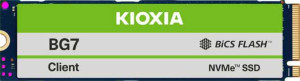
Kioxia BG7 256GB specifications and in-depth review

Kioxia BG7 256GB

Manufacturer: Kioxia

The Kioxia BG7 256GB is a compact M.2 NVMe solid-state drive built around the PCIe 4 interface, targeting systems where space efficiency and modern connectivity matter. It uses Host Memory Buffer (HMB) caching rather than dedicated onboard DRAM, allowing it to maintain a slim profile while still leveraging system RAM for address translation tasks. The drive carries a five-year warranty and operates up to a maximum temperature of 70 °C.

On the performance side, the BG7 256GB is rated for sequential read speeds of 6400 MB/s and sequential write speeds of 4000 MB/s. Random performance is specified at 500,000 read IOPS and 850,000 write IOPS. The drive uses TLC NAND storage and conforms to NVMe version 2, while omitting both an integrated heatsink and RGB lighting, keeping the design straightforward and unobtrusive.

Pros
  • Sequential read speed of 6400 MB/s enables fast loading of large files and system data
  • Random write performance of 850,000 IOPS handles fragmented write workloads efficiently
  • NVMe version 2 with PCIe 4 interface ensures compatibility with modern motherboard platforms
  • Five-year warranty period provides long-term coverage
  • HMB caching removes the need for dedicated DRAM while still supporting address mapping through system memory
  • No RGB lighting or heatsink keeps the physical footprint minimal, suitable for compact or space-constrained builds
Cons
  • 256GB storage capacity is limited for users who need to store large media libraries or multiple heavy applications
  • Relies on HMB rather than dedicated onboard DRAM cache, which can affect sustained performance under heavy workloads
  • No integrated heatsink means thermal management depends entirely on the host system
  • Maximum operating temperature of 70 °C may be a constraint in thermally challenged enclosures
Who is this for?

This drive is well-matched for ultrabooks, thin-and-light laptops, and compact desktop builds where physical space is limited and an M.2 form factor is required. Users who prioritize fast sequential read throughput for tasks like booting operating systems, loading large project files, or running software from an SSD will benefit from the 6400 MB/s read rating. The PCIe 4 with NVMe 2 interface also makes it a practical fit for modern systems that support these standards, and the absence of a heatsink or RGB hardware suits low-profile or fanless enclosures where minimal component bulk is a design requirement.

Who is this NOT for?

Users with substantial local storage needs will find the 256GB capacity insufficient, particularly those working with large video libraries, game collections, or extensive project archives that quickly exhaust smaller drives. Workstation environments running sustained, intensive workloads may also be affected by the drive's reliance on HMB caching instead of dedicated DRAM, as performance under prolonged queue-heavy conditions can be less consistent than with drives carrying onboard memory. Additionally, systems lacking proper airflow or thermal management may struggle to keep the drive within its operating range, since there is no integrated heatsink to assist with heat dissipation during extended use.

Read speed:

sequential read speed 6400 MB/s
random read speed 500000 IOPS

The Kioxia BG7 256GB delivers a sequential read speed of 6400 MB/s, making it well-suited for tasks that involve reading large files in a continuous stream. For workloads involving smaller, scattered data requests, the drive is rated at 500,000 random read IOPS, reflecting a solid capability for handling mixed-access patterns typical in everyday computing environments.

Write speed:

sequential write speed 4000 MB/s
random write speed 850000 IOPS

The Kioxia BG7 256GB is rated for a sequential write speed of 4000 MB/s, covering sustained write operations such as transferring or saving large files. On the random side, the drive reaches 850,000 random write IOPS, indicating a strong capability for handling fragmented write operations across varied block sizes commonly encountered during active system use.

Benchmarks:

General info:

type M2
SSD cache HMB (Host Memory Buffer)
Is an NVMe SSD
NVMe version 2
internal storage 256GB
SSD storage type TLC
PCI Express (PCIe) version 4
warranty period 5 years
Has an integrated heatsink
maximum operating temperature 70 °C
has RGB lighting

The Kioxia BG7 256GB is an M.2 NVMe SSD conforming to NVMe version 2 and running on a PCIe 4 interface, offering 256GB of TLC NAND storage. It relies on HMB (Host Memory Buffer) caching rather than dedicated onboard memory, and has a maximum operating temperature of 70 °C. The drive carries a five-year warranty and does not include an integrated heatsink or RGB lighting, keeping its form factor clean and straightforward.

Final Verdict

The Kioxia BG7 256GB is a focused M.2 NVMe drive that delivers where its specifications are strongest — namely in sequential read throughput of 6400 MB/s and high random write IOPS, backed by a PCIe 4 and NVMe 2 foundation that aligns well with contemporary system platforms. Its compact, heatsink-free design and HMB caching approach make it a practical fit for space-constrained builds, though users should go in with a clear understanding that the 256GB capacity and DRAM-less architecture set natural boundaries on how far it scales with demanding or storage-heavy workloads. For users whose primary needs center on a modern, fast boot and application drive in a slim system, the BG7 256GB is a well-defined option — but those with broader storage requirements or sustained heavy-load scenarios would need to look toward higher-capacity or DRAM-equipped alternatives.