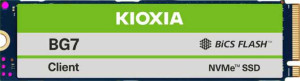
Kioxia BG7 512GB specifications and in-depth review

Kioxia BG7 512GB

Manufacturer: Kioxia

The Kioxia BG7 512GB is a compact M.2 NVMe solid-state drive built around the PCIe 4 interface, targeting systems that benefit from fast internal storage without a dedicated DRAM cache. Instead of onboard memory, it relies on Host Memory Buffer (HMB) technology, borrowing a portion of system RAM to maintain lookup tables and sustain consistent performance under typical workloads. The drive carries a five-year warranty and operates within a maximum temperature of 70 °C.

On the performance side, the BG7 512GB reaches sequential read and write speeds of 6400 MB/s and 5000 MB/s respectively, while random throughput is rated at 550,000 read IOPS and 850,000 write IOPS. Storage uses TLC NAND, and the drive is rated for 300 terabytes written over its lifetime. It conforms to NVMe version 2 and ships without an integrated heatsink or RGB lighting, keeping its physical footprint straightforward for space-constrained builds.

Pros
  • Sequential read speed of 6400 MB/s and write speed of 5000 MB/s reflect strong throughput for an M.2 drive
  • Random write performance rated at 850,000 IOPS supports demanding workloads involving frequent small write operations
  • NVMe 2 over PCIe 4 ensures a modern, fast interface well-suited for current platforms
  • A five-year warranty provides solid long-term coverage for a storage device
  • No integrated heatsink or RGB lighting keeps the physical footprint minimal, which suits compact or space-constrained builds
  • TLC NAND offers a reasonable balance between storage density and write longevity at 300 TBW
Cons
  • Relies on HMB rather than dedicated onboard DRAM cache, which may result in less consistent performance under sustained heavy loads
  • 300 TBW endurance rating is relatively modest for a drive of this speed class, particularly in write-intensive environments
  • Maximum operating temperature of 70 °C leaves limited thermal headroom without an integrated heatsink
  • 512GB capacity may prove insufficient for users with large application libraries or data-heavy workflows
Who is this for?

This drive is a solid fit for users building compact or slim systems — such as ultrabooks or small form factor desktops — where a heatsink-free M.2 form factor is a practical necessity. The PCIe 4 interface paired with NVMe 2 makes it well-suited for mainstream productivity machines, light creative workloads, and everyday computing that can take advantage of sequential read speeds up to 6400 MB/s. The five-year warranty and HMB-based caching also make it a reasonable choice for office environments where moderate, mixed-use storage demands are the norm rather than continuous heavy throughput.

Who is this NOT for?

Users with write-intensive workloads — such as video editing, large database operations, or frequent large file transfers — may find the 300 TBW endurance limiting over time. The absence of dedicated onboard DRAM means performance can become less predictable under sustained queue pressure, making this drive a poor match for high-demand server or workstation environments. Additionally, the 512GB capacity will likely feel restrictive for users managing large media libraries, game collections, or data archives that routinely push storage limits.

Read speed:

sequential read speed 6400 MB/s
random read speed 550000 IOPS

The Kioxia BG7 512GB reaches a sequential read speed of 6400 MB/s, making it capable of moving large files through the pipeline at a sustained pace. For workloads involving smaller, scattered data, the drive delivers 550,000 random read IOPS, reflecting solid responsiveness under queue-heavy or mixed-access conditions.

Write speed:

sequential write speed 5000 MB/s
random write speed 850000 IOPS

On the write side, the Kioxia BG7 512GB supports a sequential write speed of 5000 MB/s, allowing large data transfers to complete at a brisk pace. Its random write performance reaches 850,000 IOPS, indicating strong throughput when handling numerous small write operations simultaneously across varied workloads.

Benchmarks:

General info:

type M2
SSD cache HMB (Host Memory Buffer)
Is an NVMe SSD
NVMe version 2
internal storage 512GB
SSD storage type TLC
PCI Express (PCIe) version 4
Terabytes Written (TBW) 300
warranty period 5 years
Has an integrated heatsink
maximum operating temperature 70 °C
has RGB lighting

The Kioxia BG7 512GB is an M.2 form factor drive that uses the NVMe 2 protocol over a PCIe 4 interface, with 512GB of TLC NAND as its underlying storage medium. Rather than dedicated onboard DRAM, it relies on HMB (Host Memory Buffer) to manage caching duties. Endurance is rated at 300 TBW, and the drive is backed by a five-year warranty. It operates at temperatures up to 70 °C and ships without an integrated heatsink or RGB lighting.

Final Verdict

The Kioxia BG7 512GB positions itself as a capable M.2 NVMe drive for mainstream systems, delivering sequential read speeds of 6400 MB/s over a PCIe 4 interface alongside respectable random I/O figures that hold up well under typical mixed workloads. Its heatsink-free design and reliance on Host Memory Buffer rather than dedicated DRAM make it a natural fit for compact builds and everyday computing scenarios, though users with sustained heavy write demands or large storage needs will find its endurance rating and capacity somewhat constraining. Backed by a five-year warranty and built on NVMe 2, the BG7 512GB is a well-rounded choice for those seeking modern interface standards and solid throughput in a space-efficient package, as long as workload expectations remain within its practical limits.