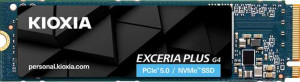
Kioxia Exceria Plus G4 2TB specifications and in-depth review

Kioxia Exceria Plus G4 2TB

Manufacturer: Kioxia

The Kioxia Exceria Plus G4 2TB is an M.2 NVMe solid-state drive built around the PCIe 5.0 interface, targeting users who need high-throughput storage in a compact form factor. It uses TLC NAND flash memory and relies on a Host Memory Buffer cache architecture rather than dedicated DRAM, keeping the drive's footprint minimal while still supporting the demands of modern NVMe 2.0 workflows. The drive ships without an integrated heatsink or RGB lighting, making it a straightforward option for systems with their own thermal management solutions.

On the performance side, the Exceria Plus G4 2TB reaches sequential read and write speeds of 10,000 MB/s and 8,200 MB/s respectively, while random I/O is rated at 1,300,000 read IOPS and 1,400,000 write IOPS. The Phison PS5031-E31T controller manages data across four channels. Kioxia rates the drive at 1,200 terabytes written over its lifetime and specifies a mean time between failures of 1.5 million hours. A five-year warranty accompanies the drive, and its total usable capacity sits at 2,000 GB.

Pros
  • Sequential read and write speeds of 10,000 MB/s and 8,200 MB/s respectively indicate very high sustained throughput for large file operations
  • Random write performance reaches 1,400,000 IOPS, while random reads are rated at 1,300,000 IOPS, supporting demanding workloads with many concurrent small operations
  • The PCIe 5.0 interface and NVMe 2.0 support reflect a current-generation bus standard that allows the drive to operate at its rated speeds on compatible platforms
  • A TBW rating of 1,200 terabytes written on a 2TB drive provides a solid endurance figure for long-term use
  • The 5-year warranty offers extended coverage for the product lifetime
  • The M.2 form factor keeps the drive compact, and the absence of an integrated heatsink allows it to fit in tighter builds or systems with dedicated cooling solutions
Cons
  • Relies on Host Memory Buffer caching instead of dedicated DRAM, which means cache performance depends on the availability and allocation of system RAM
  • The four-channel controller configuration is narrower than higher-channel alternatives, which may limit parallelism under certain sustained workloads
  • No integrated heatsink is included, so adequate system-level thermal management is required to maintain performance under sustained loads
  • PCIe 5.0 compatibility requires a motherboard with a matching slot, limiting usability on older platforms
Who is this for?

This drive is well-matched to users who need high-throughput storage for tasks that move large volumes of data continuously, such as video editing, 3D rendering, or large dataset processing, where the 10,000 MB/s sequential read speed translates directly into faster load and transfer times. The 1,400,000 random write IOPS also make it a strong fit for environments with heavy mixed I/O activity, including workstation builds or enthusiast desktop systems running demanding applications simultaneously. Users building a high-end system on a PCIe 5.0-compatible platform who want a compact M.2 drive with a substantial 2TB capacity and a 5-year warranty will find the specifications align well with long-term, intensive storage needs.

Who is this NOT for?

Users on platforms without a PCIe 5.0 M.2 slot will not be able to take advantage of the drive's rated speeds, making it a poor fit for systems built around older motherboards that only support PCIe 4.0 or earlier. The reliance on Host Memory Buffer caching rather than dedicated DRAM means performance under sustained mixed workloads can be influenced by system memory availability, which may be a concern in memory-constrained environments. Additionally, since the drive ships without an integrated heatsink, it is not ideal for installations in chassis or slots where active thermal management is unavailable, as sustained high-speed operation can generate significant heat.

Read speed:

sequential read speed 10000 MB/s
random read speed 1300000 IOPS

The Kioxia Exceria Plus G4 2TB reaches a sequential read speed of 10,000 MB/s, reflecting the throughput available for large file transfers over its PCIe 5.0 interface. For workloads that involve frequent access to smaller, scattered data, the drive is rated at 1,300,000 random read IOPS, indicating its capacity to handle a high volume of simultaneous read operations.

Write speed:

sequential write speed 8200 MB/s
random write speed 1400000 IOPS

The Kioxia Exceria Plus G4 2TB is rated for a sequential write speed of 8,200 MB/s, covering sustained large-file write operations at a substantial throughput level. On the random side, the drive reaches 1,400,000 random write IOPS, representing its ability to process a high number of small, non-sequential write requests concurrently.

Benchmarks:

General info:

type M2
SSD cache HMB (Host Memory Buffer)
Is an NVMe SSD
NVMe version 2
internal storage 2000GB
controller Phison PS5031-E31T
SSD storage type TLC
PCI Express (PCIe) version 5
Controller channels 4
Terabytes Written (TBW) 1200
MTBF 1.5million hours
warranty period 5 years
Has an integrated heatsink
has RGB lighting

This drive uses the M.2 form factor and operates as an NVMe SSD under NVMe version 2 over a PCIe 5.0 interface, with a total internal storage capacity of 2,000 GB. It relies on a Host Memory Buffer caching scheme rather than dedicated onboard DRAM, and its TLC NAND is managed by the Phison PS5031-E31T controller across four channels. Endurance is rated at 1,200 terabytes written with an MTBF figure of 1.5 million hours, and the drive is covered by a 5-year warranty. It does not include an integrated heatsink or RGB lighting.

Final Verdict

The Kioxia Exceria Plus G4 2TB is a current-generation M.2 NVMe SSD that delivers on the core promise of PCIe 5.0 storage, with sequential read throughput of 10,000 MB/s and random write performance reaching 1,400,000 IOPS making it a capable option for users running demanding workloads on compatible platforms. Its 2TB capacity, 1,200 TBW endurance rating, and 5-year warranty give it solid long-term credentials, while the HMB caching architecture and absence of an integrated heatsink are factors worth accounting for when planning a build. For users with a PCIe 5.0-ready system and adequate thermal headroom, the Exceria Plus G4 2TB represents a well-specified drive that covers the full range of high-throughput storage needs without unnecessary additions.