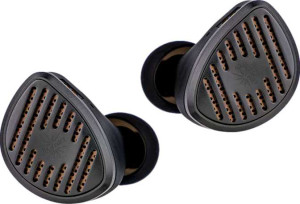
Kiwi Ears Septet specifications and in-depth review

Kiwi Ears Septet

Manufacturer: Kiwi Ears

The Kiwi Ears Septet is an in-ear monitor built around an unusually diverse driver topology, combining four distinct driver technologies within a single CNC-machined metal housing. With a total of seven drivers per earpiece — spanning a dynamic driver, four balanced armatures, a planar magnetic driver, and a piezoelectric bone conduction unit — the Septet represents a technically ambitious approach to hybrid IEM design. The shell is constructed via CNC machining from metal, and a travel bag is included in the package.

On the technical side, the Septet carries an impedance rating of 15 ohms, making it relatively easy to drive across a range of sources. Total harmonic distortion is specified at ≤1% measured at 1 kHz. The cable is detachable and uses a 2-pin 0.78 mm connector, measuring 1.2 meters in length and terminating in a 3.5 mm plug. The earphones do not include a built-in microphone or an in-line control panel. The dynamic driver diaphragm is made from a composite material.

Pros
  • The detachable 2-pin 0.78 mm cable allows for straightforward replacement if the cable wears out or if the user prefers a different termination
  • Seven drivers spanning four distinct technologies — dynamic, balanced armature, planar magnetic, and piezoelectric bone conduction — represent a notably complex driver architecture for an in-ear monitor
  • At 15 ohms impedance, the earphones can be driven without requiring dedicated high-powered amplification equipment
  • The CNC-machined metal shell provides a more durable and rigid construction compared to resin-based alternatives
  • A travel bag is included, offering a practical storage and transport solution out of the box
  • THD is specified at no more than 1% at 1 kHz, indicating a controlled distortion figure at that reference frequency
Cons
  • The absence of a built-in microphone means the earphones cannot be used for calls or voice input without a separate solution
  • No in-line control panel is included, so playback and volume adjustments must be handled directly on the source device
  • The 3.5 mm termination limits direct compatibility with devices that have moved exclusively to USB-C or Lightning outputs without an adapter
  • Managing seven drivers across four different technologies within a single housing may result in a physically larger or heavier shell that some users find less comfortable during extended wear
Who is this for?

The Kiwi Ears Septet is well-suited to dedicated audio enthusiasts who prioritize technical driver diversity and want to explore how four distinct driver technologies interact within a single in-ear monitor. Its 15-ohm impedance means it pairs comfortably with portable sources such as DAPs or dongle DACs without demanding powerful amplification, making it a practical choice for on-the-go listening setups. The inclusion of a detachable 2-pin cable and a travel bag also makes it a reasonable fit for users who want a degree of cable flexibility and portability in their listening rig.

Who is this NOT for?

Users looking for a hands-free or communication-capable earphone will find the Septet falls short, as it lacks both a built-in microphone and an in-line control panel, making it impractical for calls, voice assistants, or on-cable media control. The seven-driver architecture housed in a CNC-machined metal shell may also result in a bulkier fit that is less comfortable for those sensitive to in-ear monitor size and weight during prolonged sessions. Additionally, users whose devices lack a 3.5 mm output will face connectivity limitations, as the cable terminates exclusively in a 3.5 mm connector with no alternative termination provided.

General info:

Driver configuration 1DD + 4BA + 1PD + 1PZT
Type of drivers Planar magnetic, Piezoelectric bone conduction (PZT), Dynamic driver (DD), Balanced armature (BA)
Diaphragm material Composite
Shell material/process CNC-machined metal
has a built-in microphone
travel bag is included
Has an in-line control panel

The Kiwi Ears Septet uses a hybrid driver configuration of 1DD + 4BA + 1PD + 1PZT, drawing on four distinct driver technologies: a dynamic driver with a composite diaphragm, four balanced armatures, a planar magnetic driver, and a piezoelectric bone conduction unit. The shell is crafted from CNC-machined metal, and a travel bag is included in the package. The earphones do not feature a built-in microphone or an in-line control panel.

Specifications:

drivers count 7
impedance 15 Ohms
Total harmonic distortion (THD) ≤1% (@1kHz)

The Septet houses a total of 7 drivers and operates at an impedance of 15 ohms, placing it on the easier-to-drive end of the spectrum. Total harmonic distortion is rated at ≤1% measured at 1 kHz, reflecting a controlled distortion threshold at that reference frequency.

Cable:

Connector type 3.5 mm
Pin connector 2-Pin (0.78 mm)
cable length 1.2 m
has a detachable cable

The Septet comes with a detachable cable measuring 1.2 meters in length, terminating in a 3.5 mm connector. It attaches to the earphones via a 2-pin 0.78 mm pin connector, a widely used standard that allows for straightforward cable replacement or upgrades.

Final Verdict

The Kiwi Ears Septet is a technically ambitious in-ear monitor that makes a clear statement through its seven-driver hybrid architecture spanning four distinct driver technologies. Built into a CNC-machined metal shell and paired with a detachable cable, it is shaped around the needs of dedicated listeners who value driver complexity and a portable, source-friendly impedance of 15 ohms. Its limitations — namely the absence of a microphone, in-line controls, and any alternative cable termination — make clear that it is designed exclusively as a pure listening tool rather than an all-purpose earphone. For the right user, the Kiwi Ears Septet represents a focused, technically dense option within the in-ear monitor category.