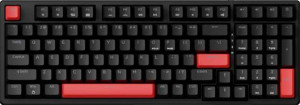
The Lemokey X5 is a wired mechanical gaming keyboard built around a 96% full-size layout with a standard profile, connecting via USB at a 1000 Hz polling rate. It uses a gasket mount design and features a detachable cable, adding flexibility for storage and cable management. The board is also compatible with Mac, making it usable across different systems. Physically, it measures 380.5 mm wide, 133.7 mm deep, and 38.6 mm thick, weighing in at 521 g — reasonably compact for its layout size. It carries a 1-year warranty.
The Lemokey X5 features a plastic and steel case with a steel plate, available exclusively in black. It includes backlighting with a north-facing LED orientation, though RGB lighting is not supported, meaning the illumination is limited to a single color. The keyboard has adjustable feet for typing angle customization, but does not come with a wrist rest. No wrist rest is included in the package.
The Lemokey X5 is equipped with Keychron Brown Switches, a mechanical tactile type that provides a noticeable bump during keystrokes without an audible click. They actuate at 2 mm with a required force of 55 g and offer a total travel distance of 4 mm, making them suitable for both typing and general use. The switches are hot-swappable, so they can be replaced without soldering, giving users the option to swap in different switches down the line.
The Lemokey X5 supports N-key rollover (NKRO), ensuring every simultaneous keypress is registered without conflict. On the software side, it is compatible with both QMK and VIA, allowing users to remap keys and adjust firmware behavior directly — ZMK support is not available. The board does not include analog input, rapid trigger, dual actuation, or adjustable actuation, and it lacks USB passthrough and an onboard display.
The Lemokey X5 uses an ANSI (United States) layout with a standard key arrangement, so third-party keycap sets are broadly compatible. The keycaps are double-shot ABS in an OEM profile, offering a familiar, slightly sculpted feel across rows. Media functions are accessible via the Fn key rather than dedicated keys, and there is no rotary dial on the board.