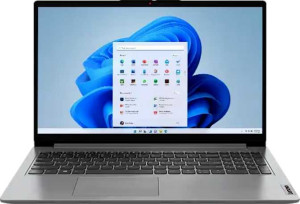
The Lenovo IdeaPad 1 Gen 7 15″ is classified as a productivity laptop and carries a weight of 1,610 g with overall dimensions of 360 mm wide, 236 mm deep, and 17 mm thick, resulting in a total volume of 1,444.32 cm³. It does not use a fanless design, and the keyboard lacks a backlit option. The build is neither rugged nor weather-sealed, so it is not intended for use in harsh or wet environments. The machine comes with a 2-year warranty.
The IdeaPad 1 Gen 7 15″ features a 15.6″ IPS LCD panel with LED backlighting, delivering a 1920×1080 resolution at a pixel density of 141 ppi. The display operates at a 60 Hz refresh rate and reaches a typical brightness of 250 nits. An anti-reflection coating is present to help reduce glare, though the screen does not support touch input.
The IdeaPad 1 Gen 7 15″ is equipped with an 8-core CPU running at 1.8 GHz with a turbo frequency of 4.3 GHz, supported by 16 threads via multithreading for handling parallel tasks. It carries 16GB of DDR4 RAM at 3,200 MHz across a single memory slot, which also represents the maximum supported memory capacity. Storage is handled by a 1TB NVMe SSD over a PCIe 4.0 interface, providing flash-based storage with no mechanical drive involved. The GPU runs at a base clock of 300 MHz and boosts up to 1,900 MHz, with support for DirectX 12 and 64-bit operation; XeSS (XMX) is not supported. The processor is built on a 7 nm semiconductor process.
In benchmark testing, the IdeaPad 1 Gen 7 15″ recorded a Geekbench 6 multi-core score of 5,408 alongside a single-core score of 1,397, reflecting the processor's multi-threaded capabilities relative to its single-core throughput. The PassMark result came in at 15,606 overall, with a single-core PassMark score of 2,558. In Cinebench R20, the system achieved a multi-core result of 3,381 and a single-core score of 495.
The IdeaPad 1 Gen 7 15″ offers a modest but functional port selection, including one USB 3.2 Gen 1 Type-C port, one USB 3.2 Gen 1 Type-A port, and one USB 2.0 port; there are no Thunderbolt 3 or 4 ports, no USB 4 ports, and no higher-speed USB 3.2 Gen 2 connections. Video output is provided through a single HDMI 1.4 port, with no DisplayPort, mini DisplayPort, or VGA connector present. Wireless connectivity covers Wi-Fi 6 (802.11ax) along with backward-compatible Wi-Fi 5 and Wi-Fi 4, paired with Bluetooth 5.2. The laptop also includes an external memory card slot and supports AirPlay, while an RJ45 Ethernet port is absent.
The IdeaPad 1 Gen 7 15″ is fitted with a 42 Wh battery. It does not include sleep-and-charge USB ports, meaning connected devices cannot be charged while the laptop is powered off or in sleep mode, and there is no MagSafe power adapter.
The IdeaPad 1 Gen 7 15″ includes stereo speakers and a 3.5 mm headset jack for audio output, along with a dual-microphone setup and a front-facing camera for video calls. It does not support Dolby Atmos, and there is no S/PDIF output port. On the security side, the laptop lacks both a fingerprint scanner and 3D facial recognition, and voice commands are not supported. Motion and location sensors are absent, with no gyroscope, accelerometer, compass, or GPS on board. Graphics-related features such as ray tracing and DLSS are not supported, no stylus is included, and there is no optical disc drive.
The IdeaPad 1 Gen 7 15″ uses a laptop-class CPU with a 15W TDP, a clock multiplier of 18, and a maximum rated temperature of 105 °C; the multiplier is locked, so overclocking is not supported, though a PassMark overclocked result of 15,953 is recorded. The processor features 512 KB of L1 cache, 4 MB of L2 cache (0.5 MB per core), and 8 MB of L3 cache (1 MB per core), with a maximum supported RAM speed of 4,266 MHz. It supports the AVX, AES, FMA3, F16C, and MMX instruction sets, includes an NX bit for hardware-level security, and does not use big.LITTLE heterogeneous core technology. Graphics are handled by the integrated Radeon RX Vega 8, which counts 512 shading units, 32 texture mapping units, 8 render output units, and 8 execution units, with support for OpenCL 2.1 and OpenGL 4.6. The chip is built with 9,800 million transistors, and compatible chipsets include X570, B550, A520, X470, and B450.