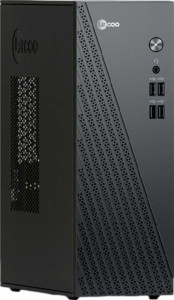
The Lenovo Lecoo Cool 310 uses a Micro-ATX form factor and comes equipped with a 1000GB SSD for local storage. It is worth noting that this drive is not an NVMe SSD, meaning it operates over a standard storage interface rather than the faster NVMe protocol.
The CPU runs eight cores at a base speed of 3.8 GHz per core, with a turbo clock that reaches 4.9 GHz under load, and supports 16 threads through multithreading. It carries a 15W TDP and a maximum operating temperature of 100°C, with a clock multiplier of 38 that is locked rather than unlocked. Cache memory totals 8MB of L2 at 1MB per core and 16MB of L3 at 2MB per core, helping to reduce memory latency across workloads. The processor supports 64-bit computing and includes integrated graphics, making it a self-contained solution without requiring a discrete GPU for display output.
The integrated graphics solution delivers 8.294 TFLOPS of floating-point performance, with a base clock of 800 MHz and a turbo frequency of 2700 MHz, backed by 768 shading units, 48 texture mapping units, and 32 render output units that produce a texture rate of 129.6 GTexels/s and a pixel rate of 86.4 GPixel/s. Built on a 4nm process with 25,390 million transistors, it connects via PCIe 4 and supports up to four displays simultaneously through its multi-display technology. The GPU is compatible with DirectX 12 Ultimate, OpenGL 4.6, and OpenCL 2.1, and includes support for ray tracing and Double Precision Floating Point, though DLSS is not supported.
The system is equipped with 16GB of DDR5 RAM, representing the fifth generation of DDR memory technology, which brings higher bandwidth and improved power efficiency compared to its predecessors.
Wireless connectivity covers Wi-Fi 6E (802.11ax) along with backwards-compatible Wi-Fi 6, Wi-Fi 5, and Wi-Fi 4 standards, paired with Bluetooth 5.3 for short-range peripheral connections. On the wired side, there is one RJ45 Ethernet port and a single HDMI output for display, while audio is handled through a 3.5mm headset jack; there is no VGA connector, DisplayPort output, or S/PDIF port. USB connectivity consists of six USB 2.0 ports and two USB 3.2 Gen 1 Type-A ports, with no USB 3.2 Gen 2, USB-C, USB 4, Thunderbolt 3, or Thunderbolt 4 ports available.
In PassMark benchmark testing, the system scores 28,797 in the multi-core test, reflecting its overall multi-threaded processing capability, while the single-core result stands at 3,556, representing the performance of an individual CPU core.
The Radeon 780M GPU is based on the RDNA 3.0 architecture and the system supports stereoscopic 3D output. Memory can be expanded up to 256GB across two channels, with a maximum RAM speed of 7500 MHz, and ECC memory is supported for added data integrity; there is no external memory slot. The CPU is classified for both laptop and desktop use, supports a range of instruction sets including MMX, F16C, FMA3, AES, AVX, AVX2, SSE 4.1, and SSE 4.2, includes NX bit support, and does not use big.LITTLE technology. The system does not use flash storage and has no air-water cooling solution, and it comes with a one-year warranty.