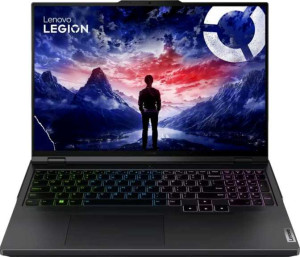
The Lenovo Legion 5 Pro Gen 14 (2024) is classified as a gaming laptop with a body measuring 363 mm wide, 261 mm deep, and 21 mm thick, giving it a total volume of approximately 1,989.6 cm³. It weighs 2,500 g and does not use a fanless design, which is typical for a machine built around active cooling. The keyboard includes backlighting, and the laptop comes with a 2-year warranty. It is not weather-sealed or splashproof.
The laptop features a 16″ IPS panel running at a 2560 x 1600 px resolution with a pixel density of 188 ppi and a 240Hz refresh rate, making it well-suited for fast-moving content. Typical brightness is rated at 500 nits, and an anti-reflection coating is present to help reduce glare. The display does not support touch input, and the system can drive up to four external displays simultaneously.
The processor runs at 6 cores clocked at 2.6 GHz and 8 cores at 1.9 GHz across 20 threads, with multithreading enabled and a turbo clock speed reaching 4.9 GHz, built on a 4 nm semiconductor process and supporting 64-bit operation. System memory consists of 32GB of DDR5 RAM at 5,600 MHz across two slots, which also represents the maximum supported memory amount. Storage is handled by a 1,024GB NVMe SSD connected via PCIe 4.0, using flash storage technology. On the graphics side, the GPU runs at a base clock of 1,605 MHz and boosts to 2,370 MHz, backed by 6GB of GDDR6 VRAM delivering 12.13 TFLOPS of floating-point performance, a texture rate of 204.8 GTexels/s, and a pixel rate of 113.76 GPixel/s. The GPU supports DirectX 12 Ultimate but does not include XeSS (XMX) support.
In CPU benchmarks, this laptop scores 2,328 in Geekbench 6 single-core and 12,286 in Geekbench 6 multi-core, reflecting the processor's threaded workload capacity. The overall PassMark result stands at 29,125, with a single-core PassMark score of 3,613. GPU performance is represented by a PassMark G3D result of 17,148.
The laptop's port selection includes two USB 3.2 Gen 2 Type-C ports and four USB 3.2 Gen 1 Type-A ports, while there are no Thunderbolt 3 or 4 ports, no USB 4 ports, and no DisplayPort or mini DisplayPort outputs. Video output is handled by a single HDMI 2.1 port, and there is no VGA connector present. Wired networking is covered by one RJ45 port, and wireless connectivity spans Wi-Fi 6E (802.11ax) down through Wi-Fi 4 (802.11n), alongside Bluetooth 5.2. AirPlay is supported, but there is no external memory card slot.
The laptop is equipped with an 80 Wh battery rated for approximately 5.2 hours of use. It supports sleep-and-charge functionality, allowing compatible devices to be charged through USB ports even when the laptop is powered off. There is no MagSafe power adapter included.
Audio output is handled by stereo speakers with a 3.5 mm headset jack, while two built-in microphones and a front camera are also present. Dolby Atmos is not supported, and there is no S/PDIF output. On the graphics side, the laptop supports both ray tracing and DLSS, relevant for compatible gaming workloads. Biometric security features are absent — there is no fingerprint scanner and no 3D facial recognition — and voice commands are not supported. The device does not include a stylus, an optical disc drive, or any motion and location sensors such as a gyroscope, accelerometer, compass, or GPS.
The processor is a laptop-class CPU using big.LITTLE technology with a clock multiplier of 26, a maximum operating temperature of 100 °C, a TDP of 115W, and a 24 MB L3 cache. It supports a range of instruction sets including MMX, F16C, FMA3, AES, AVX, AVX2, SSE 4.1, and SSE 4.2, along with Double Precision Floating Point (DPFP) and the NX bit, though the multiplier is not unlocked. Integrated graphics are present alongside the discrete GPU, which is built on the Ada Lovelace architecture and contains 18,900 million transistors, 2,560 shading units, 80 texture mapping units, 48 ROPs, and 32 execution units. GPU memory runs at 2,000 MHz with an effective speed of 16,000 MHz, a 96-bit bus, and a maximum bandwidth of 192 GB/s. The system supports Intel Resizable BAR, ECC memory, stereoscopic 3D, and multi-display output, while LHR is not present. Graphics API support covers OpenCL 3 and OpenGL 4.6, and memory is accessed across two channels with a maximum RAM speed of 5,600 MHz.