Lenovo Legion Pro 7 16" AMD Ryzen 9 7945HX 2.5GHz / Nvidia GeForce RTX 4080 Laptop / 32GB RAM / 1TB SSD specifications and in-depth review

Lenovo Legion Pro 7 16" AMD Ryzen 9 7945HX 2.5GHz / Nvidia GeForce RTX 4080 Laptop / 32GB RAM / 1TB SSD

Manufacturer: Lenovo

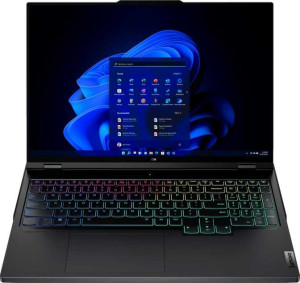
The Lenovo Legion Pro 7 16″ is a gaming laptop built around AMD's Ryzen 9 7945HX processor, pairing it with an Nvidia GeForce RTX 4080 Laptop GPU to cover a broad range of demanding workloads and gaming scenarios. Weighing 2650 g and measuring 21 mm thick, it balances a relatively slim chassis with the thermal headroom required by its 150W TDP CPU. The 16-inch display runs at a 2560 x 1600 resolution with a 240Hz refresh rate and supports up to four simultaneous outputs.

On the performance side, the Ryzen 9 7945HX runs 16 cores across 32 threads at a base clock of 2.5 GHz, reaching a turbo of 5.4 GHz, and sits on a PCIe 4.0 platform with DDR5 memory running at up to 5200 MHz. The RTX 4080 Laptop GPU is based on the Ada Lovelace architecture, delivering 24.72 TFLOPS of floating-point performance, a 192-bit memory bus, and 432 GB/s of maximum memory bandwidth from its 12 GB of GDDR6 VRAM. The system ships with 32 GB of RAM expandable to 64 GB, a 1 TB NVMe SSD, and connectivity that includes USB 3.2 Gen 2 Type-C, two USB 3.2 Gen 1 Type-A ports, HDMI 2.1, and a single RJ45 port.

Pros
  • The 16-core, 32-thread CPU reaches a turbo clock of 5.4 GHz and is backed by a large 64 MB L3 cache, supporting demanding multi-threaded workloads
  • The RTX 4080 Laptop GPU delivers 24.72 TFLOPS of floating-point performance with 432 GB/s of memory bandwidth, enabling ray tracing and DLSS support
  • The 2560 x 1600 display runs at 240Hz, providing both a sharp image and a fast refresh rate suited to gaming use
  • System RAM is upgradeable up to 64 GB of DDR5, and the 1 TB NVMe SSD uses flash storage for quick data access
  • The inclusion of a backlit keyboard, stereo speakers, a 3.5 mm audio jack, a front camera, and sleep-and-charge USB ports covers everyday usability without requiring external accessories
  • Wired networking via RJ45, Wi-Fi support, HDMI 2.1 output, and the ability to drive up to four displays offer versatile connectivity options
Cons
  • At 2650 g and 21 mm thick, the chassis is relatively heavy and bulky for a portable device
  • The display lacks both an anti-reflection coating and touchscreen support, limiting usability in bright environments or touch-based workflows
  • There are no Thunderbolt 3 or 4 ports and no USB 4 connections, restricting high-bandwidth peripheral and external display options
  • No external memory slot is available, limiting quick storage expansion
  • The absence of a fingerprint scanner and 3D facial recognition means the system relies solely on traditional login methods
  • There is no DisplayPort output, leaving HDMI 2.1 as the only dedicated video-out option for external monitors
Who is this for?

This laptop is well-suited to users who need sustained processing and graphics capability for demanding gaming sessions, given its 240Hz 2560x1600 display, ray tracing and DLSS support, and an RTX 4080 Laptop GPU capable of 24.72 TFLOPS. The 16-core CPU with a 5.4 GHz turbo clock and 64 MB L3 cache also makes it a reasonable fit for content creation and heavily threaded workloads such as 3D rendering or video encoding. Users who frequently connect external monitors or peripherals will appreciate the HDMI 2.1 output, multi-display support for up to four screens, RJ45 wired networking, and the 12-hour rated battery life for extended desk-based use.

Who is this NOT for?

Users who prioritize portability and lightweight travel will find the 2650 g weight and 21 mm thickness impractical for daily commuting or on-the-go use. The absence of Thunderbolt 3 or 4 ports and any DisplayPort output makes this a poor fit for professionals who rely on high-bandwidth peripherals or multi-monitor setups requiring those interfaces. Additionally, users who need a touchscreen, biometric login via fingerprint or facial recognition, or an external memory slot for quick storage expansion will find those capabilities entirely absent from this configuration.

Design:

Type Gaming
weight 2650 g
Uses a fanless design
Has a backlit keyboard
volume 1997.226 cm³
width 363 mm
height 262 mm
thickness 21 mm
is weather-sealed (splashproof)

The Lenovo Legion Pro 7 16″ is classified as a gaming laptop with a footprint of 363 × 262 mm and a thickness of 21 mm, giving it a volume of roughly 1997 cm³. It weighs 2650 g and relies on an active cooling solution rather than a fanless design. The chassis includes a backlit keyboard but does not offer weather sealing or splashproofing.

Display:

screen size 16"
resolution 2560 x 1600 px
has a touch screen
refresh rate 240Hz
has anti-reflection coating
supported displays 4

The laptop features a 16″ screen running at a 2560 x 1600 px resolution and a 240Hz refresh rate, making it suited for fast-paced content. The display does not include a touchscreen or an anti-reflection coating, and the system supports up to four connected displays simultaneously.

Performance:

RAM 32GB
Uses flash storage
internal storage 1024GB
CPU speed 16 x 2.5 GHz
CPU threads 32 threads
VRAM 12GB
floating-point performance 24.72 TFLOPS
GDDR version GDDR6
texture rate 386.3 GTexels/s
pixel rate 133.2 GPixel/s
Is an NVMe SSD
DirectX version DirectX 12 Ultimate
GPU clock speed 1350 MHz
uses multithreading
maximum memory amount 64GB
DDR memory version 5
turbo clock speed 5.4GHz
GPU turbo 2280 MHz
PCI Express (PCIe) version 4
semiconductor size 5 nm
has XeSS (XMX)
Supports 64-bit

The system is equipped with a 16-core, 32-thread CPU running at a base clock of 2.5 GHz per core and a turbo clock of 5.4 GHz, built on a 5 nm semiconductor process and connected via a PCIe 4.0 interface; notably, it does not use multithreading. System memory stands at 32 GB of DDR5, expandable up to 64 GB, while storage is handled by a 1024 GB NVMe SSD using flash storage. On the graphics side, the GPU carries 12 GB of GDDR6 VRAM, a base clock of 1350 MHz boosting to 2280 MHz, and delivers 24.72 TFLOPS of floating-point performance alongside a texture rate of 386.3 GTexels/s and a pixel rate of 133.2 GPixel/s. The GPU supports DirectX 12 Ultimate and 64-bit operation, but does not include XeSS acceleration.

Benchmarks:

Geekbench 6 result (multi) 16149
Geekbench 6 result (single) 2768
PassMark (G3D) result 26235
PassMark result 54562
PassMark result (single) 4040
Cinebench R20 (multi) result 12914
Cinebench R20 (single) result 758

In CPU benchmarks, the system scores 16149 in Geekbench 6 multi-core and 2768 in the single-core variant, while Cinebench R20 records 12914 in the multi-core test and 758 in the single-core test. The overall PassMark result reaches 54562, with the single-core PassMark at 4040. On the graphics side, the PassMark G3D score stands at 26235, reflecting the GPU's rendering capability as measured by that benchmark.

Connectivity:

USB 3.2 Gen 2 ports (USB-C) 1
USB 3.2 Gen 2 ports (USB-A) 0
USB 4 20Gbps ports 0
USB 4 40Gbps ports 0
Thunderbolt 4 ports 0
USB 3.2 Gen 1 ports (USB-C) 0
USB 3.2 Gen 1 ports (USB-A) 2
Thunderbolt 3 ports 0
has an HDMI output
Has USB Type-C
supports Wi-Fi
has an external memory slot
RJ45 ports 1
HDMI ports 1
HDMI version HDMI 2.1
DisplayPort outputs 0
has AirPlay
mini DisplayPort outputs 0
has a VGA connector

The laptop's port selection includes one USB 3.2 Gen 2 USB-C port, two USB 3.2 Gen 1 USB-A ports, and a single HDMI 2.1 output, while DisplayPort, mini DisplayPort, and VGA outputs are absent. There are no Thunderbolt 3 or 4 ports, no USB 4 connections, and no external memory slot. Wired networking is covered by one RJ45 port, and the system also supports Wi-Fi and AirPlay for wireless connectivity.

Battery:

Battery life 12 hours
Has sleep-and-charge USB ports
Has a MagSafe power adapter

The laptop is rated for a battery life of 12 hours and includes sleep-and-charge USB ports, allowing connected devices to be charged even when the system is powered off. It does not use a MagSafe power adapter.

Features:

has stereo speakers
has a socket for a 3.5 mm audio jack
supports ray tracing
supports DLSS
has Dolby Atmos
Stylus included
Has a fingerprint scanner
Uses 3D facial recognition
has voice commands
has a front camera
Has S/PDIF Out port
has a gyroscope
has GPS
has an accelerometer
has a compass
Has an optical disc drive

The laptop includes stereo speakers, a 3.5 mm headset jack, and a front camera, though it lacks Dolby Atmos, an S/PDIF output, and an optical disc drive. On the graphics feature side, it supports both ray tracing and DLSS, while motion and positioning sensors such as a gyroscope, accelerometer, compass, and GPS are not present. Security and input options are similarly limited, with no fingerprint scanner, 3D facial recognition, voice commands, or included stylus.

Miscellaneous:

clock multiplier 25
PassMark (DirectCompute) result 12281
has LHR
Thermal Design Power (TDP) 150W
Supports 3D
Supports multi-display technology
OpenCL version 3
OpenGL version 4.6
Supports ECC memory
memory bus width 192-bit
effective memory speed 18000 MHz
maximum memory bandwidth 432 GB/s
render output units (ROPs) 80
texture mapping units (TMUs) 232
shading units 7424
Has Double Precision Floating Point (DPFP)
GPU memory speed 2250 MHz
number of transistors 35800 million
GPU architecture Ada Lovelace
PassMark result (overclocked) 55403
GPU name Radeon 610M
Type Laptop
Uses big.LITTLE technology
Has an unlocked multiplier
Has NX bit
instruction sets MMX, F16C, FMA3, AES, AVX, AVX2, SSE 4.1, SSE 4.2
GPU execution units 2
Has integrated graphics
L3 core 4 MB/core
L3 cache 64 MB
L2 core 1 MB/core
L2 cache 16 MB
L1 cache 1000 KB
memory channels 2
CPU temperature 100 °C
RAM speed (max) 5200 MHz

The CPU is a laptop-class processor with a 150W TDP, a clock multiplier of 25, an unlocked multiplier, and an NX bit for hardware-level execution protection; it does not use big.LITTLE technology and supports a maximum CPU temperature of 100 °C. The cache hierarchy spans 1000 KB of L1, 16 MB of L2 at 1 MB per core, and 64 MB of L3 cache at 4 MB per core, with two memory channels and a maximum RAM speed of 5200 MHz. Supported instruction sets include MMX, F16C, FMA3, AES, AVX, AVX2, SSE 4.1, and SSE 4.2, and the CPU also features integrated graphics alongside the discrete GPU. On the graphics side, the Ada Lovelace-based GPU contains 35,800 million transistors, 7424 shading units, 232 texture mapping units, and 80 ROPs, with a memory bus width of 192-bit, a GPU memory speed of 2250 MHz, and an effective memory speed of 18,000 MHz yielding up to 432 GB/s of memory bandwidth. The GPU supports OpenCL 3, OpenGL 4.6, stereoscopic 3D, multi-display output, and double-precision floating point, but does not include LHR; the PassMark DirectCompute result is 12,281 and the overclocked PassMark score reaches 55,403.
Final Verdict

The Lenovo Legion Pro 7 16″ is a desktop-replacement gaming laptop that consolidates substantial CPU and GPU capability into a single chassis, pairing a 16-core Ryzen 9 7945HX with an RTX 4080 Laptop GPU that supports ray tracing, DLSS, and delivers 24.72 TFLOPS of floating-point performance alongside a 240Hz 2560x1600 display. Its breadth of processing power, generous cache architecture, and DDR5 memory platform make it a credible option for both gaming and threaded creative workloads, though users should weigh the significant chassis weight and the absence of Thunderbolt connectivity against their workflow requirements. For those whose priorities align with raw performance at a fixed desk or workstation-style setup rather than lightweight portability, the Legion Pro 7 16″ represents a well-specified, focused machine.