Lenovo Legion Tower 5i Gen 10 (Ultra 7 265F / RTX 5070 / 32GB RAM / 2TB SSD) specifications and in-depth review

Lenovo Legion Tower 5i Gen 10 (Ultra 7 265F / RTX 5070 / 32GB RAM / 2TB SSD)

Manufacturer: Lenovo

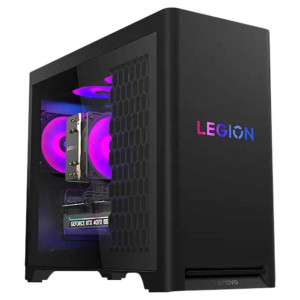
The Lenovo Legion Tower 5i Gen 10 is a desktop gaming PC built around Intel's Ultra 7 265F processor and NVIDIA's RTX 5070 graphics card. Housed in an ATX form factor chassis with a volume of roughly 37,090 cm³, the system ships with 32GB of DDR5 memory running at 5,600 MHz and a 2TB NVMe SSD, giving it a well-rounded storage and memory configuration for modern gaming workloads.

The RTX 5070 at the heart of this system is based on NVIDIA's Blackwell architecture, built on a 5 nm process with 6,144 shading units and 12GB of GDDR7 VRAM on a 192-bit bus, delivering up to 672 GB/s of memory bandwidth and 30.84 TFLOPS of floating-point performance. The GPU supports DirectX 12 Ultimate, ray tracing, and DLSS, and connects via PCIe 5.0. On the connectivity side, the tower includes Wi-Fi 6E, Bluetooth 5.3, a 2.5GbE RJ45 port, three DisplayPort outputs, one HDMI 2.1 port, and a mix of USB 3.2 Gen 1 and Gen 2 ports alongside four USB 2.0 connections.

Pros
  • The RTX 5070 GPU delivers 30.84 TFLOPS of floating-point performance with 12GB of GDDR7 VRAM and 672 GB/s memory bandwidth, making it well-suited for demanding gaming workloads
  • Support for ray tracing, DLSS, and DirectX 12 Ultimate enables access to modern rendering features in compatible titles
  • Wi-Fi 6E support ensures fast and low-latency wireless connectivity across current-generation networks
  • The 2TB NVMe SSD provides ample fast storage for large game libraries and applications
  • With a maximum memory capacity of 192GB across dual channels and ECC support, the platform offers significant headroom for future memory upgrades
  • Up to four displays can be driven simultaneously via three DisplayPort outputs and one HDMI 2.1 port
Cons
  • The CPU multiplier is locked, removing any possibility of manual overclocking
  • No Thunderbolt 3 or Thunderbolt 4 ports are present, limiting high-bandwidth peripheral and external display options
  • The system does not include air-water cooling, which may be a consideration given the CPU's 250W TDP
  • No USB 4 ports are available, restricting connectivity to users with newer high-speed USB 4 devices
  • The product carries no stated warranty period, offering no documented post-purchase coverage
Who is this for?

This system is well-matched for users who regularly engage in demanding gaming sessions that benefit from ray tracing, DLSS, and DirectX 12 Ultimate support, as the RTX 5070 GPU and its 30.84 TFLOPS of floating-point performance can handle visually intensive titles with modern rendering pipelines. The 2TB NVMe SSD and 32GB of DDR5 RAM running at 5,600 MHz make it equally capable for content creation and multitasking workflows where fast storage access and responsive memory throughput matter. Users who want a multi-monitor setup will also find the four-display support across three DisplayPort outputs and one HDMI 2.1 port a practical advantage, whether for productivity spanning multiple screens or an immersive gaming environment.

Who is this NOT for?

Users who need a system they can transport or use in space-constrained environments will find this ATX tower's physical footprint — 458 mm deep, 383.8 mm tall, and 211 mm wide — impractical, as it is strictly a stationary desktop form factor. Those who rely on Thunderbolt connectivity for high-bandwidth peripherals, external GPUs, or fast external storage will be disappointed by the complete absence of Thunderbolt 3 or Thunderbolt 4 ports. Additionally, users who prioritize manual CPU tuning will find the platform limiting, as the locked CPU multiplier prevents any form of overclocking to extract additional processing headroom.

General info:

SSD storage capacity 2000GB
form factor ATX
Is an NVMe SSD
volume 37089.6644 cm³
thickness 458 mm
height 383.8 mm
width 211 mm

The Lenovo Legion Tower 5i Gen 10 follows an ATX form factor design, measuring 458 mm in depth, 383.8 mm in height, and 211 mm in width, resulting in a total volume of approximately 37,090 cm³. Storage is handled by a 2TB NVMe SSD, offering fast data access through the NVMe interface for both the operating system and installed applications.

Graphics card:

VRAM 12GB
floating-point performance 30.84 TFLOPS
effective memory speed 28000 MHz
GPU clock speed 2330 MHz
GPU memory speed 1750 MHz
GPU turbo 2510 MHz
GDDR version GDDR7
DirectX version DirectX 12 Ultimate
PCI Express (PCIe) version 5
supports ray tracing
texture rate 481.9 GTexels/s
pixel rate 200.8 GPixel/s
maximum memory bandwidth 672 GB/s
memory bus width 192-bit
supports DLSS
supported displays 4
semiconductor size 5 nm
texture mapping units (TMUs) 192
shading units 6144
render output units (ROPs) 80
OpenGL version 4.6
OpenCL version 3
has LHR
Supports multi-display technology
Has Double Precision Floating Point (DPFP)
Supports 3D
has RGB lighting
number of transistors 31100 million

The graphics card features 12GB of GDDR7 VRAM on a 192-bit memory bus, with an effective memory speed of 28,000 MHz and a maximum memory bandwidth of 672 GB/s. The GPU runs at a base clock of 2,330 MHz and boosts up to 2,510 MHz, delivering 30.84 TFLOPS of floating-point performance alongside a texture rate of 481.9 GTexels/s and a pixel rate of 200.8 GPixel/s. Built on a 5 nm process with 31,100 million transistors, it houses 6,144 shading units, 192 texture mapping units, and 80 render output units. The card connects via PCIe 5.0 and supports DirectX 12 Ultimate, ray tracing, DLSS, double precision floating point, stereoscopic 3D, and multi-display output across up to 4 screens, while also offering OpenGL 4.6 and OpenCL 3 compatibility. It does not include LHR or RGB lighting.

CPU:

CPU speed 8 x 2.4 & 12 x 1.8 GHz
Has integrated graphics
Has an unlocked multiplier
L2 cache 36 MB
turbo clock speed 5.3GHz
CPU threads 20 threads
Turbo Boost version 2
clock multiplier 24
Supports 64-bit
CPU temperature 105 °C

The processor runs across 20 threads with a base configuration of 8 cores at 2.4 GHz and 12 cores at 1.8 GHz, reaching a turbo clock speed of 5.3 GHz via Turbo Boost version 2. It carries a clock multiplier of 24 and a generous 36 MB of L2 cache, and supports 64-bit processing with a maximum rated temperature of 105 °C. The CPU does not include integrated graphics and its multiplier is locked.

Benchmarks:

Memory:

RAM 32GB
RAM speed 5600 MHz
DDR memory version 5

The system is equipped with 32GB of DDR5 RAM running at a speed of 5,600 MHz, providing a solid foundation for handling demanding applications and multitasking workloads.

Connectivity:

Wi-Fi version Wi-Fi 6E (802.11ax), Wi-Fi 6 (802.11ax), Wi-Fi 5 (802.11ac), Wi-Fi 4 (802.11n)
supports Wi-Fi
USB 2.0 ports 4
USB 3.2 Gen 2 ports (USB-A) 0
USB 3.2 Gen 1 ports (USB-A) 3
USB 3.2 Gen 2 ports (USB-C) 1
USB 4 40Gbps ports 0
USB 4 20Gbps ports 0
USB 3.2 Gen 2x2 ports 0
USB 3.2 Gen 1 ports (USB-C) 1
RJ45 ports 1
Thunderbolt 4 ports 0
Thunderbolt 3 ports 0
DisplayPort outputs 3
HDMI version HDMI 2.1
HDMI ports 1
Has Bluetooth
Bluetooth version 5.3
has an external memory slot
DVI outputs 0
Has S/PDIF Out port
has a socket for a 3.5 mm audio jack
has a VGA connector

Wireless connectivity is handled by Wi-Fi 6E (802.11ax) with backward compatibility for Wi-Fi 6, Wi-Fi 5, and Wi-Fi 4, complemented by Bluetooth 5.3. For wired networking, a single RJ45 port is available. The USB port selection includes four USB 2.0 ports, three USB 3.2 Gen 1 Type-A ports, one USB 3.2 Gen 2 Type-C port, and one USB 3.2 Gen 1 Type-C port; there are no USB 4, Thunderbolt 3, or Thunderbolt 4 ports. Display output options consist of three DisplayPort outputs and one HDMI 2.1 port, while DVI and VGA connectors are absent. The system also includes a 3.5 mm audio jack, but lacks an S/PDIF output and an external memory card slot.

Miscellaneous:

has an HDMI output
AMD SAM / Intel Resizable BAR Intel Resizable BAR
GPU architecture Blackwell
USB-C ports 0
Has air-water cooling
Thermal Design Power (TDP) 250W
mini DisplayPort outputs 0
Supports ECC memory
has XeSS (XMX)
Type Desktop
chipset Z890
instruction sets MMX, F16C, FMA3, AES, AVX, AVX2, SSE 4.1, SSE 4.2
Has NX bit
CPU socket LGA 1851
memory channels 2
RAM speed (max) 6400 MHz
maximum memory amount 192GB
Uses big.LITTLE technology
warranty period 0 years

This desktop system is built on the Z890 chipset with an LGA 1851 CPU socket and a 250W TDP, employing big.LITTLE technology for its hybrid core configuration. The CPU supports a range of instruction sets including MMX, F16C, FMA3, AES, AVX, AVX2, SSE 4.1, and SSE 4.2, and includes an NX bit for hardware-level security. Memory support extends to a maximum of 192GB across 2 channels, with a peak RAM speed of 6,400 MHz and compatibility with ECC memory. The GPU is based on the Blackwell architecture and benefits from Intel Resizable BAR, while XeSS is not supported. The system includes an HDMI output but no mini DisplayPort outputs, and air-water cooling is not present. There are no USB-C ports in this configuration, and the product carries no stated warranty period.
Final Verdict

The Lenovo Legion Tower 5i Gen 10 (Ultra 7 265F / RTX 5070 / 32GB RAM / 2TB SSD) is a capable desktop gaming system that brings together a modern hybrid-core processor, a full-featured RTX 5070 GPU built on the Blackwell architecture, and a well-rounded connectivity suite into a standard ATX chassis. Its 30.84 TFLOPS of GPU performance paired with 12GB of GDDR7 VRAM positions it as a solid choice for users who want access to contemporary rendering technologies like ray tracing and DLSS without compromise, while the 2TB NVMe SSD and DDR5 memory configuration ensure the rest of the platform keeps pace. The locked CPU multiplier and absence of Thunderbolt ports are real constraints for users with specific expansion or tuning needs, but for those seeking a stationary gaming and productivity workstation with multi-display support and up-to-date wireless connectivity, the Legion Tower 5i Gen 10 delivers a coherent and well-specified package.