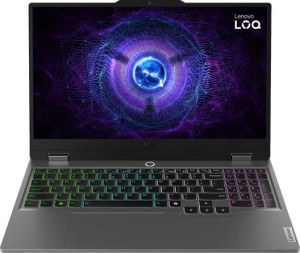
The Lenovo LOQ 15IAX9I is a gaming laptop with a physical footprint of 359 mm wide by 258 mm deep and a 21 mm thickness, resulting in a total volume of 1,945 cm³. It weighs 2,380 g and relies on an active cooling system rather than a fanless design. The chassis includes a backlit keyboard for low-light use, though it is not weather-sealed or splashproof. Lenovo covers the unit with a two-year warranty.
The laptop features a 15.6-inch IPS panel with an LED-backlit LCD matrix, rendering at a 1920x1080 resolution and a pixel density of 141 ppi. It operates at a 144Hz refresh rate, which benefits fast-paced content, and delivers a typical brightness of 300 nits alongside an anti-reflection coating to reduce glare. The display does not support touch input, and the GPU can drive up to four screens simultaneously.
The processor runs eight cores across 12 threads with a base configuration of 4 x 2.4 GHz and 4 x 1.8 GHz, boosting up to 4.4 GHz, and is built on a 6 nm process with multithreading and 64-bit support. The system ships with 24GB of DDR5 RAM at 4800 MHz across two slots, expandable to a maximum of 32GB. Storage is handled by a 1024GB NVMe SSD connected over PCIe 4.0. On the graphics side, the GPU carries 8GB of GDDR6 VRAM, clocks between 900 MHz and 1200 MHz in turbo, and delivers 3.994 TFLOPS of floating-point performance alongside a texture rate of 124.8 GTexels/s and a pixel rate of 62.4 GPixel/s. It supports DirectX 12 Ultimate and Intel XeSS upscaling via XMX acceleration.
In PassMark testing, the system scores 18,228 in the overall CPU benchmark and 3,335 in the single-thread test, reflecting the processor's multi-core and per-core capabilities respectively. The GPU achieves a PassMark G3D score of 6,238, indicating its graphics rendering capacity.
The laptop's wired port selection includes one USB 3.2 Gen 2 Type-C port, three USB 3.2 Gen 1 Type-A ports, one HDMI 2.1 output, and a single RJ45 Ethernet jack; there are no Thunderbolt, DisplayPort, mini DisplayPort, or VGA connectors, and no external memory card slot. Wireless connectivity covers Wi-Fi 6 (802.11ax) along with backward-compatible Wi-Fi 5 and Wi-Fi 4, paired with Bluetooth 5.2. The device also supports AirPlay.
The laptop is equipped with a 60 Wh battery and includes sleep-and-charge USB ports, allowing connected devices to be charged even when the laptop is powered off or in sleep mode. It does not use a MagSafe power adapter.
Audio output is handled by stereo speakers with a 3.5 mm headset jack, while two built-in microphones and a front-facing camera cover basic communication needs; there is no S/PDIF port, Dolby Atmos support, or optical disc drive. The GPU supports ray tracing, though DLSS is not available. Biometric options are absent — the laptop includes neither a fingerprint scanner nor 3D facial recognition — and there is no voice command support, stylus, gyroscope, accelerometer, compass, or GPS.
The CPU uses an LGA 1700 socket with a clock multiplier of 24, an unlocked multiplier, Turbo Boost version 2, a 65W TDP, a maximum operating temperature of 100°C, 12MB of L3 cache, and big.LITTLE architecture; it supports NX bit, 64-bit instruction sets including SSE 4.1, SSE 4.2, AVX, AES, FMA3, F16C, and MMX, and is compatible with Z690, H670, B660, and H610 chipsets. Integrated graphics are present in the form of the UHD Graphics 710 with 16 execution units. The discrete GPU is built on a Generation 12.7 architecture with 1,536 shading units, 96 TMUs, 48 ROPs, and 11,500 million transistors; its memory runs at 1,750 MHz with an effective speed of 14,000 MHz across a 128-bit bus, yielding a maximum bandwidth of 224 GB/s, while double-precision floating point is not supported and LHR is absent. The system supports OpenCL 3, OpenGL 4.6, stereoscopic 3D, multi-display output, and ECC memory, and achieves a PassMark DirectCompute score of 2,931; RAM speed tops out at 4,800 MHz across two memory channels.