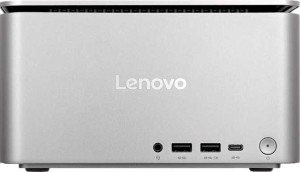
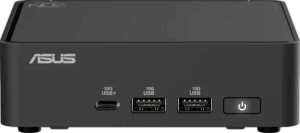
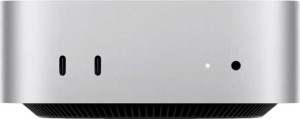
The Lenovo ThinkCentre Neo Ultra follows a Mini-ITX form factor, with dimensions of 196 mm in thickness, 195 mm in width, and 107 mm in height, resulting in a total volume of 4,089.54 cm³. Storage is handled by a 4TB NVMe SSD, offering a substantial capacity within a compact chassis that is designed to minimize desk footprint without heavily compromising on internal hardware.
The CPU operates with a base configuration of 8 cores at 1.1 GHz and 16 cores at 0.8 GHz, delivering 32 threads through multithreading support, and can reach a turbo clock speed of 5.5 GHz via Turbo Boost version 2. It carries a thermal design power of 115W and a maximum rated temperature of 100 °C, with a clock multiplier of 11 that remains locked. Cache is distributed across 32 MB of L2 and 36 MB of L3, and the processor supports 64-bit computing alongside integrated graphics. The multiplier is fixed, so clock speed adjustments through overclocking are not available on this configuration.
The graphics card is built on a 5 nm semiconductor process and houses 18,900 million transistors, with 3,072 shading units, 96 texture mapping units, and 32 render output units working together to deliver 15.11 TFLOPS of floating-point performance, a texture rate of 236.2 GTexels/s, and a pixel rate of 78.72 GPixel/s. It carries 8GB of GDDR6 memory across a 128-bit bus, with a memory speed of 2,125 MHz, an effective speed of 17,000 MHz, and a maximum bandwidth of 272 GB/s. The base GPU clock runs at 1,830 MHz and can boost up to 2,460 MHz. The card supports ray tracing, DLSS, double precision floating point, and multi-display output across up to four screens, and is compatible with DirectX 12 Ultimate, OpenGL 4.6, and OpenCL 3. It connects via PCIe 4, does not include LHR or RGB lighting, and the API and feature set aligns with current-generation graphics standards.
The system is equipped with 64GB of DDR5 RAM, running at a speed of 5,600 MHz, which represents the current generation of memory technology and places this configuration at the higher end of what the platform supports in terms of both capacity and throughput.
Wired networking is provided through a single RJ45 port, while wireless connectivity is not supported on this unit despite Wi-Fi version data being listed. Bluetooth 5.3 is built in for short-range wireless peripherals. On the USB side, there are four USB 3.2 Gen 2 Type-A ports and two USB 3.2 Gen 1 Type-A ports, along with one USB 3.2 Gen 2x2 port; there are no USB 2.0, USB-C Gen 2, USB 4, Thunderbolt 3, or Thunderbolt 4 ports. Display output is handled by one HDMI 2.1 port and one DisplayPort, with no DVI, VGA, or mini DisplayPort outputs present. Audio connectivity includes a 3.5 mm headset jack, while S/PDIF output is absent.
In PassMark testing, the system achieves an overall score of 39,135 and a single-thread score of 4,176, with the overclocked result reaching 47,791. The PassMark G3D score, which reflects graphics performance, comes in at 19,578.
The system uses a desktop-class CPU seated in an LGA 1700 socket, compatible with chipsets including B760, H770, Z790, H610, H670, B660, and Z690, and employs big.LITTLE technology alongside a supported instruction set that covers MMX, F16C, FMA3, AES, AVX, AVX2, SSE 4.1, and SSE 4.2, with NX bit also present. Memory is capped at 64GB across two channels, with a maximum RAM speed of 5,600 MHz, ECC memory support, and no external memory slot. Storage relies on flash memory, and there is no air or water cooling solution included. The integrated GPU is identified as the UHD Graphics 770, built on the Ada Lovelace architecture with 32 execution units, and the graphics memory uses GDDR6; Intel Resizable BAR is supported, while XeSS is not. The unit includes an HDMI output, supports stereoscopic 3D, and uses flash-based storage, but has no USB-C ports, no mini DisplayPort outputs, and does not feature air-water cooling.