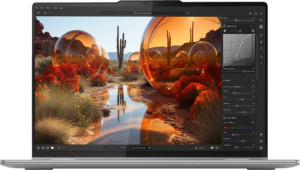
The Lenovo Yoga 7 2-in-1 16AHP9 has a physical footprint of 361 mm wide by 249 mm deep, with a slim 16 mm thickness and a total volume of 1438.224 cm³. At 1990 g, it carries a moderate weight for a 16″ convertible, and the chassis does not use a fanless design, meaning active cooling is present. The keyboard features backlighting for use in low-light conditions, while the device is not weather-sealed against splashes or moisture. A one-year warranty is included with the product.
The display is a 16″ IPS LCD panel with LED backlighting, offering a resolution of 1920 x 1200 pixels at a pixel density of 141 ppi. It supports touch input, making it well-suited for use in convertible orientations, though it does not include an anti-reflection coating. The system can drive up to four displays simultaneously, providing flexibility for multi-monitor setups.
The processor runs eight cores at a base frequency of 3.3 GHz with multithreading across 16 threads, and can reach a turbo clock speed of 5.1 GHz, all built on a 4 nm semiconductor process with 64-bit support. The system carries 16GB of DDR5 RAM running at 6400 MHz, which also represents the maximum supported memory capacity, and there are no user-accessible memory slots for expansion. Storage is handled by a 1024GB NVMe SSD connected via PCIe 4.0, using flash-based technology for fast data access. The integrated GPU operates at a base clock of 800 MHz with a turbo frequency of 2700 MHz, and the system supports DirectX 12 for graphics workloads.
In Geekbench 6, the processor scores 2057 in the single-core test and 9043 in the multi-core test, reflecting its eight-core, multithreaded configuration. PassMark results follow a similar pattern, with a multi-threaded score of 24956 and a single-threaded score of 3626.
The port selection includes two USB 3.2 Gen 2 Type-C ports and two USB 3.2 Gen 1 Type-A ports, while there are no Thunderbolt 3 or 4 ports, no USB 4 ports, and no DisplayPort or VGA outputs. Video output is handled by a single HDMI 2.1 port, and an external memory card slot is also present. Wireless connectivity covers Wi-Fi 6E (802.11ax) along with backward-compatible Wi-Fi 6, 5, and 4 standards, paired with Bluetooth 5.3. AirPlay is supported, though there is no RJ45 Ethernet port for wired network connections.
The laptop is equipped with a 71 Wh battery and supports sleep-and-charge through its USB ports, allowing connected devices to be charged even when the system is powered down. It does not use a MagSafe power adapter.
The device includes stereo speakers and a 3.5 mm headset jack for audio output, though it does not support Dolby Atmos or an S/PDIF port. A stylus is included in the box, complementing the touchscreen for handwriting and drawing. Security is covered by both a fingerprint scanner and 3D facial recognition, while a front camera and dual microphones support video calls. Voice commands are not supported natively, and the device lacks motion and location sensors — there is no gyroscope, accelerometer, compass, or GPS. An optical disc drive is also absent.
The laptop CPU is a laptop-class processor with a clock multiplier of 33 and a locked multiplier, operating within a 28W TDP and rated to a maximum temperature of 100 °C. It does not use big.LITTLE heterogeneous core architecture and supports a range of instruction sets including MMX, AES, AVX, AVX2, FMA3, F16C, SSE 4.1, and SSE 4.2, along with NX bit for hardware-level security. The cache hierarchy consists of 512 KB of L1, 8 MB of L2 at 1 MB per core, and 16 MB of L3 cache at 2 MB per core, with a dual-channel memory controller supporting speeds up to 7500 MHz, though ECC memory is not supported. Graphics are handled by the integrated Radeon 780M, which features 768 shading units, 48 texture mapping units, 32 ROPs, and 12 execution units, with support for OpenCL 2.1 and OpenGL 4.6.