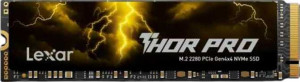
Lexar Thor Pro 2TB specifications and in-depth review

Lexar Thor Pro 2TB

Manufacturer: Lexar

The Lexar Thor Pro 2TB is an NVMe M.2 SSD designed to offer high-performance storage. With a sequential read speed of 7000 MB/s, it delivers fast data transfers suitable for demanding applications.

Featuring 5500 MB/s sequential write speed, the Lexar Thor Pro also comes equipped with a MaxioTech MAP1602A Falcon Lite controller and 4 PCIe 4.0 lanes. The SSD utilizes QLC storage and includes a 5-year warranty for reliability.

Pros
  • Offers a fast sequential read speed of 7000 MB/s, suitable for high-performance tasks like gaming and video editing.
  • Supports NVMe 2.0, ensuring compatibility with modern systems and faster data transfer rates.
  • Provides 2000GB of internal storage, offering ample space for large file storage and data-intensive applications.
  • Equipped with HMB (Host Memory Buffer) for enhanced cache performance, optimizing data processing speeds.
  • Backed by a 5-year warranty, providing long-term reliability and peace of mind.
Cons
  • Does not have an integrated heatsink, which could potentially affect thermal performance under heavy use.
  • Lacks RGB lighting, which may be a downside for users looking for aesthetic customization options.
  • Uses QLC storage type, which can be less durable compared to other SSD technologies like TLC in heavy write workloads.
Who is this for?

The Lexar Thor Pro 2TB is ideal for users who need high-speed storage, such as gamers or professionals working with large files. With its 7000 MB/s sequential read speed and 2000GB of storage, it excels in environments where fast data access and ample space are essential, like video editing, high-performance computing, or data-intensive applications.

Who is this NOT for?

This SSD may not be ideal for users prioritizing longevity in heavy-write environments, as it uses QLC storage type, which can be less durable for frequent data writing. Additionally, the lack of an integrated heatsink might result in thermal limitations under sustained high workloads, making it less suited for intense, prolonged operations in heat-sensitive systems.

Read speed:

sequential read speed 7000 MB/s

The Lexar Thor Pro 2TB offers a sequential read speed of 7000 MB/s, providing fast data access for high-performance applications. This high read speed ensures smooth operation, particularly in data-intensive tasks like gaming, video editing, and large file transfers.

Write speed:

sequential write speed 5500 MB/s

The Lexar Thor Pro 2TB provides a sequential write speed of 5500 MB/s, ensuring fast and efficient data writing for tasks such as video rendering, large file transfers, and intensive applications. This high write speed enhances overall system performance and responsiveness.

Benchmarks:

PassMark result 38121

The Lexar Thor Pro 2TB has achieved a PassMark result of 38121, indicating strong performance in benchmark testing. This score highlights the SSD's capability in handling demanding tasks and delivering consistent speed in real-world applications.

General info:

type M2
SSD cache HMB (Host Memory Buffer)
Is an NVMe SSD
NVMe version 2
internal storage 2000GB
release date May 2025
controller MaxioTech MAP1602A Falcon Lite
SSD storage type QLC
PCI Express (PCIe) version 4
Controller channels 4
warranty period 5 years
Has an integrated heatsink
has RGB lighting

The Lexar Thor Pro 2TB is an NVMe M.2 SSD offering 2000GB of internal storage. It is powered by the MaxioTech MAP1602A Falcon Lite controller and utilizes QLC storage technology. The drive supports PCIe 4.0 and features 4 controller channels. Additionally, it comes with a 5-year warranty and does not include an integrated heatsink or RGB lighting.

Final Verdict

The Lexar Thor Pro 2TB is a high-performance NVMe SSD that excels with its 7000 MB/s sequential read speed and substantial 2000GB of storage. Ideal for users in need of fast data access and large-capacity storage, it delivers solid performance for demanding tasks like gaming and video editing. While it lacks an integrated heatsink and uses QLC storage, making it less suitable for heavy write environments, its strengths in speed and reliability make it a strong choice for many high-performance computing needs.