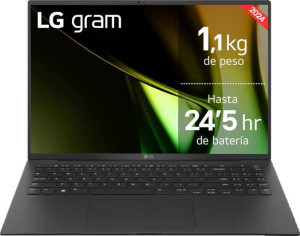
The LG Gram (2024) 16″ has a notably slim and light physical profile for a 16-inch laptop, measuring 355 mm wide, 242 mm tall, and 16 mm thick, with a total volume of 1374.56 cm³ and a weight of just 1199 g. The chassis uses active cooling rather than a fanless design, and it is not weather-sealed against splashes or moisture. A backlit keyboard is not included.
The LG Gram (2024) 16″ features a 16-inch IPS LED-backlit panel with a 2560 x 1600 px resolution at 188 ppi, delivering a sharp and detailed image across its wide display area. Typical brightness is rated at 350 nits with a 60Hz refresh rate, and an anti-reflection coating helps reduce glare under varied lighting conditions. The screen is not a touchscreen, and the GPU supports connectivity to up to four simultaneous external displays.
The LG Gram (2024) 16″ is powered by a hybrid-architecture processor built on a 7 nm process, pairing four performance cores at 1.2 GHz with eight efficiency cores at 0.7 GHz and reaching a turbo frequency of 4.5 GHz across 18 multithreaded threads, all within a 28W TDP. It ships with 16GB of DDR5 RAM expandable up to 96GB across two channels, alongside a 512GB PCIe 5 NVMe SSD for fast flash storage access. The integrated GPU runs at a base clock of 300 MHz with a turbo of 2200 MHz and supports DirectX 12, while the system operates fully in 64-bit mode.
The LG Gram (2024) 16″ records a PassMark multi-thread score of 21104 and a single-thread score of 3400, reflecting the processor's parallel and sequential throughput respectively. In Geekbench 6 testing, it achieves a multi-core score of 10239 and a single-core score of 2256, providing an additional measure of real-world CPU performance across both sustained and lightly-threaded workloads.
The LG Gram (2024) 16″ keeps its wired port selection relatively lean, offering two USB 3.2 Gen 2 Type-A ports and one HDMI 2.1 output for external display connections, alongside a USB Type-C port and an external memory card slot. There are no Thunderbolt 3 or 4 ports, no USB 4 connections, no DisplayPort or VGA outputs, and no RJ45 ethernet port. Wireless connectivity covers Wi-Fi 6E, Wi-Fi 6, Wi-Fi 5, and Wi-Fi 4, with Bluetooth 5.3 for peripherals, and AirPlay is also supported.
The LG Gram (2024) 16″ carries a 77 Wh battery with a rated life of 24.5 hours, making it one of the more endurance-focused options in its screen size category. Sleep-and-charge functionality is supported, allowing USB-connected devices to be charged while the laptop is powered down. A MagSafe power adapter is not included.
The LG Gram (2024) 16″ includes stereo speakers, a 3.5 mm headset jack, a dual-microphone setup, and a front camera, covering the core audio and video requirements for everyday use and video calls. Dolby Atmos and S/PDIF output are not supported. Neither a fingerprint scanner nor 3D facial recognition is available for biometric sign-in, and voice commands are not supported. No stylus is included, and the device lacks motion and location sensors including a gyroscope, accelerometer, GPS, and compass. There is no optical disc drive.
The laptop CPU uses big.LITTLE technology with a clock multiplier of 36, a 28W TDP, and a maximum operating temperature of 110 °C, supported by 18 MB of L3 cache and a dual-channel memory configuration with a maximum RAM speed of 5600 MHz. The multiplier is locked and ECC memory is not supported, though NX bit protection is active alongside instruction set support for MMX, F16C, FMA3, AES, AVX, AVX2, SSE 4.1, and SSE 4.2. Graphics are handled by the integrated GPU, which includes 768 shading units, 48 texture mapping units, 24 render output units, and 7 execution units, with compatibility for OpenCL 3 and OpenGL 4.6. The overclocked PassMark result is recorded at 22756, and no discrete GPU is present.