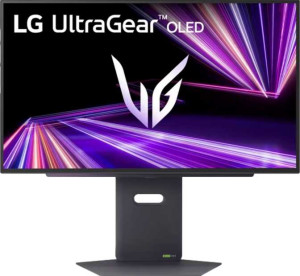
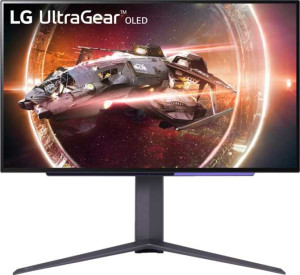
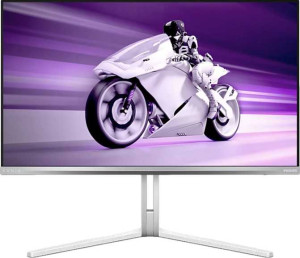
LG UltraGear OLED 27GX790A-B 27" specifications and in-depth review

LG UltraGear OLED 27GX790A-B 27"

Manufacturer: LG

The LG UltraGear OLED 27GX790A-B is a 27-inch gaming monitor built around an OLED/AMOLED panel, offering a 2560 x 1440 pixel resolution at 111 ppi. With a 480Hz refresh rate, it targets demanding gaming scenarios where motion clarity and timing precision matter. The display features a matte panel with anti-glare coating, wide 178-degree viewing angles both horizontally and vertically, and support for portrait mode and height adjustment via a swivel stand with VESA mount compatibility.

On the technical side, the panel delivers a contrast ratio of 1,500,000:1 alongside a typical brightness of 275 nits and 10-bit color depth covering 1,070 million colors. Adaptive sync support spans Nvidia G-Sync, Nvidia G-Sync Compatible, and AMD FreeSync. Connectivity includes two HDMI 2.1a ports, one DisplayPort 2.1 output, three USB 3.1 ports, and a 3.5mm audio jack. Operating power consumption is rated at 48.22W, with a standby draw of 0.5W. The monitor also supports color calibration and picture-in-picture functionality.

Pros
  • The OLED/AMOLED panel delivers a contrast ratio of 1,500,000:1, producing deep blacks and distinct light-to-dark transitions across the screen
  • A 480Hz refresh rate combined with a 0.03ms response time makes this monitor well-suited for fast-paced gaming where motion clarity is critical
  • Adaptive sync support covers both Nvidia G-Sync and AMD FreeSync, making it compatible with a wide range of graphics hardware
  • The stand supports tilt, swivel, and portrait mode, offering meaningful flexibility in how the display can be physically positioned
  • DisplayPort 2.1 and HDMI 2.1a ports provide up to-date video input options capable of handling high bandwidth signals
  • The matte panel with anti-glare coating helps reduce reflections in environments with ambient lighting
Cons
  • At 275 nits typical brightness, the panel may struggle in very bright room conditions
  • The monitor carries an EU energy label of F, indicating relatively high energy consumption for its class
  • No USB Type-C port is available, limiting direct connection options for modern laptops and devices without adapters
  • There are no built-in speakers, so a separate audio solution is required for sound output
  • No Ethernet, Wi-Fi, or AirPlay support means the monitor cannot connect to a network independently
Who is this for?

This monitor is a strong fit for competitive and fast-paced gaming, where its 480Hz refresh rate and 0.03ms response time allow for smooth, responsive visuals with minimal motion blur. The combination of Nvidia G-Sync and AMD FreeSync support makes it a practical choice for users with either GPU brand, while the DisplayPort 2.1 and HDMI 2.1a inputs suit those running modern, high-bandwidth graphics setups. The swivel stand and portrait mode capability also make it a reasonable option for users who need flexible screen positioning or occasionally work with vertically oriented content.

Who is this NOT for?

Users who work in bright or high-ambient-light environments may find the 275 nits typical brightness limiting, as the panel may not produce sufficient visibility under strong lighting conditions. The absence of built-in speakers and USB Type-C connectivity makes this monitor less practical for those seeking a streamlined, all-in-one desk setup with minimal external peripherals. Additionally, users with strict energy efficiency requirements should note the EU energy label of F, meaning the monitor is not well-suited for setups where low power consumption is a priority.

Display:

Display type OLED/AMOLED
response time 0.03 ms
screen size 27"
resolution 2560 x 1440 px
pixel density 111 ppi
Adaptive synchronization Nvidia G-Sync, AMD FreeSync, Nvidia G-Sync Compatible
has anti-glare coating
refresh rate 480Hz
maximum horizontal viewing angle 178º
maximum vertical viewing angle 178º
has a matte panel
has a glossy panel
has a touch screen

The display section of this monitor is built around an OLED/AMOLED panel measuring 27 inches, with a resolution of 2560 x 1440 pixels at a pixel density of 111 ppi. Its 480Hz refresh rate is paired with an exceptionally low response time of 0.03ms, making it well-suited for fast-paced content. The panel is matte and carries an anti-glare coating, while both horizontal and vertical viewing angles reach 178 degrees. Adaptive sync support covers Nvidia G-Sync, Nvidia G-Sync Compatible, and AMD FreeSync. The screen does not have a glossy finish and does not include touch input.

General info:

Type Gaming
EU energy label F
supports total tilt
Has a swivel stand
Supports VESA mount
height 351 mm
width 605.2 mm
thickness 45.3 mm
weight 9300 g
supports portrait mode
volume 9622.86156 cm³

This is a gaming-type monitor with an EU energy label of F, measuring 605.2 mm wide, 351 mm tall, and 45.3 mm thick, with a total volume of 9622.86 cm³ and a weight of 9300 g. The stand supports tilt, swivel, and portrait mode, giving users a reasonable range of positioning options. VESA mount compatibility is also included for those who prefer an alternative mounting solution.

Colors:

brightness (typical) 275 nits
supports color calibration
display colors 1070 million
bit depth 10-bit
contrast ratio 1500000:1

The display is capable of rendering 1,070 million colors at a 10-bit color depth, supported by a typical brightness of 275 nits and a contrast ratio of 1,500,000:1. Color calibration is also supported, allowing for adjustments to color accuracy when needed.

Connectivity:

HDMI ports 2
supports Thunderbolt
DisplayPort outputs 1
DisplayPort version DisplayPort 2.1
has a socket for a 3.5 mm audio jack
has a DVI connector
USB ports 3
USB version 3.1
Has USB Type-C
HDMI version HDMI 2.1a
supports Ethernet
supports Wi-Fi
has AirPlay
mini DisplayPort outputs 0
has a VGA connector

The monitor offers a wired connectivity setup built around two HDMI 2.1a ports and one DisplayPort 2.1 output, along with three USB 3.1 ports and a 3.5mm audio jack. It does not include USB Type-C, Thunderbolt, DVI, VGA, or mini DisplayPort outputs, nor does it support Ethernet, Wi-Fi, or AirPlay, keeping the connection options focused on standard display and peripheral use.

Power:

operating power consumption 48.22W
standby power consumption 0.5W

The monitor draws 48.22W during normal operation and drops to a low 0.5W in standby mode.

Features:

has PiP
has stereo speakers
has built-in smart TV
has a remote control
supports Dolby Digital
supports Dolby Digital Plus
has DTS Surround
has an ambient light sensor
has a front camera

The monitor includes picture-in-picture (PiP) functionality, but does not feature stereo speakers, a remote control, a front camera, or an ambient light sensor. Audio-related technologies such as Dolby Digital, Dolby Digital Plus, and DTS Surround are not supported, and the monitor does not include built-in smart TV capabilities.

Final Verdict

The LG UltraGear OLED 27GX790A-B is a gaming monitor built around a clear set of priorities: speed, responsiveness, and display depth. Its 480Hz refresh rate paired with a 0.03ms response time places it firmly in the upper tier of gaming-focused displays, and the 1,500,000:1 contrast ratio of its OLED panel adds a level of visual depth that flat LCD panels cannot replicate. The connectivity suite, featuring DisplayPort 2.1 and HDMI 2.1a, ensures the hardware is well-matched to current-generation graphics equipment. Where it falls short — notably in brightness, the absence of speakers, and limited USB versatility — reflects deliberate trade-offs rather than oversights, making it best appreciated by users whose needs align tightly with competitive gaming and immersive visuals rather than a general-purpose workstation setup.

Popular Comparisons

LG UltraGear OLED 27GX790A-B 27"
VS
Asus ROG Strix OLED XG27AQDPG 27"
LG UltraGear OLED 27GX790A-B 27"
VS
Asus ROG Strix OLED XG27UCDMG 27"
LG UltraGear OLED 27GX790A-B 27"
VS
LG UltraGear 27GS95QE-B 27"
LG UltraGear OLED 27GX790A-B 27"
VS
Asus ROG Strix OLED XG27ACDNG 27"
LG UltraGear OLED 27GX790A-B 27"
VS
Dell Alienware AW2725DF 27"
LG UltraGear OLED 27GX790A-B 27"
VS
Asus ROG Swift OLED PG27UCDM 27"
LG UltraGear OLED 27GX790A-B 27"
VS
Samsung Odyssey OLED G8 (G81SF) 27"
LG UltraGear OLED 27GX790A-B 27"
VS
MSI MAG 271QP QD-OLED X24 27"
LG UltraGear OLED 27GX790A-B 27"
VS
MSI MAG 273QP QD-OLED X24 27"
LG UltraGear OLED 27GX790A-B 27"
VS
MSI MPG 272QR QD-OLED X50 27"
LG UltraGear OLED 27GX790A-B 27"
VS
Samsung Odyssey OLED G6 27" (G60SD)
LG UltraGear OLED 27GX790A-B 27"
VS
Philips Evnia 27M2N8500/27 27"