Manli GeForce RTX 4070 Super (M2592+N693) specifications and in-depth review

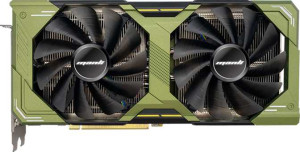
Manli GeForce RTX 4070 Super (M2592+N693)

Manufacturer: Manli

The Manli GeForce RTX 4070 Super (M2592+N693) is a graphics card built on NVIDIA's Ada Lovelace architecture, produced on a 5 nm process with 35,800 million transistors. It features 7168 shading units and a boost clock of 2475 MHz, delivering 35.48 TFLOPS of floating-point performance and a texture rate of 554.4 GTexels/s. At 264 mm in length and 127 mm in height, it occupies a relatively compact footprint compared to many cards in its segment.

Memory is handled by 12GB of GDDR6X VRAM running at an effective 21,000 MHz across a 192-bit bus, yielding a maximum bandwidth of 504 GB/s. ECC memory and DPFP support are both included. On the feature side, the card covers DirectX 12 Ultimate, OpenGL 4.6, OpenCL 3, ray tracing, DLSS, stereoscopic 3D, and Intel Resizable BAR. Connectivity spans one HDMI 2.1a port and three DisplayPort outputs, supporting up to four displays, with no USB-C, DVI, or mini DisplayPort connections present.

Pros
  • At 264 mm in length and 127 mm in height, the card has a relatively compact physical footprint that improves compatibility with a wider range of case sizes
  • Ray tracing and DLSS are supported at the hardware level, enabling real-time lighting effects and AI-based upscaling in compatible titles
  • 12GB of GDDR6X VRAM with a 504 GB/s bandwidth ceiling provides solid capacity for texture-heavy gaming and moderate content creation workloads
  • ECC memory support adds a layer of data integrity useful for compute workloads where accuracy is a priority
  • DPFP support extends the card's usefulness into double-precision compute applications beyond conventional graphics tasks
  • Four simultaneous display outputs via one HDMI 2.1a and three DisplayPort connections suit users who need a broad multi-monitor setup
Cons
  • The 192-bit memory bus width limits potential bandwidth scaling compared to wider bus configurations
  • No USB-C video output is available, which restricts compatibility with displays and devices that require that connection type
  • Air-water hybrid cooling is not supported, leaving thermal management solely dependent on the air cooling solution
  • RGB lighting is absent, which may matter to users who prioritize visual build aesthetics
Who is this for?

This card is a natural fit for users who want ray tracing and DLSS support in their gaming setup, as both are available at the hardware level alongside DirectX 12 Ultimate. Its relatively compact dimensions of 264 mm by 127 mm make it well-suited to mid-tower and smaller case builds where physical clearance is more constrained than usual for this GPU class. The combination of 12GB GDDR6X VRAM, ECC memory, and DPFP support also makes it a reasonable choice for users who balance gaming with compute or content creation workloads that benefit from higher memory reliability and numerical precision.

Who is this NOT for?

Users who need USB-C video output for their display or device setup will find the port selection limiting, as no such connection is available on this card. Those who require liquid or hybrid cooling will also be constrained, since thermal management is restricted to air cooling only. Additionally, the 192-bit memory bus places a ceiling on bandwidth scaling, making the card less suitable for workloads that demand sustained high-bandwidth memory throughput at the upper end of what this GPU class can theoretically support.

Performance:

GPU clock speed 1980 MHz
GPU turbo 2475 MHz
pixel rate 198 GPixel/s
floating-point performance 35.48 TFLOPS
texture rate 554.4 GTexels/s
GPU memory speed 1313 MHz
shading units 7168
texture mapping units (TMUs) 224
render output units (ROPs) 80
Has Double Precision Floating Point (DPFP)

The card operates at a base GPU clock of 1980 MHz with a boost up to 2475 MHz, supported by a GPU memory speed of 1313 MHz. Its 7168 shading units and 224 texture mapping units yield a texture rate of 554.4 GTexels/s and a pixel rate of 198 GPixel/s, while 80 render output units handle the final output stage. Floating-point performance is rated at 35.48 TFLOPS, and Double Precision Floating Point (DPFP) support is included, broadening the card's applicability to compute workloads beyond standard graphics tasks.

Memory:

effective memory speed 21000 MHz
maximum memory bandwidth 504 GB/s
VRAM 12GB
GDDR version GDDR6X
memory bus width 192-bit
Supports ECC memory

The card uses 12GB of GDDR6X VRAM with an effective memory speed of 21,000 MHz running over a 192-bit bus, which delivers a maximum bandwidth of 504 GB/s. ECC memory support is also present, offering an added degree of data reliability for workloads where computational accuracy is important.

Features:

DirectX version DirectX 12 Ultimate
OpenGL version 4.6
OpenCL version 3
Supports multi-display technology
supports ray tracing
Supports 3D
supports DLSS
has XeSS (XMX)
AMD SAM / Intel Resizable BAR Intel Resizable BAR
has LHR
has RGB lighting
supported displays 4

The card supports DirectX 12 Ultimate, OpenGL 4.6, and OpenCL 3, addressing a wide range of graphics and compute API requirements. Ray tracing and DLSS are both enabled at the hardware level, and stereoscopic 3D and multi-display technology are also supported, with up to four displays operable simultaneously. Intel Resizable BAR is included to improve CPU-to-GPU memory access efficiency. XeSS (XMX), LHR, and RGB lighting are not featured on this model.

Ports:

has an HDMI output
HDMI ports 1
HDMI version HDMI 2.1a
DisplayPort outputs 3
USB-C ports 0
DVI outputs 0
mini DisplayPort outputs 0

Output options consist of one HDMI 2.1a port and three DisplayPort outputs, covering a total of four video connections. USB-C, DVI, and mini DisplayPort outputs are not included on this card.

General info:

GPU architecture Ada Lovelace
Thermal Design Power (TDP) 220W
PCI Express (PCIe) version 4
semiconductor size 5 nm
number of transistors 35800 million
Has air-water cooling
width 264 mm
height 127 mm

Underpinned by the Ada Lovelace architecture and manufactured on a 5 nm process, the card integrates 35,800 million transistors and uses a PCIe 4 interface. Its TDP sits at 220W, and cooling is handled exclusively by air, with no air-water hybrid option available. Physically, the card measures 264 mm in width and 127 mm in height, giving it a relatively modest footprint within its product category.
Final Verdict

The Manli GeForce RTX 4070 Super (M2592+N693) makes a coherent case for users who want a capable RTX 4070 Super in a physically manageable form factor, with its 264 mm length and 12GB of GDDR6X VRAM standing out as practical advantages for case compatibility and memory-demanding workloads alike. Ray tracing, DLSS, DPFP, and ECC memory support add meaningful versatility across gaming and compute use cases, while the 220W TDP keeps power demands at a reasonable level. Connectivity and cooling flexibility are areas where the card shows its constraints, but for users building in tighter spaces who prioritize feature coverage over expandability, the M2592+N693 delivers a well-rounded specification set within a compact chassis.