Manli GeForce RTX 4070 Super Polar Fox (M2609+N693) specifications and in-depth review

Manli GeForce RTX 4070 Super Polar Fox (M2609+N693)

Manufacturer: Manli

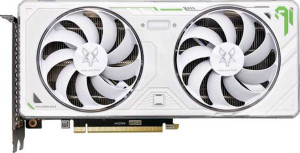
The Manli GeForce RTX 4070 Super Polar Fox (M2609+N693) is a graphics card built on NVIDIA's Ada Lovelace architecture, fabricated at 5nm with 35,800 million transistors. One of its more notable physical characteristics is its compact footprint — measuring just 251 mm in width and 120 mm in height — which makes it a viable option for builds where case space is at a premium. The card has no RGB lighting, keeping its aesthetic straightforward and unobtrusive.

Under the hood, 7,168 shading units are paired with 224 texture mapping units and 80 render output units, running at a base clock of 1980 MHz with a boost up to 2475 MHz, producing a texture rate of 554.4 GTexels/s and a floating-point throughput of 35.48 TFLOPS. The card carries 12GB of GDDR6X VRAM on a 192-bit bus at an effective speed of 21,000 MHz, delivering up to 504 GB/s of memory bandwidth, with ECC support included. Its feature set spans DirectX 12 Ultimate, OpenGL 4.6, OpenCL 3, ray tracing, DLSS, stereoscopic 3D, Intel Resizable BAR, and multi-display support for up to four screens via one HDMI 2.1a port and three DisplayPort outputs, all within a 220W TDP over PCIe 4.

Pros
  • At 251 mm wide and 120 mm tall, the card fits comfortably in compact and small-form-factor cases where larger graphics cards would not physically clear
  • Ray tracing, DLSS, and DirectX 12 Ultimate are all supported, covering the primary rendering feature requirements of modern gaming workloads
  • Intel Resizable BAR support allows the CPU to access the full VRAM pool, which can contribute to smoother frame delivery on compatible systems
  • ECC memory support and DPFP capability make the card usable for compute tasks where data integrity and 64-bit precision are relevant
  • No LHR restriction means the card's full compute throughput is available without any built-in limitations
  • A 220W TDP is relatively modest for a card with this feature set, placing less strain on the system power supply
Cons
  • The 192-bit memory bus constrains maximum bandwidth to 504 GB/s, which can limit sustained performance in heavily bandwidth-dependent scenarios
  • 12GB of GDDR6X VRAM may prove insufficient for users working with very large texture assets or running games at very high resolutions with high texture settings
  • RGB lighting is absent, which may be a drawback for users who want visual customization within their build
  • XeSS (XMX) upscaling is not supported, removing that option for users who prefer or depend on it in compatible applications
  • There are no USB-C, DVI, or mini DisplayPort outputs, limiting compatibility with certain display hardware without additional adapters
Who is this for?

This card is well-suited to users who need a capable graphics card but are working within the constraints of a compact or small-form-factor case, where its 251 mm length and 120 mm height allow installation that many full-size cards simply would not permit. Support for ray tracing, DLSS, and DirectX 12 Ultimate makes it a practical fit for gamers who want access to modern rendering features without requiring a larger chassis. Its ECC memory and DPFP support also make it a reasonable secondary option for users who occasionally run compute or precision-sensitive workloads alongside gaming, without needing a dedicated professional card.

Who is this NOT for?

Users working with very high-resolution textures or memory-intensive creative applications may find 12GB of VRAM limiting over time, particularly as asset sizes in modern games and production tools continue to grow. The 192-bit memory bus keeps peak bandwidth at 504 GB/s, which can become a constraint for workloads that place sustained pressure on memory throughput. Those who want RGB lighting for a visually customized build, or who rely on XeSS upscaling in their workflow, will also find neither available on this model.

Performance:

GPU clock speed 1980 MHz
GPU turbo 2475 MHz
pixel rate 198 GPixel/s
floating-point performance 35.48 TFLOPS
texture rate 554.4 GTexels/s
GPU memory speed 1313 MHz
shading units 7168
texture mapping units (TMUs) 224
render output units (ROPs) 80
Has Double Precision Floating Point (DPFP)

The GPU clocks in at 1980 MHz base with a turbo frequency of 2475 MHz, driven by 7,168 shading units, 224 texture mapping units, and 80 render output units. This configuration yields a texture rate of 554.4 GTexels/s, a pixel rate of 198 GPixel/s, and a floating-point throughput of 35.48 TFLOPS. GPU memory operates at 1313 MHz, and Double Precision Floating Point (DPFP) is supported, making the card suitable for compute workloads that require 64-bit numerical precision.

Memory:

effective memory speed 21000 MHz
maximum memory bandwidth 504 GB/s
VRAM 12GB
GDDR version GDDR6X
memory bus width 192-bit
Supports ECC memory

The card is fitted with 12GB of GDDR6X VRAM on a 192-bit memory bus, running at an effective speed of 21,000 MHz to reach a maximum memory bandwidth of 504 GB/s. ECC memory support is also present, providing a degree of data integrity protection for workloads where memory accuracy is a practical requirement.

Features:

DirectX version DirectX 12 Ultimate
OpenGL version 4.6
OpenCL version 3
Supports multi-display technology
supports ray tracing
Supports 3D
supports DLSS
has XeSS (XMX)
AMD SAM / Intel Resizable BAR Intel Resizable BAR
has LHR
has RGB lighting
supported displays 4

The card supports DirectX 12 Ultimate, OpenGL 4.6, and OpenCL 3, along with ray tracing, DLSS, and stereoscopic 3D, providing solid coverage of current graphics and compute API requirements. XeSS (XMX) is not supported, and RGB lighting is absent on this model. Multi-display technology is included with support for up to four simultaneous outputs, Intel Resizable BAR is present to facilitate broader CPU access to VRAM, and there is no LHR restriction in place.

Ports:

has an HDMI output
HDMI ports 1
HDMI version HDMI 2.1a
DisplayPort outputs 3
USB-C ports 0
DVI outputs 0
mini DisplayPort outputs 0

Display output is handled by one HDMI 2.1a port and three DisplayPort outputs, giving a total of four available connections. No USB-C, DVI, or mini DisplayPort outputs are present on this card.

General info:

GPU architecture Ada Lovelace
Thermal Design Power (TDP) 220W
PCI Express (PCIe) version 4
semiconductor size 5 nm
number of transistors 35800 million
Has air-water cooling
width 251 mm
height 120 mm

This card is grounded in the Ada Lovelace architecture, built on a 5nm process with 35,800 million transistors, and connects via PCIe 4. With a thermal design power of 220W and dimensions of 251 mm in width and 120 mm in height, it occupies a notably compact footprint for a full-featured graphics card. Cooling is handled by air alone, as air-water hybrid cooling is not part of this configuration.
Final Verdict

The Manli GeForce RTX 4070 Super Polar Fox (M2609+N693) makes its strongest case through its exceptionally compact dimensions — 251 mm in length and 120 mm in height — paired with a feature set that includes ray tracing, DLSS, DirectX 12 Ultimate, and ECC memory support, giving it genuine utility for both modern gaming and occasional compute workloads within a physically constrained build. The 12GB VRAM capacity and 192-bit bus do impose boundaries that users with the most demanding memory or bandwidth requirements should consider carefully, and the absence of RGB lighting and XeSS support narrows its appeal for certain users. That said, for anyone prioritizing a full-featured Ada Lovelace card that can fit where larger designs cannot, the Polar Fox delivers a well-rounded and space-efficient solution that few cards in this category can match on physical footprint alone.