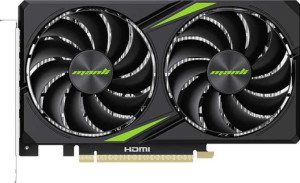
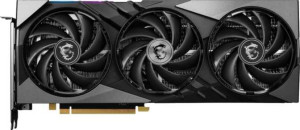
The Performance section of the Manli Nebula GeForce RTX 5050 centers on a base GPU clock of 2317 MHz that boosts up to 2572 MHz, contributing to a floating-point throughput of 13.17 TFLOPS. The card's 2560 shading units work alongside 80 texture mapping units and 32 render output units, producing a texture rate of 205.8 GTexels/s and a pixel rate of 82.3 GPixel/s. GPU memory runs at 2500 MHz, and the card does support Double Precision Floating Point (DPFP), broadening its suitability beyond purely graphics-oriented workloads.
The Manli Nebula GeForce RTX 5050 is equipped with 8GB of GDDR6 VRAM running at an effective speed of 20,000 MHz across a 128-bit memory bus, yielding a maximum memory bandwidth of 320 GB/s. The card also supports ECC memory, which enables error detection and correction for workloads where data integrity is a consideration.
The Manli Nebula GeForce RTX 5050 supports DirectX 12 Ultimate, OpenGL 4.6, and OpenCL 3, covering a broad range of graphics and compute workloads. It includes hardware-accelerated ray tracing, DLSS, and stereoscopic 3D support, while XeSS (XMX) is not present. The card can drive up to four displays simultaneously via its multi-display technology, and it comes with Intel Resizable BAR support for improved CPU-to-GPU data transfer. Lite Hash Rate (LHR) limiting is not applied, and the card does not feature RGB lighting.
The Manli Nebula GeForce RTX 5050 offers a total of four video outputs: one HDMI 2.1b port and three DisplayPort outputs. There are no USB-C, DVI, or mini DisplayPort connections on this card.
The Manli Nebula GeForce RTX 5050 is built on the Blackwell architecture, using a 5nm manufacturing process that integrates 16,900 million transistors. It connects via PCIe 5.0 and carries a Thermal Design Power (TDP) of 130W, with cooling handled by an air-based solution — liquid cooling is not supported. The card measures 211 mm in width and 120 mm in height.