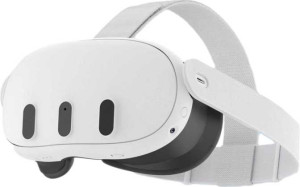
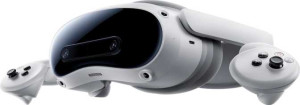
Meta Quest 3S specifications and in-depth review

Meta Quest 3S

Manufacturer: Oculus

The Meta Quest 3S is a self-contained VR headset designed for wireless use, offering a 3840 x 1832 pixel LCD display with a 773 ppi pixel density and a 97-degree field of view. It runs on an octa-core processor clocked at 2.54 GHz per core, paired with 8GB of RAM, making it a capable standalone device without the need for an external computer or console.

On the tracking side, the Quest 3S uses six tracking sensors and four cameras to support full 360-degree head movement tracking, gesture control, and positional tracking, though it does not include eye tracking or laser-based tracking. Connectivity options include USB 3.2 Type-C, Bluetooth 5.2, and Wi-Fi 6E, and the headset is compatible with both Android and iOS devices. It ships with touch controllers weighing 126 g each, integrated stereo speakers, a single microphone, and support for 3D audio, while omitting a 3.5 mm headphone jack.

Pros
  • Supports wireless use, removing the need for cables during sessions
  • Adjustable IPD and adjustable lenses allow the fit and optics to be tailored to individual users
  • Six tracking sensors and four cameras enable full 360-degree positional tracking and gesture control without external hardware
  • Wi-Fi 6E support alongside Bluetooth 5.2 provides a capable wireless connectivity foundation
  • 256GB of internal storage offers substantial space for apps and media
  • Integrated stereo speakers, 3D audio support, and a built-in microphone mean no additional audio accessories are required for basic use
Cons
  • No 3.5 mm headphone jack limits wired audio options
  • Eye tracking and gaze capabilities are absent, which restricts certain interaction methods
  • No external memory slot means storage cannot be expanded beyond the built-in 256GB
  • The single microphone may limit audio capture quality in certain use scenarios
  • No compass is included, which may affect certain spatial or orientation-dependent applications
Who is this for?

The Meta Quest 3S is well suited to users who want a self-contained VR experience without the need for external hardware or cables, thanks to its fully wireless design and built-in tracking system that requires no external sensors. The 120Hz refresh rate and 3840 x 1832 px resolution make it a solid fit for those who prioritize visual clarity and smooth motion during gaming or immersive media consumption. With 256GB of onboard storage and gesture control support, it also works well for users who want a straightforward, all-in-one setup that is ready to use without additional accessories.

Who is this NOT for?

Users who require eye tracking or gaze-based interaction — such as those using VR for accessibility purposes or specific professional applications that rely on foveal rendering — will find this headset lacks those capabilities. The absence of a 3.5 mm headphone jack makes it a poor fit for users who depend on wired audio peripherals for privacy or audio quality. Additionally, since internal storage cannot be expanded through an external memory slot, users with large content libraries or professional workflows requiring significant local storage may find the fixed 256GB capacity a limiting factor over time.

Design:

weight 514 g
Can be used wirelessly
adjustable IPD
battery power 4324 mAh
has a battery level indicator
thickness 98 mm
height 160 mm
volume 2885.12 cm³
width 184 mm

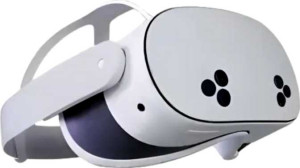
The Meta Quest 3S weighs 514 g and measures 184 mm wide, 160 mm tall, and 98 mm thick, giving it a total volume of 2885.12 cm³. It is designed for wireless use and includes an adjustable IPD to accommodate different users. Powering the headset is a 4324 mAh battery with a built-in battery level indicator, so users can monitor remaining charge at a glance.

Display & Lenses:

resolution 3840 x 1832 px
field of view 97°
refresh rate 120Hz
Display type LCD
Has adjustable lenses
Has a display
pixel density 773 ppi

The Meta Quest 3S features an LCD display with a combined resolution of 3840 x 1832 px and a pixel density of 773 ppi, delivering a sharp visual output across a 97-degree field of view. The display supports a 120Hz refresh rate, helping to produce smoother motion during use. Lenses are adjustable to suit individual preferences, allowing users to fine-tune the optics for a more comfortable fit.

Performance:

CPU speed 8 x 2.54 GHz
RAM 8GB
internal storage 256GB
has an external memory slot

The Meta Quest 3S is powered by an octa-core processor running at 8 x 2.54 GHz, paired with 8GB of RAM to handle processing tasks on the device itself. It comes with 256GB of internal storage for apps, games, and media, though it does not include an external memory slot, so that fixed capacity is the only storage available.

Tracking:

Tracks head movement
has a gyroscope
Has position tracking
Can track 360° head movement
has an accelerometer
Has gesture control
Has an infrared sensor
Has gaze and eye tracking capabilities
tracking sensors 6
Has a laser tracking system
number of cameras 4
has a compass

The Meta Quest 3S includes a comprehensive tracking setup built around six tracking sensors and four cameras, supporting full head movement tracking, 360-degree positional tracking, and gesture control without the need for external base stations. Motion sensing is handled by an onboard gyroscope, accelerometer, and infrared sensor, enabling accurate real-time movement detection. The headset does not include a compass, laser tracking system, or gaze and eye tracking capabilities.

Connectivity:

Has USB Type-C
Bluetooth version 5.2
Is compatible with Android
Is compatible with iOS
DisplayPort outputs 1
USB version 3.2
supports Wi-Fi
Wi-Fi version Wi-Fi 6E (802.11ax), Wi-Fi 6 (802.11ax), Wi-Fi 5 (802.11ac), Wi-Fi 4 (802.11n)

The Meta Quest 3S connects wirelessly via Wi-Fi 6E (802.11ax) and is also backward compatible with Wi-Fi 6, Wi-Fi 5, and Wi-Fi 4 networks, alongside Bluetooth 5.2 for additional wireless connectivity. For wired connections, it features a USB Type-C port running on USB 3.2 and one DisplayPort output. The headset is compatible with both Android and iOS devices, broadening its usability across different mobile platforms.

Features:

Game controller included
has see-through mode
has a socket for a 3.5 mm audio jack
Has integrated audio
has stereo speakers
Has touch controllers
supports a remote smartphone
has a remote control
controller weight 126 g
number of microphones 1
has voice commands

The Meta Quest 3S ships with touch controllers weighing 126 g each, and the headset also supports see-through mode for awareness of the surrounding environment. Audio is handled entirely through integrated stereo speakers and a single built-in microphone, with voice command support included; there is no 3.5 mm headphone jack available. The device does not support smartphone remote control or a dedicated remote control unit.

Miscellaneous:

Supports 3D audio

The Meta Quest 3S supports 3D audio, allowing sound to be rendered spatially during use.
Final Verdict

The Meta Quest 3S stands as a capable standalone VR headset that covers the essentials well — wireless freedom, a sharp high-refresh display, and a self-contained tracking system that requires no external setup. Its all-in-one design with 256GB of storage, gesture control, and Wi-Fi 6E connectivity makes it a practical choice for users seeking an accessible entry into immersive VR without added complexity. Where it falls short — notably the absence of eye tracking, no expandable storage, and no wired audio output — reflects deliberate trade-offs rather than oversights, and these gaps will matter more to specialized or professional users than to the general audience it is clearly built for. For those whose needs align with its feature set, the Meta Quest 3S represents a well-rounded and self-sufficient VR platform.

Popular Comparisons

Meta Quest 3S
Meta Quest 3S
VS
HTC Vive Focus Vision
Meta Quest 3S
Meta Quest 3S
VS
Apple Vision Pro
Apple Vision Pro
Meta Quest 3S
Meta Quest 3S
VS
Meta Quest 3 128GB
Meta Quest 3 128GB
Meta Quest 3S
Meta Quest 3S
VS
Steam Frame
Steam Frame
Meta Quest 3S
Meta Quest 3S
VS
Pico 4 Ultra
Pico 4 Ultra