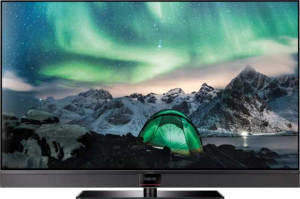
The Metz FA63 features a 65″ OLED/AMOLED panel with a 4K UHD resolution of 3840 x 2160 pixels and a pixel density of 68 ppi, rendering up to 1070 million colors at 10-bit depth. Brightness reaches a typical 1000 nits, and the 120Hz refresh rate paired with a 1 ms response time keeps motion handling sharp and fluid. The screen supports the full range of HDR standards — HDR10, HDR10+, Dolby Vision, and HLG — while both horizontal and vertical viewing angles extend to 180°. An anti-reflection coating and an ambient light sensor help maintain image quality across different lighting conditions.
The Metz FA63 offers a well-rounded set of wired and wireless connectivity options. On the wired side, it includes four HDMI 2.1 ports, three USB ports, one RJ45 Ethernet port, and a 3.5 mm headset jack, while VGA and DVI connectors are not present, nor is an external memory slot. Wireless connectivity covers Bluetooth, Wi-Fi 4 (802.11n) and Wi-Fi 5 (802.11ac), along with Miracast support for screen mirroring. For broadcast reception, the TV is compatible with DVB-T, DVB-T2, DVB-C, DVB-S, and DVB-S2 standards, covering a broad range of terrestrial, cable, and satellite tuning options.
The Metz FA63 is equipped with a stereo speaker system delivering 2 x 30W of audio output, without a subwoofer. It supports Dolby Digital, Dolby Digital Plus, and Dolby Audio, though Dolby Atmos, Dolby Virtual, and SRS TheaterSound HD are not included. Digital Out is available for connecting external audio equipment, and the TV features both HDMI ARC and HDMI eARC, allowing audio to be routed to compatible soundbars or receivers through the HDMI connection.
The Metz FA63 measures 1447 mm wide, 895 mm tall, and 77 mm thick, with a total volume of 99720.005 cm³ and a weight of 30900 g. The TV supports VESA mounting, making it compatible with standard wall mount brackets.
The Metz FA63 includes a built-in smart TV platform with an integrated web browser, and it supports smartphone remote control for added convenience, though the physical remote control is not rechargeable. USB recording is available for capturing broadcast content directly to a connected drive, and practical tools such as a sleep timer and child lock are also on board. Power consumption sits at 92W during operation and drops to 0.35W in standby, with the TV carrying an EU energy label of E.