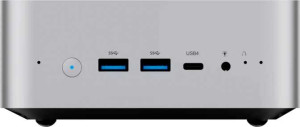
The Minisforum AI X1 follows a Micro-ATX form factor, with a compact footprint measuring 128 mm wide, 126 mm thick, and 52 mm tall, resulting in a total volume of 838.656 cm³. Storage is handled by a 2000GB SSD, though it is worth noting this drive does not use the NVMe interface.
The CPU runs eight cores at a base speed of 3.8 GHz with a turbo clock of 4.9 GHz, supported by 16 threads through multithreading and a 15W TDP, with a maximum operating temperature of 100°C. Cache is arranged as 8 MB of L2 (1 MB per core) and 16 MB of L3 (2 MB per core), while the clock multiplier is set at 38 and cannot be unlocked. The processor supports 64-bit computing and includes integrated graphics, though the multiplier is fixed with no overclocking flexibility.
The integrated GPU operates at a base clock of 800 MHz, boosting up to 2700 MHz, and delivers 8.294 TFLOPS of floating-point performance alongside a texture rate of 129.6 GTexels/s and a pixel rate of 86.4 GPixel/s, backed by 768 shading units, 48 texture mapping units, and 32 ROPs. Built on a 4nm process with 25,390 million transistors, it supports DirectX 12 Ultimate, OpenGL 4.6, OpenCL 2.1, ray tracing, double precision floating point, and connects via PCIe 4, though DLSS is not supported. The GPU can drive up to four displays simultaneously through its multi-display support.
The Minisforum AI X1 is equipped with 64GB of DDR5 RAM running at a speed of 5600 MHz, providing a solid memory configuration for the system's workloads.
Wireless connectivity covers Wi-Fi 7 (802.11be) along with Wi-Fi 6E, 6, 5, and 4, complemented by Bluetooth 5.4. On the wired side, the unit provides two Thunderbolt 4 ports, two USB 4 40Gbps ports, two USB 3.2 Gen 2 USB-A ports, and one USB 2.0 port, while USB 3.2 Gen 1 and Gen 2x2 ports are absent. Display output is handled by one HDMI 2.1 port and one DisplayPort, and a single RJ45 port covers wired networking. A 3.5mm audio jack is also present, though there is no VGA connector or S/PDIF output.
In PassMark testing, the Minisforum AI X1 achieves a multi-threaded score of 28,797 alongside a single-threaded score of 3,556, offering a measurable reference point for both parallel and single-core processing performance.
The Radeon 780M GPU is based on the RDNA 3.0 architecture, and the system supports stereoscopic 3D as well as ECC memory, with a maximum supported RAM capacity of 256GB across two memory channels and a peak RAM speed of 7500 MHz. The CPU is classified for both laptop and desktop use, supports an NX bit for hardware-level security, and carries instruction sets including MMX, F16C, FMA3, AES, AVX, AVX2, SSE 4.1, and SSE 4.2, without using big.LITTLE technology. There is no external memory slot, no air-water cooling system, and storage does not rely on flash memory, while the unit comes with a one-year warranty.