General info:
| SSD storage capacity |
1000GB |
| form factor |
Micro-ATX |
| Is an NVMe SSD |
✓ |
| thickness |
153 mm |
| height |
61 mm |
| width |
268 mm |
| volume |
2501.244 cm³ |
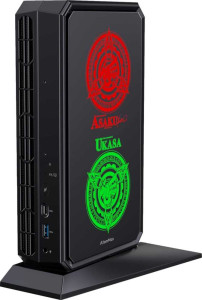
The system uses a Micro-ATX form factor and measures 268 mm wide, 153 mm deep, and 61 mm tall, giving it a total volume of approximately 2,501 cm³. Storage is handled by a 1TB NVMe SSD, offering fast read and write speeds through the NVMe interface.
CPU:
| Thermal Design Power (TDP) |
120W |
| CPU speed |
16 x 2.5 GHz |
| turbo clock speed |
5.4GHz |
| CPU threads |
32 threads |
| Has integrated graphics |
✓ |
| uses multithreading |
✓ |
| L3 cache |
64 MB |
| L2 cache |
16 MB |
| L1 cache |
1000 KB |
| L2 core |
1 MB/core |
| L3 core |
4 MB/core |
| clock multiplier |
25 |
| Has an unlocked multiplier |
✓ |
| Supports 64-bit |
✓ |
| CPU temperature |
100 °C |
The CPU is a 16-core, 32-thread processor with a base clock of 2.5GHz across all cores and a turbo frequency of 5.4GHz, operating within a 120W TDP envelope and supporting multithreading and 64-bit instruction sets. The multiplier is unlocked, allowing for manual frequency adjustments, and the maximum rated operating temperature sits at 100°C. Cache is organized as 1,000 KB of L1, 16 MB of L2 at 1 MB per core, and 64 MB of L3 at 4 MB per core, and integrated graphics are also present on the chip.
Graphics card:
| VRAM |
8GB |
| floating-point performance |
21.4 TFLOPS |
| effective memory speed |
18000 MHz |
| GPU clock speed |
1437 MHz |
| GPU memory speed |
2250 MHz |
| GPU turbo |
2608 MHz |
| texture rate |
334.7 GTexels/s |
| pixel rate |
166.9 GPixel/s |
| supports ray tracing |
✓ |
| supports DLSS |
✕ |
| maximum memory bandwidth |
288 GB/s |
| memory bus width |
128-bit |
| PCI Express (PCIe) version |
4 |
| texture mapping units (TMUs) |
128 |
| shading units |
2048 |
| render output units (ROPs) |
64 |
| DirectX version |
DirectX 12 Ultimate |
| OpenGL version |
4.6 |
| OpenCL version |
2.2 |
| semiconductor size |
6 nm |
| supported displays |
4 |
| has LHR |
✕ |
| Supports multi-display technology |
✓ |
| Has Double Precision Floating Point (DPFP) |
✓ |
| number of transistors |
13300 million |
The discrete GPU is built on a 6nm process and houses 2,048 shading units, 128 texture mapping units, and 64 render output units across 13,300 million transistors, delivering 21.4 TFLOPS of floating-point performance alongside a texture rate of 334.7 GTexels/s and a pixel rate of 166.9 GPixel/s. It carries 8GB of GDDR6 VRAM on a 128-bit bus with a memory speed of 2,250 MHz, an effective memory speed of 18,000 MHz, and a maximum bandwidth of 288 GB/s, while the GPU itself runs at a base clock of 1,437 MHz and boosts up to 2,608 MHz. The card supports ray tracing, DirectX 12 Ultimate, OpenGL 4.6, OpenCL 2.2, double precision floating point, and multi-display output across up to four screens via PCIe 4.0; DLSS and LHR are not present. Multi-display support for up to four outputs is available, making it suited to productivity or monitoring setups requiring multiple screens simultaneously.
Memory:
| RAM |
32GB |
| RAM speed |
5600 MHz |
| DDR memory version |
5 |
The system comes with 32GB of DDR5 RAM running at 5,600 MHz, providing a fast and modern memory configuration suited to demanding multitasking and compute workloads.
Connectivity:
| Wi-Fi version |
Wi-Fi 6E (802.11ax), Wi-Fi 6 (802.11ax), Wi-Fi 5 (802.11ac), Wi-Fi 4 (802.11n), Wi-Fi 7 (802.11be) |
| supports Wi-Fi |
✓ |
| Has Bluetooth |
✓ |
| Bluetooth version |
5.4 |
| USB 2.0 ports |
0 |
| USB 3.2 Gen 2 ports (USB-A) |
4 |
| USB 3.2 Gen 1 ports (USB-A) |
0 |
| USB 3.2 Gen 2 ports (USB-C) |
2 |
| USB 4 40Gbps ports |
0 |
| USB 4 20Gbps ports |
0 |
| USB 3.2 Gen 2x2 ports |
0 |
| USB 3.2 Gen 1 ports (USB-C) |
0 |
| Thunderbolt 4 ports |
0 |
| Thunderbolt 3 ports |
0 |
| DisplayPort outputs |
1 |
| HDMI version |
HDMI 2.0 |
| HDMI ports |
1 |
| RJ45 ports |
1 |
| has a socket for a 3.5 mm audio jack |
✓ |
| has a VGA connector |
✕ |
| Has S/PDIF Out port |
✕ |
Wireless connectivity covers Wi-Fi 7 (802.11be) along with Wi-Fi 6E, Wi-Fi 6, Wi-Fi 5, and Wi-Fi 4, paired with Bluetooth 5.4 for peripheral connections. On the wired side, there are four USB 3.2 Gen 2 Type-A ports and two USB 3.2 Gen 2 Type-C ports, with no USB 2.0, USB 4, or Thunderbolt ports present. Display output is handled by one HDMI 2.0 port and one DisplayPort, while a single RJ45 port provides wired network access. A 3.5mm audio jack is also included, though there is no VGA connector or S/PDIF output.
Benchmarks:
| PassMark result |
54562 |
| PassMark result (single) |
4040 |
| Geekbench 6 result (multi) |
16149 |
| Geekbench 6 result (single) |
2768 |
| PassMark result (overclocked) |
55403 |
| Cinebench R20 (multi) result |
12914 |
| Cinebench R20 (single) result |
758 |
In multi-threaded workloads, the system achieves a PassMark score of 54,562 — rising slightly to 55,403 in overclocked configuration — and a Geekbench 6 multi-core result of 16,149, reflecting strong parallel processing throughput from its 16-core CPU. Single-core results stand at 4,040 in PassMark and 2,768 in Geekbench 6, indicating solid per-core performance as well. The Cinebench R20 multi-core score of 12,914 further underlines its rendering capability, while the single-core Cinebench R20 result of 758 reflects consistent per-core rendering output.
Miscellaneous:
| maximum memory amount |
64GB |
| has an external memory slot |
✕ |
| GDDR version |
GDDR6 |
| Supports 3D |
✓ |
| Supports ECC memory |
✓ |
| has XeSS (XMX) |
✕ |
| GPU architecture |
RDNA 3.0 |
| GPU name |
Radeon 610M |
| Type |
Laptop |
| Uses big.LITTLE technology |
✕ |
| Has NX bit |
✓ |
| instruction sets |
MMX, F16C, FMA3, AES, AVX, AVX2, SSE 4.1, SSE 4.2 |
| GPU execution units |
2 |
| memory channels |
2 |
| RAM speed (max) |
5200 MHz |
| warranty period |
1 years |
The system supports up to 64GB of maximum RAM across two memory channels, with a maximum rated RAM speed of 5,200 MHz, and includes ECC memory support for improved data reliability in error-sensitive workloads. There is no external memory slot. The integrated GPU is a Radeon 610M based on the RDNA 3.0 architecture with 2 execution units, using GDDR6 memory, while XeSS is not supported. The CPU is classified as a laptop-type processor and does not use big.LITTLE technology, but supports an NX bit and a full set of instruction sets including MMX, AES, AVX, AVX2, F16C, FMA3, SSE 4.1, and SSE 4.2. Stereoscopic 3D output is supported, and the unit comes with a one-year warranty.