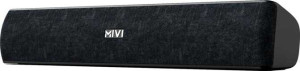
Mivi Fort Q18 specifications and in-depth review

Mivi Fort Q18

Manufacturer: Mivi

The Mivi Fort Q18 is a compact soundbar designed for straightforward wireless audio playback. It runs on Bluetooth 5.1 and supports a 2-channel sound output configuration, making it a no-frills option for users who want reliable connectivity without a complex feature set. At 348 mm wide and 832 g, the unit has a modest physical footprint suited to smaller setups.

On the audio codec side, the Fort Q18 covers both aptX Adaptive and aptX, alongside AAC, offering a reasonable spread of wireless audio formats. Connectivity is kept simple, with a built-in AUX input available for wired sources, while Wi-Fi, HDMI, S/PDIF, and NFC pairing are all absent. There is no microphone input, no voice command support, and no companion smartphone app — controls are handled directly via the on-device panel.

Pros
  • Supports aptX Adaptive and aptX alongside AAC, covering a useful range of Bluetooth audio codecs
  • Bluetooth 5.1 provides a relatively current wireless standard for stable audio streaming
  • Includes an AUX input, allowing wired connection to audio sources without relying on Bluetooth
  • On-device control panel means basic operation is possible without any secondary device
  • Compact physical dimensions make it straightforward to place in smaller spaces
Cons
  • No remote control included, requiring the user to operate the soundbar directly at the unit
  • No Wi-Fi, AirPlay, Chromecast, or Spotify Connect support, limiting wireless streaming options
  • Lacks Dolby Atmos, DTS:X, Dolby Digital, and Dolby Digital Plus, restricting audio format compatibility
  • No HDMI output or S/PDIF port, making direct connection to TVs or AV receivers more limited
  • No dedicated smartphone app available for extended control or customization
  • Voice commands and voice assistant compatibility are entirely absent
Who is this for?

The Mivi Fort Q18 is well suited to users who want a simple, no-fuss soundbar for everyday audio playback without the complexity of multi-device ecosystems. Its Bluetooth 5.1 with aptX Adaptive and AAC support makes it a reasonable fit for listeners who primarily stream audio wirelessly from a smartphone or tablet. The addition of an AUX input also makes it practical for setups where a direct wired connection to a source device is preferred, and its compact dimensions fit comfortably in smaller rooms or on modest shelving arrangements.

Who is this NOT for?

Users looking to integrate a soundbar into a broader home entertainment or smart home setup will find the Fort Q18 significantly lacking, as it offers no HDMI output, Wi-Fi, AirPlay, Chromecast, or voice assistant support. Those who expect immersive audio formats will also be disappointed, given the absence of Dolby Atmos, DTS:X, Dolby Digital, and Dolby Digital Plus. Additionally, anyone who prefers the convenience of a remote control or a dedicated smartphone app for managing playback and settings will need to interact with the unit directly, which may be impractical depending on placement.

Audio:

number of channels of sound output 2
has aptX
has aptX Adaptive
has AAC

The Mivi Fort Q18 delivers audio through a 2-channel output configuration and supports three Bluetooth codec formats: aptX Adaptive, aptX, and AAC. This combination allows the soundbar to handle a range of wireless audio streams, with aptX Adaptive being the most capable of the three in terms of dynamic bitrate handling.

Features:

compatible with Google Assistant
works with Alexa
has Spotify Connect
has Dolby Atmos
has DTS:X
has Chromecast built-in
works with Siri/Apple HomeKit
has AirPlay
supports Dolby Digital Plus
supports Dolby Digital
supports Bluetooth pairing using NFC

The Mivi Fort Q18 does not include voice assistant integration, meaning Google Assistant, Alexa, and Siri/Apple HomeKit are all unsupported. Streaming conveniences such as Spotify Connect, Chromecast, and AirPlay are equally absent. On the audio format side, the soundbar does not support Dolby Atmos, DTS:X, Dolby Digital Plus, or Dolby Digital, and NFC-based Bluetooth pairing is not available either.

Connectivity:

has an AUX input
HDMI ports 0
has an HDMI output
Bluetooth version 5.1
Has Bluetooth
supports Wi-Fi
RJ45 ports 0
has a microphone input
Has S/PDIF Out port

The Mivi Fort Q18 connects wirelessly via Bluetooth 5.1 and also includes an AUX input for wired audio sources. Beyond these two options, connectivity is fairly limited — there are no HDMI ports, no S/PDIF output, no RJ45 ports, and no Wi-Fi support. A microphone input is likewise not present.

General info:

volume 1534.68 cm³
has voice commands
control panel placed on a device
has a remote control
has a rechargeable remote control
Has a dedicated smartphone app
number of microphones 0
thickness 70 mm
weight 832 g
width 348 mm
height 63 mm

The Mivi Fort Q18 measures 348 mm wide, 63 mm tall, and 70 mm thick, with a total volume of 1534.68 cm³ and a weight of 832 g. Controls are handled directly through an on-device panel, as there is no remote control, no rechargeable remote, and no dedicated smartphone app. Voice commands are not supported, and the unit contains no microphones.

Final Verdict

The Mivi Fort Q18 is a straightforward 2-channel soundbar that keeps its scope deliberately narrow. Its strongest asset is aptX Adaptive Bluetooth support alongside Bluetooth 5.1 and a wired AUX input, giving it a practical set of connection options for users with modest, everyday audio needs. However, the absence of HDMI, Wi-Fi, surround sound formats, voice assistants, and app control means it sits firmly outside the territory of home theatre or smart home integration. For users who simply need a reliable wireless audio solution without ecosystem complexity, the Mivi Fort Q18 delivers on its basic promise — but those seeking a more feature-complete soundbar experience should look at options with broader connectivity and format support.