General info:
| SSD storage capacity |
2000GB |
| form factor |
ATX |
| Is an NVMe SSD |
✓ |
| Uses flash storage |
✓ |
| volume |
41409 cm³ |
| thickness |
430 mm |
| height |
450 mm |
| width |
214 mm |
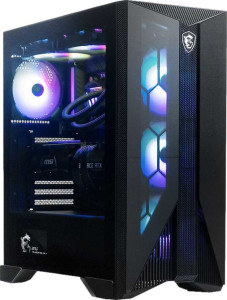
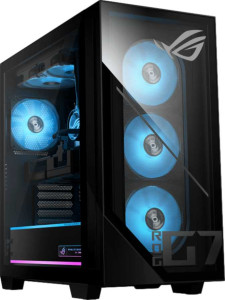
The chassis follows an ATX form factor and measures 450 mm in height, 214 mm in width, and 430 mm in thickness, giving it a total internal volume of 41,409 cm³. Storage is handled by a 2TB NVMe SSD built on flash memory, providing fast access speeds alongside a generous capacity suited to large game libraries and software installations.
Graphics card:
| VRAM |
16GB |
| floating-point performance |
44.1 TFLOPS |
| effective memory speed |
21000 MHz |
| GPU clock speed |
2340 MHz |
| GPU memory speed |
1313 MHz |
| GPU turbo |
2610 MHz |
| GDDR version |
GDDR6X |
| DirectX version |
DirectX 12 Ultimate |
| PCI Express (PCIe) version |
4 |
| supports ray tracing |
✓ |
| texture rate |
689 GTexels/s |
| pixel rate |
250.6 GPixel/s |
| maximum memory bandwidth |
672.3 GB/s |
| memory bus width |
256-bit |
| supports DLSS |
✓ |
| supported displays |
4 |
| semiconductor size |
5 nm |
| texture mapping units (TMUs) |
264 |
| shading units |
8448 |
| render output units (ROPs) |
96 |
| OpenGL version |
4.6 |
| OpenCL version |
3 |
| has LHR |
✕ |
| Supports multi-display technology |
✓ |
| Has Double Precision Floating Point (DPFP) |
✓ |
| Supports 3D |
✓ |
| has RGB lighting |
✕ |
| number of transistors |
45900 million |
The graphics card carries 16GB of GDDR6X VRAM across a 256-bit memory bus, achieving an effective memory speed of 21,000 MHz and a peak bandwidth of 672.3 GB/s. Running at a base clock of 2,340 MHz with a boost up to 2,610 MHz, it produces 44.1 TFLOPS of floating-point performance through 8,448 shading units, 264 texture mapping units, and 96 render output units, yielding a texture rate of 689 GTexels/s and a pixel rate of 250.6 GPixel/s. Built on a 5nm process with 45,900 million transistors, the card interfaces via PCIe 4.0 and is compatible with DirectX 12 Ultimate, OpenGL 4.6, and OpenCL 3. It supports ray tracing, DLSS, stereoscopic 3D, double precision floating point, and multi-display output for up to four screens, while LHR and RGB lighting are not present.
CPU:
| CPU speed |
8 x 2.1 & 12 x 1.5 GHz |
| Has integrated graphics |
✕ |
| Has an unlocked multiplier |
✕ |
| L2 cache |
28 MB |
| L3 cache |
33 MB |
| turbo clock speed |
5.4GHz |
| CPU threads |
28 threads |
| uses multithreading |
✓ |
| Turbo Boost version |
2 |
| clock multiplier |
21 |
| Supports 64-bit |
✓ |
| CPU temperature |
100 °C |
The processor runs a hybrid core layout with eight cores at 2.1 GHz and twelve cores at 1.5 GHz, capable of boosting up to 5.4 GHz via Turbo Boost 2 with a clock multiplier of 21. Multithreading is supported across 28 threads in total, and the chip is fully 64-bit compatible with a maximum rated temperature of 100 °C. Cache resources stand at 28 MB of L2 and 33 MB of L3. The CPU does not include integrated graphics and ships with a locked multiplier, leaving no manual overclocking headroom on the frequency side.
Benchmarks:
| Geekbench 6 result (multi) |
16601 |
| Geekbench 6 result (single) |
2730 |
| PassMark (G3D) result |
31767 |
| PassMark result |
43697 |
| PassMark result (single) |
4300 |
Geekbench 6 results show a multi-core score of 16,601 and a single-core score of 2,730, reflecting the CPU's threaded capacity alongside its per-core output. On the PassMark side, the overall CPU score reaches 43,697 with a single-thread result of 4,300, while the PassMark G3D score of 31,767 captures the graphics subsystem's measured rendering performance.
Memory:
| RAM |
32GB |
| RAM speed |
5600 MHz |
| DDR memory version |
5 |
The system is equipped with 32GB of DDR5 RAM running at 5,600 MHz, providing a modern memory standard with sufficient speed and capacity for gaming workloads and everyday multitasking.
Connectivity:
| Wi-Fi version |
Wi-Fi 6E (802.11ax), Wi-Fi 7 (802.11be), Wi-Fi 6 (802.11ax), Wi-Fi 5 (802.11ac), Wi-Fi 4 (802.11n) |
| supports Wi-Fi |
✓ |
| USB 2.0 ports |
4 |
| USB 3.2 Gen 2 ports (USB-A) |
2 |
| USB 3.2 Gen 1 ports (USB-A) |
2 |
| USB 3.2 Gen 2 ports (USB-C) |
2 |
| USB 4 40Gbps ports |
0 |
| USB 4 20Gbps ports |
0 |
| USB 3.2 Gen 2x2 ports |
0 |
| USB 3.2 Gen 1 ports (USB-C) |
0 |
| RJ45 ports |
1 |
| Thunderbolt 4 ports |
0 |
| Thunderbolt 3 ports |
0 |
| DisplayPort outputs |
3 |
| HDMI version |
HDMI 2.1 |
| HDMI ports |
1 |
| Has Bluetooth |
✓ |
| Bluetooth version |
5 |
| has an external memory slot |
✕ |
| DVI outputs |
0 |
| Has S/PDIF Out port |
✓ |
| has a socket for a 3.5 mm audio jack |
✓ |
| has a VGA connector |
✕ |
Wireless connectivity spans a broad range of standards, with support for Wi-Fi 7 (802.11be), Wi-Fi 6E, Wi-Fi 6, Wi-Fi 5, and Wi-Fi 4, complemented by Bluetooth 5.0 and a single RJ45 port for wired Ethernet. The USB layout is notably varied, offering four USB 2.0 ports, two USB 3.2 Gen 1 Type-A ports, two USB 3.2 Gen 2 Type-A ports, and two USB 3.2 Gen 2 Type-C ports; no USB 4, USB 3.2 Gen 2x2, or Thunderbolt ports are included. Display output is handled by three DisplayPort outputs and one HDMI 2.1 port, with no DVI, VGA, or mini DisplayPort connectors present. On the audio side, both a 3.5mm headset jack and an S/PDIF output are available, while there is no external memory card slot.
Miscellaneous:
| has an HDMI output |
✓ |
| AMD SAM / Intel Resizable BAR |
Intel Resizable BAR |
| USB-C ports |
0 |
| Has air-water cooling |
✕ |
| Thermal Design Power (TDP) |
285W |
| mini DisplayPort outputs |
0 |
| Supports ECC memory |
✓ |
| has XeSS (XMX) |
✕ |
| GPU architecture |
Ada Lovelace |
| Type |
Desktop |
| CPU socket |
LGA 1700 |
| chipset |
B760, H770, Z790, H610, H670, B660, Z690 |
| instruction sets |
MMX, F16C, FMA3, AES, AVX, AVX2, SSE 4.1, SSE 4.2 |
| Has NX bit |
✓ |
| memory channels |
2 |
| RAM speed (max) |
5600 MHz |
| maximum memory amount |
64GB |
| Uses big.LITTLE technology |
✓ |
| warranty period |
1 years |
The desktop CPU uses an LGA 1700 socket and is compatible with chipsets including B760, H770, Z790, H610, H670, B660, and Z690, while employing big.LITTLE technology and supporting instruction sets such as MMX, F16C, FMA3, AES, AVX, AVX2, SSE 4.1, and SSE 4.2, alongside an NX bit for hardware-level security. The platform supports up to 64GB of RAM across two memory channels with a maximum RAM speed of 5,600 MHz, and ECC memory is supported. The GPU is built on the Ada Lovelace architecture, and the system benefits from Intel Resizable BAR, while XeSS is not available. With a 285W TDP, the system does not include air-water cooling, and there are no USB-C ports or mini DisplayPort outputs. An HDMI output is present, and the system is covered by a one-year warranty.