MSI Aegis R2 14th (i7-14700F / RTX 4070 Ti Super / 32GB RAM / 2TB SSD) specifications and in-depth review

MSI Aegis R2 14th (i7-14700F / RTX 4070 Ti Super / 32GB RAM / 2TB SSD)

Manufacturer: MSI

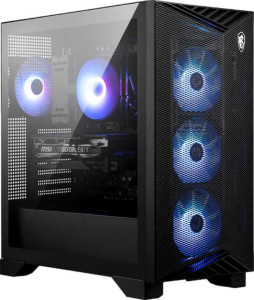
The MSI Aegis R2 14th is a desktop gaming PC built around Intel's i7-14700F processor and NVIDIA's RTX 4070 Ti Super graphics card. Housed in an ATX form factor with dimensions of 493 × 231 × 482 mm, the system ships with 32GB of DDR5 memory running at 6000 MHz and a 2TB NVMe SSD, offering a well-rounded foundation for demanding workloads and gaming sessions alike.

On the graphics side, the RTX 4070 Ti Super carries 16GB of GDDR6X VRAM across a 256-bit memory bus, with a GPU boost clock reaching 2610 MHz and 44.1 TFLOPS of floating-point performance. The card supports DirectX 12 Ultimate, ray tracing, DLSS, and can drive up to four displays simultaneously via three DisplayPort outputs and one HDMI 2.1 port. Connectivity options include Wi-Fi 7, Bluetooth 5.3, USB 3.2 Gen 2 ports in both Type-A and Type-C configurations, and a single RJ45 Ethernet port, while the system carries a one-year warranty.

Pros
  • The RTX 4070 Ti Super delivers 44.1 TFLOPS of floating-point performance alongside 16GB of GDDR6X VRAM on a 256-bit bus, providing substantial graphical headroom for demanding workloads
  • Support for ray tracing, DLSS, and DirectX 12 Ultimate enables access to modern rendering features without additional hardware
  • The i7-14700F's 28-thread configuration with Turbo Boost reaching 5.4 GHz, backed by a Geekbench 6 multi-core score of 16,601, reflects strong multi-threaded processing capability
  • Wi-Fi 7 support alongside backward compatibility with Wi-Fi 4 through 6E ensures broad wireless flexibility
  • Up to four displays can be driven simultaneously through three DisplayPort outputs and one HDMI 2.1 port, offering a versatile multi-monitor setup
  • The system supports up to 192GB of ECC memory across two channels, giving meaningful room for future upgrades beyond the current 32GB
Cons
  • The maximum supported RAM speed is listed at 5,600 MHz despite the installed DDR5 running at 6,000 MHz, indicating the CPU's official ceiling sits below the configured memory speed
  • There are no USB 4, Thunderbolt 3, or Thunderbolt 4 ports, limiting high-bandwidth external device connectivity
  • No 3.5 mm headset jack is present, requiring an adapter or alternative audio solution for standard headphones
  • Air-water cooling is not included, leaving thermal management entirely dependent on the stock cooling configuration
  • The warranty period covers only one year, which is relatively short for a desktop system of this specification level
Who is this for?

This desktop is well-suited to users who need sustained, demanding computing across tasks like high-resolution gaming and GPU-intensive rendering, given the RTX 4070 Ti Super's 44.1 TFLOPS, ray tracing support, and 16GB of GDDR6X memory. The i7-14700F's 28-thread configuration and strong multi-core benchmark results make it equally capable for workloads that benefit from parallel processing, such as video editing or 3D scene compilation. Users looking to run multi-monitor setups of up to four displays will find the combination of three DisplayPort outputs and one HDMI 2.1 port directly accommodating, and the 2TB NVMe SSD ensures fast load times across a large local library of applications or assets.

Who is this NOT for?

Users who require a portable or space-constrained solution will find the ATX form factor and overall volume of nearly 55,000 cm³ impractical, as this is strictly a stationary desktop. Those who depend on high-bandwidth external device connectivity through Thunderbolt 3, Thunderbolt 4, or USB 4 will encounter limitations, as none of these interfaces are present. Additionally, users who rely on a standard 3.5 mm headset jack for audio output will need an alternative solution, since no such connector is included on this system.

General info:

SSD storage capacity 2000GB
form factor ATX
Is an NVMe SSD
volume 54891.606 cm³
thickness 482 mm
height 493 mm
width 231 mm

The MSI Aegis R2 14th follows an ATX form factor with a height of 493 mm, a width of 231 mm, and a thickness of 482 mm, resulting in a total volume of approximately 54,891.6 cm³. Storage is handled by a 2TB NVMe SSD, offering both substantial capacity and fast data access through the NVMe interface.

Graphics card:

VRAM 16GB
floating-point performance 44.1 TFLOPS
effective memory speed 21000 MHz
GPU clock speed 2340 MHz
GPU memory speed 1313 MHz
GPU turbo 2610 MHz
GDDR version GDDR6X
DirectX version DirectX 12 Ultimate
PCI Express (PCIe) version 4
supports ray tracing
texture rate 689 GTexels/s
pixel rate 250.6 GPixel/s
maximum memory bandwidth 672.3 GB/s
memory bus width 256-bit
supports DLSS
supported displays 4
semiconductor size 5 nm
texture mapping units (TMUs) 264
shading units 8448
render output units (ROPs) 96
OpenGL version 4.6
OpenCL version 3
has LHR
Supports multi-display technology
Has Double Precision Floating Point (DPFP)
Supports 3D
has RGB lighting
number of transistors 45900 million

The RTX 4070 Ti Super is built on a 5 nm semiconductor process and packs 45,900 million transistors, with 8,448 shading units, 264 texture mapping units, and 96 render output units working in tandem to deliver 44.1 TFLOPS of floating-point performance. Its 16GB of GDDR6X memory operates across a 256-bit bus at an effective speed of 21,000 MHz, yielding a maximum memory bandwidth of 672.3 GB/s, while the GPU runs at a base clock of 2,340 MHz and boosts up to 2,610 MHz. The card connects via PCIe 4.0 and supports DirectX 12 Ultimate, OpenGL 4.6, and OpenCL 3, along with ray tracing, DLSS, double precision floating point, and stereoscopic 3D output. Multi-display support extends to up to four screens simultaneously, with a texture rate of 689 GTexels/s and a pixel rate of 250.6 GPixel/s rounding out its rendering capabilities. The card does not include LHR or RGB lighting.

CPU:

CPU speed 8 x 2.1 & 12 x 1.5 GHz
Has integrated graphics
Has an unlocked multiplier
L2 cache 28 MB
L3 cache 33 MB
turbo clock speed 5.4GHz
CPU threads 28 threads
uses multithreading
Turbo Boost version 2
clock multiplier 21
Supports 64-bit
CPU temperature 100 °C

The Intel i7-14700F features a hybrid core configuration running at 8 cores clocked at 2.1 GHz and 12 cores at 1.5 GHz, with Turbo Boost 2.0 pushing speeds up to 5.4 GHz across its 28 threads with multithreading enabled. The processor carries 28 MB of L2 cache and 33 MB of L3 cache, uses a clock multiplier of 21, and has a maximum rated temperature of 100 °C. It supports 64-bit computing but does not include an unlocked multiplier or integrated graphics.

Benchmarks:

Geekbench 6 result (multi) 16601
Geekbench 6 result (single) 2730
PassMark (G3D) result 31767
PassMark result 43697
PassMark result (single) 4300

In benchmark testing, the system achieves a Geekbench 6 multi-core score of 16,601 and a single-core score of 2,730, reflecting the CPU's threaded and per-core capabilities respectively. On the PassMark side, the overall result stands at 43,697 with a single-core PassMark score of 4,300, while the graphics-focused PassMark G3D test returns a result of 31,767.

Memory:

RAM 32GB
RAM speed 6000 MHz
DDR memory version 5

The system is equipped with 32GB of DDR5 memory running at 6,000 MHz, combining a generous capacity with the higher bandwidth characteristics of the DDR5 standard.

Connectivity:

Wi-Fi version Wi-Fi 6E (802.11ax), Wi-Fi 6 (802.11ax), Wi-Fi 5 (802.11ac), Wi-Fi 4 (802.11n), Wi-Fi 7 (802.11be)
supports Wi-Fi
USB 2.0 ports 4
USB 3.2 Gen 2 ports (USB-A) 2
USB 3.2 Gen 1 ports (USB-A) 1
USB 3.2 Gen 2 ports (USB-C) 1
USB 4 40Gbps ports 0
USB 4 20Gbps ports 0
USB 3.2 Gen 2x2 ports 0
USB 3.2 Gen 1 ports (USB-C) 1
RJ45 ports 1
Thunderbolt 4 ports 0
Thunderbolt 3 ports 0
DisplayPort outputs 3
HDMI version HDMI 2.1
HDMI ports 1
Has Bluetooth
Bluetooth version 5.3
DVI outputs 0
Has S/PDIF Out port
has a socket for a 3.5 mm audio jack
has a VGA connector

Wireless connectivity covers Wi-Fi 7 (802.11be) down through Wi-Fi 4 (802.11n), complemented by Bluetooth 5.3 for short-range peripherals. The wired USB selection includes four USB 2.0 ports, two USB 3.2 Gen 2 Type-A ports, one USB 3.2 Gen 1 Type-A port, one USB 3.2 Gen 2 Type-C port, and one USB 3.2 Gen 1 Type-C port, though there are no USB 4, USB 3.2 Gen 2x2, Thunderbolt 3, or Thunderbolt 4 ports present. A single RJ45 port handles wired networking, while display output is covered by three DisplayPort outputs and one HDMI 2.1 port; DVI and VGA connectors are not included. Audio connectivity includes an S/PDIF out port, but there is no 3.5 mm headset jack.

Miscellaneous:

has an HDMI output
AMD SAM / Intel Resizable BAR Intel Resizable BAR
USB-C ports 0
Has air-water cooling
Thermal Design Power (TDP) 285W
mini DisplayPort outputs 0
Supports ECC memory
has XeSS (XMX)
GPU architecture Ada Lovelace
Type Desktop
CPU socket LGA 1700
chipset B760, H770, Z790, H610, H670, B660, Z690
instruction sets MMX, F16C, FMA3, AES, AVX, AVX2, SSE 4.1, SSE 4.2
Has NX bit
memory channels 2
RAM speed (max) 5600 MHz
maximum memory amount 192GB
Uses big.LITTLE technology
warranty period 1 years

The system uses a desktop-class CPU seated in an LGA 1700 socket, compatible with B760, H770, Z790, H610, H670, B660, and Z690 chipsets, and employs big.LITTLE technology for its core configuration. The processor supports instruction sets including MMX, F16C, FMA3, AES, AVX, AVX2, SSE 4.1, and SSE 4.2, along with the NX bit for hardware-level security. Memory support extends to a maximum of 192GB across two channels, with a rated maximum RAM speed of 5,600 MHz, and ECC memory is supported. The GPU is based on the Ada Lovelace architecture and the system includes Intel Resizable BAR support and an HDMI output, while air-water cooling and XeSS (XMX) are not present. The CPU carries a thermal design power of 285W, there are no mini DisplayPort or USB-C outputs, and the system comes with a one-year warranty.
Final Verdict

The MSI Aegis R2 14th (i7-14700F / RTX 4070 Ti Super) is a capable desktop system that brings together a high-thread-count processor and a GPU with 44.1 TFLOPS of floating-point performance and 16GB of GDDR6X VRAM into a stationary ATX chassis designed for sustained, demanding use. Its combination of DDR5 memory, a 2TB NVMe SSD, Wi-Fi 7 support, and multi-display output up to four screens makes it a well-rounded platform for users whose workloads consistently push both CPU and GPU resources. The absence of Thunderbolt connectivity and a 3.5 mm audio jack are practical considerations worth noting, but for users anchored to a fixed workstation setup, the MSI Aegis R2 14th represents a solid, specification-dense choice within the desktop gaming PC category.