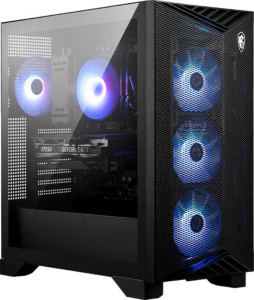
The MSI Aegis R2 14th follows an ATX form factor with a height of 493 mm, a width of 231 mm, and a thickness of 482 mm, resulting in a total volume of 54891.606 cm³. Storage is handled by a 2000GB NVMe SSD, providing fast data access through the NVMe interface.
The graphics card features 16GB of GDDR7 memory on a 256-bit bus, delivering a maximum memory bandwidth of 960 GB/s at an effective memory speed of 30000 MHz, with a base GPU clock of 2300 MHz and a turbo clock reaching 2620 MHz. Its 56.34 TFLOPS of floating-point performance is backed by 10752 shading units, 336 texture mapping units, and 112 render output units, producing a texture rate of 880 GTexels/s and a pixel rate of 293.4 GPixel/s. Built on a 5nm process with 45600 million transistors, the card connects via PCIe 5 and supports DirectX 12 Ultimate, OpenGL 4.6, OpenCL 3, ray tracing, DLSS, stereoscopic 3D, double precision floating point, and multi-display output across up to four screens. It does not include LHR or RGB lighting.
The processor runs at a base configuration of 8 cores at 2 GHz and 16 cores at 1.5 GHz, with a turbo clock speed reaching 5.8 GHz via Turbo Boost version 2 and a clock multiplier of 20. It supports 32 threads through multithreading and is fully 64-bit compatible, while the maximum rated CPU temperature sits at 100 °C. Cache consists of 32 MB of L2 and 36 MB of L3, and the processor does not include integrated graphics nor does it have an unlocked multiplier.
In standardized benchmark testing, the system records a Geekbench 6 multi-core score of 18348 and a single-core score of 2860, reflecting the processor's threaded and per-core output respectively. On the PassMark platform, the overall result comes in at 47100, with the single-threaded PassMark score reaching 4466.
The system is equipped with 64GB of DDR5 RAM running at a speed of 6000 MHz, providing a substantial amount of memory for handling memory-intensive tasks and multitasking workloads.
Wireless connectivity covers Wi-Fi 7 (802.11be) alongside Wi-Fi 6E, 6, 5, and 4, complemented by Bluetooth 5.3 for peripheral pairing. Wired networking is handled by a single RJ45 port, while the USB layout includes four USB 2.0 ports, two USB 3.2 Gen 2 USB-A ports, one USB 3.2 Gen 1 USB-A port, one USB 3.2 Gen 2 USB-C port, and one USB 3.2 Gen 1 USB-C port; there are no USB 4, USB 3.2 Gen 2x2, Thunderbolt 3, or Thunderbolt 4 ports. Display output is provided through three DisplayPort outputs and one HDMI 2.1 port, with no DVI or VGA connectors present. Audio connectivity includes an S/PDIF output, though there is no 3.5mm headset jack.
The desktop CPU uses an LGA 1700 socket and is compatible with a range of chipsets including B760, H770, Z790, H610, H670, B660, and Z690, with a 360W Thermal Design Power (TDP) and a maximum supported memory amount of 192GB across two memory channels, though the rated maximum RAM speed is 5600 MHz. The processor employs big.LITTLE technology, supports instruction sets including MMX, F16C, FMA3, AES, AVX, AVX2, SSE 4.1, and SSE 4.2, and includes an NX bit for hardware-level security. ECC memory is supported, and Intel Resizable BAR is present, while the GPU is based on the Blackwell architecture and the system includes an HDMI output. There are no mini DisplayPort outputs, no dedicated USB-C ports in this section, no air-water cooling, and XeSS (XMX) is not supported. The product comes with a one-year warranty.