MSI Aegis R2 14th (i9-14900F / RTX 4070 Super / 32GB RAM / 2TB SSD) specifications and in-depth review

MSI Aegis R2 14th (i9-14900F / RTX 4070 Super / 32GB RAM / 2TB SSD)

Manufacturer: MSI

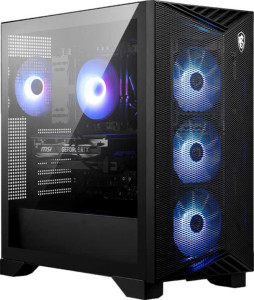
The MSI Aegis R2 14th is a desktop gaming PC built around Intel's Core i9-14900F processor and NVIDIA's RTX 4070 Super graphics card. Housed in an ATX form factor chassis measuring 493 mm tall, 231 mm wide, and 482 mm deep, it comes configured with 32GB of DDR5 RAM running at 6000 MHz and a 2TB NVMe SSD, giving it a straightforward but capable storage and memory setup out of the box.

The RTX 4070 Super handles graphics duties with 7168 shading units, 12GB of GDDR6X memory across a 192-bit bus, and a maximum memory bandwidth of 504.2 GB/s, while its 35.48 TFLOPS of floating-point performance is backed by a GPU turbo clock of 2480 MHz. The card supports DirectX 12 Ultimate, ray tracing, DLSS, and up to four simultaneous displays via three DisplayPort outputs and one HDMI 2.1 port. On the CPU side, the i9-14900F offers 32 threads with a turbo clock of 5.8 GHz, 32 MB of L2 cache, and 36 MB of L3 cache, with a TDP rated at 220W. Connectivity includes Wi-Fi 7 (802.11be), Bluetooth 5.3, eight USB ports of varying generations, and one RJ45 port for wired networking.

Pros
  • The RTX 4070 Super delivers 35.48 TFLOPS of floating-point performance alongside ray tracing and DLSS support, backed by 504.2 GB/s of memory bandwidth over a 192-bit bus
  • Wi-Fi 7 support alongside Bluetooth 5.3 ensures the system is equipped for current and near-future wireless standards
  • A broad USB port selection spanning USB 2.0, USB 3.2 Gen 1, and USB 3.2 Gen 2 in both Type-A and Type-C form factors covers a wide range of peripheral needs
  • Three DisplayPort outputs plus one HDMI 2.1 port allow up to four displays to be connected simultaneously
  • 32GB of DDR5 RAM running at 6000 MHz paired with a 2TB NVMe SSD provides a fast and spacious storage and memory setup
  • The i9-14900F supports 32 threads via multithreading and reaches a turbo clock of 5.8 GHz, making it well-suited for heavily threaded workloads
Cons
  • The CPU multiplier is locked, removing any option for manual overclocking
  • No Thunderbolt 3 or Thunderbolt 4 ports are present, limiting high-bandwidth peripheral and daisy-chaining options
  • A 3.5 mm headset jack is absent, requiring an adapter or separate audio device for standard headphone use
  • Air-water cooling is not included, and with a 220W CPU TDP the thermal solution may be a consideration for sustained workloads
  • RAM speed is capped at 5600 MHz by the platform, meaning the installed 6000 MHz kit runs beyond the official maximum supported speed
  • The warranty period covers only one year
Who is this for?

This system is well-suited for users who need a capable desktop for demanding gaming workloads, given the RTX 4070 Super's ray tracing support, DLSS capability, and ability to drive up to four displays simultaneously — making it a solid choice for those interested in multi-monitor setups. The i9-14900F's 32-thread configuration and 5.8 GHz turbo clock also make it a reasonable fit for content creators and multitaskers who run heavily threaded applications alongside their gaming sessions. The combination of DDR5 RAM at 6000 MHz and a 2TB NVMe SSD further suits users who work with large files or frequently load demanding titles, while Wi-Fi 7 and a broad USB port selection make it practical for well-connected home or studio desktop setups.

Who is this NOT for?

The absence of Thunderbolt 3 or Thunderbolt 4 makes this system a poor fit for users who rely on high-bandwidth external devices such as external GPUs, high-speed storage arrays, or professional audio interfaces that depend on Thunderbolt connectivity. The locked CPU multiplier rules out any form of manual overclocking, so users specifically seeking enthusiast-level tuning flexibility would find the platform limiting in that regard. Additionally, the lack of a 3.5 mm headset jack means the system is less convenient for users who depend on standard wired audio peripherals without an adapter, and the ATX form factor and large physical dimensions make it entirely unsuitable for anyone requiring a compact or space-constrained desktop solution.

General info:

SSD storage capacity 2000GB
form factor ATX
Is an NVMe SSD
volume 54891.606 cm³
thickness 482 mm
height 493 mm
width 231 mm

The MSI Aegis R2 14th follows an ATX form factor and occupies a volume of 54,891.606 cm³, with physical dimensions of 493 mm in height, 231 mm in width, and 482 mm in depth. Storage is handled by a 2TB NVMe SSD, offering fast data access through the NVMe interface.

Graphics card:

VRAM 12GB
floating-point performance 35.48 TFLOPS
effective memory speed 21000 MHz
GPU clock speed 1980 MHz
GPU memory speed 1313 MHz
GPU turbo 2480 MHz
GDDR version GDDR6X
DirectX version DirectX 12 Ultimate
PCI Express (PCIe) version 4
supports ray tracing
texture rate 554.4 GTexels/s
pixel rate 198 GPixel/s
maximum memory bandwidth 504.2 GB/s
memory bus width 192-bit
supports DLSS
supported displays 4
semiconductor size 5 nm
texture mapping units (TMUs) 224
shading units 7168
render output units (ROPs) 80
OpenGL version 4.6
OpenCL version 3
has LHR
Supports multi-display technology
Has Double Precision Floating Point (DPFP)
Supports 3D
has RGB lighting
number of transistors 35800 million

The graphics card carries 12GB of GDDR6X VRAM across a 192-bit memory bus, delivering a maximum memory bandwidth of 504.2 GB/s and an effective memory speed of 21,000 MHz, with a base GPU clock of 1980 MHz and a turbo clock reaching 2480 MHz. Its 7168 shading units, 224 texture mapping units, and 80 render output units contribute to a texture rate of 554.4 GTexels/s and a pixel rate of 198 GPixel/s, while overall floating-point performance sits at 35.48 TFLOPS. Built on a 5 nm semiconductor process and housing 35,800 million transistors, the card connects via PCIe 4 and supports DirectX 12 Ultimate, OpenGL 4.6, and OpenCL 3. It is capable of driving up to four displays simultaneously using multi-display technology, and includes support for ray tracing, DLSS, stereoscopic 3D, and double precision floating point, while LHR and RGB lighting are not present.

CPU:

CPU speed 8 x 2 & 16 x 1.5 GHz
Has integrated graphics
Has an unlocked multiplier
L2 cache 32 MB
L3 cache 36 MB
turbo clock speed 5.8GHz
CPU threads 32 threads
uses multithreading
Turbo Boost version 2
clock multiplier 20
Supports 64-bit
CPU temperature 100 °C

The CPU runs at a base configuration of 8 cores at 2 GHz and 16 cores at 1.5 GHz, with a turbo clock speed of 5.8 GHz via Turbo Boost version 2 and a clock multiplier of 20. It supports 32 threads through multithreading and is fully 64-bit compatible, with a maximum rated temperature of 100 °C. Cache consists of 32 MB at the L2 level and 36 MB at the L3 level. The processor does not include integrated graphics and does not have an unlocked multiplier.

Benchmarks:

Geekbench 6 result (multi) 18348
Geekbench 6 result (single) 2860
PassMark result 47100
PassMark result (single) 4466

In Geekbench 6, the system scores 18,348 in the multi-core test and 2,860 in the single-core test. PassMark results follow a similar pattern, with an overall score of 47,100 and a single-core score of 4,466.

Memory:

RAM 32GB
RAM speed 6000 MHz
DDR memory version 5

The system comes equipped with 32GB of DDR5 RAM running at a speed of 6000 MHz, providing a capable memory configuration for the platform.

Connectivity:

Wi-Fi version Wi-Fi 6E (802.11ax), Wi-Fi 6 (802.11ax), Wi-Fi 5 (802.11ac), Wi-Fi 4 (802.11n), Wi-Fi 7 (802.11be)
supports Wi-Fi
USB 2.0 ports 4
USB 3.2 Gen 2 ports (USB-A) 2
USB 3.2 Gen 1 ports (USB-A) 1
USB 3.2 Gen 2 ports (USB-C) 1
USB 4 40Gbps ports 0
USB 4 20Gbps ports 0
USB 3.2 Gen 2x2 ports 0
USB 3.2 Gen 1 ports (USB-C) 1
RJ45 ports 1
Thunderbolt 4 ports 0
Thunderbolt 3 ports 0
DisplayPort outputs 3
HDMI version HDMI 2.1
HDMI ports 1
Has Bluetooth
Bluetooth version 5.3
DVI outputs 0
Has S/PDIF Out port
has a socket for a 3.5 mm audio jack
has a VGA connector

Wireless connectivity covers Wi-Fi 7 (802.11be) along with Wi-Fi 6E, 6, 5, and 4, complemented by Bluetooth 5.3. The USB port selection includes four USB 2.0 ports, two USB 3.2 Gen 2 ports (USB-A), one USB 3.2 Gen 1 port (USB-A), one USB 3.2 Gen 2 port (USB-C), and one USB 3.2 Gen 1 port (USB-C), while USB 4, USB 3.2 Gen 2x2, Thunderbolt 3, and Thunderbolt 4 are not present. For wired networking there is one RJ45 port, and display outputs consist of three DisplayPort outputs and one HDMI 2.1 port, with no DVI or VGA connectors included. Audio connectivity includes an S/PDIF out port, though a 3.5 mm headset jack is not available.

Miscellaneous:

has an HDMI output
AMD SAM / Intel Resizable BAR Intel Resizable BAR
USB-C ports 0
Has air-water cooling
Thermal Design Power (TDP) 220W
mini DisplayPort outputs 0
Supports ECC memory
has XeSS (XMX)
GPU architecture Ada Lovelace
Type Desktop
CPU socket LGA 1700
chipset B760, H770, Z790, H610, H670, B660, Z690
instruction sets MMX, F16C, FMA3, AES, AVX, AVX2, SSE 4.1, SSE 4.2
Has NX bit
memory channels 2
RAM speed (max) 5600 MHz
maximum memory amount 192GB
Uses big.LITTLE technology
warranty period 1 years

The desktop CPU uses an LGA 1700 socket and is compatible with B760, H770, Z790, H610, H670, B660, and Z690 chipsets, employing big.LITTLE technology and supporting instruction sets including MMX, F16C, FMA3, AES, AVX, AVX2, SSE 4.1, and SSE 4.2, along with an NX bit. It has a TDP of 220W, operates across two memory channels, supports ECC memory, and can accommodate up to 192GB of RAM at a maximum speed of 5600 MHz. The GPU is built on the Ada Lovelace architecture and benefits from Intel Resizable BAR, while XeSS is not supported. The system includes an HDMI output but no mini DisplayPort outputs and no USB-C ports, and air-water cooling is not present. It comes with a 1-year warranty.
Final Verdict

The MSI Aegis R2 14th with the i9-14900F and RTX 4070 Super is a desktop gaming PC that covers the core bases well — the GPU's ray tracing, DLSS support, and multi-display capability give it enough headroom for current gaming demands, while the 32-thread CPU, DDR5 memory, and 2TB NVMe SSD round out a configuration that handles both gaming and multitasking without obvious bottlenecks. It does carry some platform constraints, particularly around audio connectivity, the locked multiplier, and the absence of Thunderbolt ports, which will matter to a subset of users. For those building a well-connected home desktop focused primarily on gaming and productivity, however, the MSI Aegis R2 14th represents a coherent and well-specified system that delivers where it counts most.