MSI AI Edge specifications and in-depth review

MSI AI Edge

Manufacturer: MSI

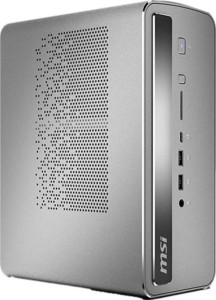
The MSI AI Edge is a Micro-ATX Mini PC built around a 16-core processor running at a base clock of 3 GHz per core, with turbo speeds reaching up to 5.1 GHz. It comes equipped with 128GB of DDR5 RAM — the maximum supported by the platform — alongside a 2TB NVMe SSD, making it a capable compact desktop for memory-intensive workloads. The integrated Radeon 8060S handles graphics duties, supporting up to four displays simultaneously.

On the connectivity side, the MSI AI Edge offers Wi-Fi 7 (802.11be) alongside Bluetooth 5.4, two HDMI 2.1 ports, one DisplayPort output, and a mix of USB 3.2 Gen 2 ports in both USB-A and USB-C form factors. The CPU carries a 55W TDP with a 64MB L3 cache and 32 threads via multithreading support, while benchmark results show a PassMark multi-core score of 54,021 and a Geekbench 6 multi-core score of 17,698. ECC memory support and PCIe 4.0 connectivity round out the technical profile of this compact system.

Pros
  • Supports up to 128GB of DDR5 RAM across 4 memory channels, with a maximum RAM speed of 8000 MHz, enabling substantial multitasking capacity
  • The 16-core CPU reaches a turbo clock of 5.1 GHz and delivers 32 threads via multithreading, suited for parallelized workloads
  • Wi-Fi 7 support alongside Bluetooth 5.4 provides up-to-date wireless connectivity options
  • The Radeon 8060S can drive up to 4 displays simultaneously, useful for multi-monitor desktop setups
  • ECC memory support adds a layer of data reliability for error-sensitive tasks
  • A 2TB NVMe SSD offers substantial fast storage within a Micro-ATX form factor
Cons
  • No RJ45 ethernet port, so wired network connectivity requires an adapter
  • The clock multiplier is locked, leaving no overclocking headroom through multiplier adjustment
  • No USB 4, Thunderbolt 3, or Thunderbolt 4 ports are available, limiting high-bandwidth peripheral options
  • No S/PDIF output or VGA connector, reducing compatibility with older audio and display equipment
  • USB port selection is limited to two USB 3.2 Gen 2 Type-A and one Type-C, with no USB 2.0 or lower-speed USB-A ports for broader legacy device support
Who is this for?

This Mini PC is well-matched for users who need a compact desktop capable of handling memory-intensive and multi-threaded workloads, such as data processing, software development, or virtualization, thanks to its 128GB DDR5 RAM, 32-thread CPU, and ECC memory support. The ability to connect up to four displays simultaneously makes it a practical fit for productivity-focused multi-monitor setups, while Wi-Fi 7 and Bluetooth 5.4 suit environments where up-to-date wireless connectivity is a priority. The 2TB NVMe SSD also serves users who regularly work with large files and need fast local storage within a space-constrained form factor.

Who is this NOT for?

Users who depend on a wired ethernet connection will find this system lacking, as there is no RJ45 port on board, making it a poor fit for network-critical environments such as servers or office setups that require stable, low-latency wired networking. Those looking to push performance beyond stock settings will also be disappointed, since the locked clock multiplier removes any overclocking flexibility. Additionally, users with high-bandwidth peripherals or docking stations that rely on Thunderbolt or USB 4 connectivity will find the port selection insufficient, as neither standard is supported.

General info:

SSD storage capacity 2000GB
form factor Micro-ATX
release date February 2026
Is an NVMe SSD

The MSI AI Edge uses a Micro-ATX form factor, fitting into a compact footprint while still accommodating its core components. Storage is handled by a 2000GB NVMe SSD, which leverages the NVMe interface for faster read and write speeds compared to traditional SATA-based drives.

CPU:

Thermal Design Power (TDP) 55W
CPU speed 16 x 3 GHz
turbo clock speed 5.1GHz
CPU threads 32 threads
Has integrated graphics
uses multithreading
L3 cache 64 MB
L2 cache 16 MB
L1 cache 1280 KB
L2 core 1 MB/core
L3 core 4 MB/core
clock multiplier 30
Has an unlocked multiplier
Supports 64-bit
CPU temperature 100 °C

The processor runs 16 cores at a base clock of 3 GHz each, with a turbo clock speed of 5.1 GHz, and supports multithreading for a total of 32 threads. It carries a 64 MB L3 cache (4 MB per core), 16 MB of L2 cache (1 MB per core), and 1280 KB of L1 cache, while operating within a 55W TDP and reaching a maximum temperature of 100 °C. The CPU supports 64-bit processing and includes integrated graphics, though its clock multiplier is fixed at 30 with no unlocked multiplier available.

Graphics card:

GPU clock speed 1295 MHz
GPU turbo 2900 MHz
PCI Express (PCIe) version 4
texture mapping units (TMUs) 160
shading units 2560
render output units (ROPs) 64
DirectX version DirectX 12
OpenGL version 4.6
OpenCL version 3
semiconductor size 4 nm
supported displays 4

The Radeon 8060S operates at a base clock of 1295 MHz, boosting up to a GPU turbo speed of 2900 MHz, and is built on a 4 nm semiconductor process. It features 2560 shading units, 160 texture mapping units, and 64 render output units, connected via PCIe 4.0. The GPU supports DirectX 12, OpenGL 4.6, and OpenCL 3, and can drive up to four displays simultaneously.

Memory:

RAM 128GB
DDR memory version 5

The MSI AI Edge is equipped with 128GB of DDR5 RAM, providing a substantial amount of system memory for demanding workloads and multitasking scenarios.

Connectivity:

Wi-Fi version Wi-Fi 6E (802.11ax), Wi-Fi 6 (802.11ax), Wi-Fi 5 (802.11ac), Wi-Fi 4 (802.11n), Wi-Fi 7 (802.11be)
supports Wi-Fi
Has Bluetooth
Bluetooth version 5.4
USB 2.0 ports 0
USB 3.2 Gen 2 ports (USB-A) 2
USB 3.2 Gen 1 ports (USB-A) 0
USB 3.2 Gen 2 ports (USB-C) 1
USB 4 40Gbps ports 0
USB 4 20Gbps ports 0
USB 3.2 Gen 2x2 ports 0
USB 3.2 Gen 1 ports (USB-C) 0
Thunderbolt 4 ports 0
Thunderbolt 3 ports 0
DisplayPort outputs 1
HDMI version HDMI 2.1
HDMI ports 2
RJ45 ports 0
has a socket for a 3.5 mm audio jack
has a VGA connector
Has S/PDIF Out port

Wireless connectivity covers Wi-Fi 7 (802.11be) alongside backward-compatible support for Wi-Fi 6E, 6, 5, and 4, complemented by Bluetooth 5.4. On the wired side, USB ports include two USB 3.2 Gen 2 Type-A and one USB 3.2 Gen 2 Type-C, with no USB 2.0, USB 4, or Thunderbolt ports present. Display outputs consist of two HDMI 2.1 ports and one DisplayPort, while a 3.5 mm audio jack is also available; there is no VGA connector, no S/PDIF output, and no RJ45 ethernet port.

Benchmarks:

PassMark result 54021
PassMark result (single) 4142
Geekbench 6 result (multi) 17698
Geekbench 6 result (single) 2774
PassMark result (overclocked) 57021

In PassMark testing, the processor scores 54,021 in the multi-core benchmark and 4,142 in the single-core test, climbing to 57,021 when overclocked. Geekbench 6 results show a multi-core score of 17,698 alongside a single-core score of 2,774.

Miscellaneous:

maximum memory amount 128GB
Type Laptop, Desktop
Uses big.LITTLE technology
instruction sets MMX, F16C, FMA3, AES, AVX, AVX2, SSE 4.1, SSE 4.2
Has NX bit
GPU name Radeon 8060S
Supports ECC memory
memory channels 4
RAM speed (max) 8000 MHz
Uses flash storage

The system is rated for both laptop and desktop deployment and pairs its Radeon 8060S GPU with a CPU that supports a broad set of instruction sets including MMX, F16C, FMA3, AES, AVX, AVX2, SSE 4.1, and SSE 4.2, along with NX bit for hardware-level security. Memory can reach a maximum of 128GB across 4 memory channels, with a peak RAM speed of 8000 MHz, and the platform supports ECC memory for error-correcting workloads. The CPU does not use big.LITTLE technology, and the system does not rely on flash storage.
Final Verdict

The MSI AI Edge is a Micro-ATX Mini PC that makes a strong case for users seeking a compact desktop with serious multitasking credentials — its 128GB DDR5 ECC RAM across four memory channels, 32-thread CPU, and 2TB NVMe SSD form a well-rounded foundation for demanding productivity and data-intensive workflows. The inclusion of Wi-Fi 7, multi-display support via the Radeon 8060S, and a solid benchmark profile further reinforce its position as a capable compact workstation. That said, the absence of wired ethernet and Thunderbolt connectivity, combined with a locked CPU multiplier, means it will not suit every deployment scenario. For users whose priorities align with its strengths — high memory capacity, modern wireless connectivity, and multi-display flexibility within a small footprint — the MSI AI Edge delivers a coherent and well-specified package.