MSI Bravo 15 C7V (2024) 15.6" AMD Ryzen 9 7940HS 4GHz / Nvidia GeForce RTX 4060 Laptop / 64GB RAM / 4TB SSD specifications and in-depth review

MSI Bravo 15 C7V (2024) 15.6" AMD Ryzen 9 7940HS 4GHz / Nvidia GeForce RTX 4060 Laptop / 64GB RAM / 4TB SSD

Manufacturer: MSI

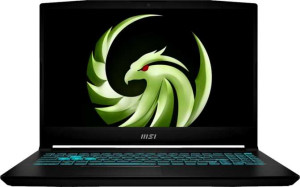
The MSI Bravo 15 C7V (2024) is a 15.6-inch gaming laptop built around AMD's Ryzen 9 7940HS processor and paired with an Nvidia GeForce RTX 4060 Laptop GPU. Weighing 2,250 g and measuring 24 mm thick, it balances a relatively portable form factor with a feature set aimed at gaming use. The machine ships with 64GB of DDR5 RAM running at 5,600 MHz and a 4TB NVMe SSD, giving it considerable headroom for both storage-intensive workloads and multitasking.

On the display side, the Bravo 15 C7V uses a 1920 x 1080 IPS panel at 141 ppi with a 144Hz refresh rate, though it lacks anti-reflection coating and touch input. The RTX 4060 Laptop GPU operates on the Ada Lovelace architecture with 8GB of GDDR6 VRAM across a 128-bit bus, delivering 14.56 TFLOPS of floating-point performance and support for both DLSS and ray tracing. Connectivity includes USB 3.2 Gen 2 Type-C, two USB 3.2 Gen 1 Type-A ports, HDMI 2.1, an RJ45 Ethernet port, Wi-Fi 6E, and Bluetooth 5.3, alongside a 53.5 Wh battery and a 3.5 mm audio jack.

Pros
  • The 144Hz IPS display provides notably smoother motion rendering for gaming use cases compared to standard 60Hz panels
  • 64GB of DDR5 RAM running at 5,600 MHz across two slots gives the system substantial headroom for memory-intensive workloads
  • A 4TB NVMe SSD connected over PCIe 4.0 offers generous local storage capacity with fast flash-based access speeds
  • The GPU supports both ray tracing and DLSS, enabling more advanced rendering options in compatible titles
  • Wi-Fi 6E support alongside Bluetooth 5.3 and a dedicated RJ45 Ethernet port provides a well-rounded range of wireless and wired networking options
  • The HDMI 2.1 output allows connection to high-bandwidth external displays
Cons
  • The 53.5 Wh battery is relatively modest for a gaming laptop drawing up to 115W from the CPU alone, which may limit unplugged runtime
  • The 1920 x 1080 resolution on a 15.6-inch panel results in a pixel density of only 141 ppi, which is not particularly sharp for close-up viewing
  • The display lacks an anti-reflection coating, which can make screen content harder to read in brighter environments
  • There is no fingerprint scanner or 3D facial recognition, leaving the system without biometric login options
  • The USB port selection includes no USB 3.2 Gen 2 Type-A ports and no Thunderbolt connectivity, limiting high-speed peripheral options
  • No external memory card slot is available, which may inconvenience users who work with camera or device storage cards
Who is this for?

This laptop is well-suited to users who need a capable gaming machine for titles that benefit from ray tracing and DLSS support, as the Ada Lovelace GPU architecture and 14.56 TFLOPS of floating-point performance provide the necessary hardware foundation for those features. The 64GB of DDR5 RAM paired with a 4TB NVMe SSD also makes it a reasonable fit for content creators or power users who run memory-hungry applications alongside large local file libraries. The 144Hz IPS panel and Wi-Fi 6E support further round out the experience for those who want responsive visuals and fast wireless connectivity at a fixed desk or home setup.

Who is this NOT for?

Users who need a laptop they can comfortably carry and use away from a power outlet for extended periods will find this machine limiting, as the 53.5 Wh battery is modest relative to the 115W CPU TDP, making sustained unplugged use impractical. The 1920 x 1080 display without anti-reflection coating is unlikely to satisfy users who prioritize sharp, glare-free visuals for colour-accurate creative work or who prefer higher-resolution panels on a 15.6-inch screen. Additionally, professionals who rely on Thunderbolt connectivity or high-speed USB-A ports for demanding peripherals or external storage will find the port selection insufficient, given the absence of any Thunderbolt or USB 3.2 Gen 2 Type-A outputs.

Design:

Type Gaming
weight 2250 g
Uses a fanless design
Has a backlit keyboard
volume 2231.544 cm³
width 359 mm
height 259 mm
thickness 24 mm
is weather-sealed (splashproof)

The MSI Bravo 15 C7V (2024) is a gaming laptop with a physical footprint of 359 mm wide by 259 mm deep and a thickness of 24 mm, giving it a volume of 2,231.544 cm³. It weighs 2,250 g and relies on an active cooling system rather than a fanless design. The chassis includes a backlit keyboard for low-light use, though it is not weather-sealed or splashproof.

Display:

screen size 15.6"
resolution 1920 x 1080 px
pixel density 141 ppi
Display type IPS
has a touch screen
refresh rate 144Hz
has anti-reflection coating

The laptop features a 15.6-inch IPS panel running at a native resolution of 1920 x 1080 px, which works out to a pixel density of 141 ppi. One of its more notable display attributes is the 144Hz refresh rate, which supports smoother on-screen motion during gaming. The screen does not include a touch layer or anti-reflection coating, and it is a non-touch display throughout.

Performance:

RAM 64GB
RAM speed 5600 MHz
Uses flash storage
internal storage 4096GB
CPU speed 8 x 4 GHz
CPU threads 16 threads
VRAM 8GB
floating-point performance 14.56 TFLOPS
GDDR version GDDR6
texture rate 227.52 GTexels/s
pixel rate 113.76 GPixel/s
Is an NVMe SSD
DirectX version DirectX 12 Ultimate
GPU clock speed 1545 MHz
uses multithreading
maximum memory amount 64GB
DDR memory version 5
turbo clock speed 5.2GHz
GPU turbo 2370 MHz
memory slots 2
PCI Express (PCIe) version 4
semiconductor size 5 nm
has XeSS (XMX)
Supports 64-bit

The processor runs eight cores at a base clock of 4 GHz with a turbo frequency reaching 5.2 GHz, supporting 16 threads and multithreading across a 5 nm architecture, while the 64-bit CPU is backed by 64GB of DDR5 RAM at 5,600 MHz across two memory slots, with that figure also representing the maximum supported memory. Storage is handled by a 4,096GB NVMe SSD connected over PCIe 4.0 using flash storage. On the graphics side, the GPU base clock sits at 1,545 MHz and boosts to 2,370 MHz, paired with 8GB of GDDR6 VRAM, delivering 14.56 TFLOPS of floating-point performance, a texture rate of 227.52 GTexels/s, and a pixel rate of 113.76 GPixel/s with DirectX 12 Ultimate support; XeSS is not supported.

Benchmarks:

Geekbench 6 result (multi) 11515
Geekbench 6 result (single) 2449
PassMark (G3D) result 17710
PassMark result 30100
PassMark result (single) 3878

In Geekbench 6, the system scores 2,449 in the single-core test and 11,515 in the multi-core test, reflecting the processor's threaded throughput. The overall PassMark result stands at 30,100, with a single-core PassMark score of 3,878. Graphics performance is represented by a PassMark G3D result of 17,710, capturing the GPU's rasterization capability as measured by that benchmark.

Connectivity:

USB 3.2 Gen 2 ports (USB-C) 1
USB 3.2 Gen 2 ports (USB-A) 0
USB 4 20Gbps ports 0
USB 4 40Gbps ports 0
Thunderbolt 4 ports 0
USB 3.2 Gen 1 ports (USB-C) 0
USB 3.2 Gen 1 ports (USB-A) 2
Thunderbolt 3 ports 0
has an HDMI output
Has USB Type-C
supports Wi-Fi
Wi-Fi version Wi-Fi 6E (802.11ax), Wi-Fi 6 (802.11ax), Wi-Fi 5 (802.11ac), Wi-Fi 4 (802.11n)
has an external memory slot
Bluetooth version 5.3
RJ45 ports 1
HDMI ports 1
HDMI version HDMI 2.1
DisplayPort outputs 0
USB 2.0 ports 1
has AirPlay
mini DisplayPort outputs 0
has a VGA connector

The port layout includes one USB 3.2 Gen 2 Type-C port, two USB 3.2 Gen 1 Type-A ports, and one USB 2.0 port, while Thunderbolt 3 and 4, USB 4, DisplayPort, mini DisplayPort, and VGA outputs are all absent. Video output is handled by a single HDMI 2.1 port, and there is no external memory card slot. Wired networking is covered by one RJ45 Ethernet port, and wireless connectivity spans Wi-Fi 6E (802.11ax) along with Wi-Fi 6, Wi-Fi 5, and Wi-Fi 4, complemented by Bluetooth 5.3. The laptop also supports AirPlay.

Battery:

battery size 53.5 Wh
Has sleep-and-charge USB ports
Has a MagSafe power adapter

The laptop is equipped with a 53.5 Wh battery and supports sleep-and-charge functionality through its USB ports, allowing connected devices to be charged even when the system is off or in sleep mode. It does not use a MagSafe power adapter.

Features:

has stereo speakers
has a socket for a 3.5 mm audio jack
supports ray tracing
supports DLSS
has Dolby Atmos
Stylus included
Has a fingerprint scanner
number of microphones 2
Uses 3D facial recognition
has voice commands
has a front camera
Has S/PDIF Out port
has a gyroscope
has GPS
has an accelerometer
has a compass
Has an optical disc drive

The laptop includes stereo speakers, a 3.5 mm headset jack, and two built-in microphones, though it does not feature Dolby Atmos or an S/PDIF output. A front camera is present, but there is no fingerprint scanner, 3D facial recognition, or voice command support. On the graphics side, the system supports both ray tracing and DLSS, while motion and location sensors — including a gyroscope, accelerometer, compass, and GPS — are absent, as is an optical disc drive. No stylus is included.

Miscellaneous:

clock multiplier 40
PassMark (DirectCompute) result 6787
number of transistors 18900 million
has LHR
Thermal Design Power (TDP) 115W
Supports 3D
Supports multi-display technology
OpenCL version 3
OpenGL version 4.6
Supports ECC memory
memory bus width 128-bit
effective memory speed 16000 MHz
maximum memory bandwidth 256 GB/s
render output units (ROPs) 48
texture mapping units (TMUs) 96
shading units 3072
Has Double Precision Floating Point (DPFP)
GPU memory speed 2000 MHz
GPU architecture Ada Lovelace
PassMark result (overclocked) 30631
GPU name Radeon 780M
GPU execution units 12
Uses big.LITTLE technology
Type Laptop
Has an unlocked multiplier
instruction sets MMX, SSE 4.1, SSE 4.2, AES, AVX, AVX2, F16C, FMA3
Has NX bit
Has integrated graphics
memory channels 2
L3 core 2 MB/core
L3 cache 16 MB
L2 core 1 MB/core
L2 cache 8 MB
L1 cache 512 KB
CPU temperature 100 °C
RAM speed (max) 7500 MHz

The CPU carries a 115W TDP, a clock multiplier of 40, a maximum operating temperature of 100 °C, and supports instruction sets including MMX, SSE 4.1, SSE 4.2, AES, AVX, AVX2, F16C, and FMA3, along with an NX bit and Double Precision Floating Point; the multiplier is locked and big.LITTLE technology is not used. Cache is structured as 512 KB L1, 8 MB L2 at 1 MB per core, and 16 MB L3 at 2 MB per core, with two memory channels and a maximum supported RAM speed of 7,500 MHz. The integrated graphics is the Radeon 780M with 12 execution units, while the discrete GPU is built on the Ada Lovelace architecture and features 3,072 shading units, 96 TMUs, 48 ROPs, and 18,900 million transistors, with a memory bus width of 128-bit, GPU memory speed of 2,000 MHz, effective memory speed of 16,000 MHz, and maximum memory bandwidth of 256 GB/s; LHR is not present. The system supports OpenCL 3, OpenGL 4.6, stereoscopic 3D, multi-display output, and ECC memory, and achieves a PassMark DirectCompute score of 6,787 and an overclocked PassMark result of 30,631.
Final Verdict

The MSI Bravo 15 C7V (2024) is a gaming laptop that packs a meaningful set of specifications into a 24 mm chassis, with its 64GB of DDR5 RAM, 4TB NVMe SSD, and Ada Lovelace GPU making it a capable option for users who want headroom for both gaming and heavier workloads at a fixed location. The 144Hz IPS display and DLSS plus ray tracing support reinforce its gaming focus, while the well-rounded connectivity — including HDMI 2.1, Wi-Fi 6E, and Ethernet — keeps it practical for desktop-replacement use. That said, the modest battery capacity and lack of anti-reflection coating on the display mean it is best experienced at a desk rather than on the move. Overall, the Bravo 15 C7V is a solid choice for users who prioritize raw hardware capability and storage generosity over portability and display finesse.