MSI Crosshair 17 HX D14V (2024) 17" Intel Core i7-14650HX 2.2GHz / Nvidia GeForce RTX 4070 Laptop / 32GB RAM / 1TB SSD specifications and in-depth review

MSI Crosshair 17 HX D14V (2024) 17" Intel Core i7-14650HX 2.2GHz / Nvidia GeForce RTX 4070 Laptop / 32GB RAM / 1TB SSD

Manufacturer: MSI

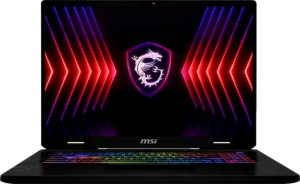
The MSI Crosshair 17 HX D14V is a 17″ gaming laptop built around Intel's Core i7-14650HX processor and paired with an Nvidia GeForce RTX 4070 Laptop GPU. Weighing 2800 g and measuring 383 mm wide by 22 mm thick, it occupies a relatively substantial footprint typical of large-screen gaming machines. The system ships with 32GB of DDR5 RAM running at 5600 MHz and a 1TB NVMe SSD, covering both memory bandwidth and fast storage from the factory. A backlit keyboard is included, while the chassis itself does not use a fanless or weather-sealed design.

The display measures 17″ with a 2560 x 1600 resolution, an IPS panel, and a 240Hz refresh rate, translating to a pixel density of 177 ppi. On the graphics side, the RTX 4070 Laptop GPU is based on the Ada Lovelace architecture, carries 8GB of GDDR6X VRAM across a 128-bit bus, and delivers a floating-point performance figure of 20.04 TFLOPS alongside a texture rate of 313.2 GTexels/s. Connectivity includes one HDMI 2.1 port, one USB 3.2 Gen 2 Type-C port, three USB 3.2 Gen 1 Type-A ports, one RJ45 port, and Wi-Fi 6E with Bluetooth 5.3. The 90 Wh battery rounds out the hardware, and the GPU supports both DLSS and ray tracing.

Pros
  • The 17-inch IPS display runs at 240Hz with a 2560x1600 resolution, making it well-suited for fast-paced gaming at a noticeably sharp pixel density of 177 ppi
  • The GPU delivers 20.04 TFLOPS of floating-point performance and supports both ray tracing and DLSS, covering the two most common real-time rendering enhancement technologies
  • 32GB of DDR5 RAM at 5600 MHz across two slots leaves room for future upgrades up to 96GB, giving the system meaningful longevity
  • Wi-Fi 6E support alongside Bluetooth 5.3 and a dedicated RJ45 port offers flexible and current-generation wired and wireless networking options
  • The HDMI 2.1 output supports up to four simultaneous displays, which is practical for users who want to extend their workspace beyond the built-in screen
  • The 1TB NVMe PCIe 4 SSD uses flash storage for fast data access, and the sleep-and-charge USB ports allow peripheral charging even when the laptop is off
Cons
  • At 2800 g and 22 mm thick, the chassis is bulky enough to make frequent portability genuinely inconvenient
  • The 90 Wh battery, while a reasonable capacity, must support a 115W TDP processor and a high-refresh display, which limits unplugged usability under load
  • There is no anti-reflection coating on the display, which can affect visibility in brightly lit environments
  • The machine includes only a single USB 3.2 Gen 2 port and no Thunderbolt or USB 4 connectivity, limiting high-speed peripheral options
  • No fingerprint scanner or 3D facial recognition is available, so biometric login is not supported
  • There is no external memory card slot, which restricts direct media transfer from cameras or other card-based devices
Who is this for?

This laptop is well-matched to users who spend significant time on gaming at high refresh rates, given the 240Hz IPS display at 2560x1600 resolution paired with a GPU capable of 20.04 TFLOPS, ray tracing, and DLSS support. The 32GB of DDR5 RAM, 1TB NVMe PCIe 4 SSD, and a 16-core CPU with a 5.2GHz turbo clock also make it a capable machine for content creation workflows such as video editing or 3D rendering that benefit from fast memory and strong multi-threaded CPU throughput. Users who work from a fixed desk setup will additionally appreciate the HDMI 2.1 output and support for up to four displays, making it a reasonable choice for extended multi-monitor productivity environments.

Who is this NOT for?

Users who need a laptop they can carry comfortably day-to-day will find the 2800 g weight and 22 mm chassis thickness a persistent inconvenience, as this is a large machine designed more for stationary use. The 115W CPU TDP combined with an active cooling system and a high-refresh display means the 90 Wh battery will deplete quickly under any real workload, making this a poor fit for people who regularly need extended unplugged operation. Additionally, the absence of Thunderbolt, USB 4, and an external memory card slot means users who depend on high-speed external storage, professional capture cards, or direct camera media transfer workflows will find the connectivity options notably restrictive.

Design:

Type Gaming
weight 2800 g
Uses a fanless design
Has a backlit keyboard
volume 2350.854 cm³
width 383 mm
height 279 mm
thickness 22 mm
is weather-sealed (splashproof)

The MSI Crosshair 17 HX D14V is a gaming laptop with a weight of 2800 g and overall dimensions of 383 mm wide, 279 mm tall, and 22 mm thick, giving it a total volume of approximately 2350.854 cm³. It features a backlit keyboard for low-light use, while the chassis does not employ a fanless cooling design, indicating active cooling is used. The laptop is also not weather-sealed, so it offers no splash resistance.

Display:

screen size 17"
resolution 2560 x 1600 px
pixel density 177 ppi
Display type IPS
has a touch screen
refresh rate 240Hz
has anti-reflection coating
supported displays 4

The display is a 17″ IPS panel with a 2560 x 1600 resolution and a pixel density of 177 ppi, offering a fairly detailed image across its large surface. It runs at a 240Hz refresh rate, which benefits fast-paced applications, and the GPU supports up to four simultaneous external displays. The screen does not include touch input or an anti-reflection coating.

Performance:

RAM 32GB
RAM speed 5600 MHz
Uses flash storage
internal storage 1024GB
CPU speed 8 x 2.2 & 8 x 1.6 GHz
CPU threads 24 threads
VRAM 8GB
floating-point performance 20.04 TFLOPS
GDDR version GDDR6X
texture rate 313.2 GTexels/s
pixel rate 104.4 GPixel/s
Is an NVMe SSD
DirectX version DirectX 12 Ultimate
GPU clock speed 1230 MHz
uses multithreading
maximum memory amount 96GB
DDR memory version 5
turbo clock speed 5.2GHz
GPU turbo 2175 MHz
memory slots 2
PCI Express (PCIe) version 4
semiconductor size 4 nm
has XeSS (XMX)
Supports 64-bit

The processor runs sixteen cores — eight at 2.2 GHz and eight at 1.6 GHz — with a turbo ceiling of 5.2 GHz, 24 threads, and multithreading support, built on a 4 nm semiconductor process. System memory stands at 32GB of DDR5 RAM at 5600 MHz across two slots, with a maximum supported capacity of 96GB. Storage is handled by a 1024GB NVMe SSD using flash memory and a PCIe 4 interface. On the graphics side, the GPU carries 8GB of GDDR6X VRAM, a base clock of 1230 MHz boosting to 2175 MHz, and delivers 20.04 TFLOPS of floating-point performance alongside a texture rate of 313.2 GTexels/s and a pixel rate of 104.4 GPixel/s, with DirectX 12 Ultimate support. The system is 64-bit compatible, does not support XeSS, and does not include an unlocked memory multiplier.

Benchmarks:

Geekbench 6 result (multi) 13325
Geekbench 6 result (single) 2443
PassMark (G3D) result 19574
PassMark result 34910
PassMark result (single) 3862

In Geekbench 6, the system scores 2443 in the single-core test and 13325 in the multi-core test, reflecting the processor's threaded throughput. The overall PassMark result comes in at 34910, with a single-core PassMark score of 3862. Graphics performance is measured at 19574 in the PassMark G3D benchmark, representing the GPU's rendering capability under that workload.

Connectivity:

USB 3.2 Gen 2 ports (USB-C) 1
USB 3.2 Gen 2 ports (USB-A) 0
USB 4 20Gbps ports 0
USB 4 40Gbps ports 0
Thunderbolt 4 ports 0
USB 3.2 Gen 1 ports (USB-C) 0
USB 3.2 Gen 1 ports (USB-A) 3
Thunderbolt 3 ports 0
has an HDMI output
Has USB Type-C
supports Wi-Fi
Wi-Fi version Wi-Fi 6E (802.11ax), Wi-Fi 6 (802.11ax), Wi-Fi 5 (802.11ac), Wi-Fi 4 (802.11n)
has an external memory slot
Bluetooth version 5.3
RJ45 ports 1
HDMI ports 1
HDMI version HDMI 2.1
DisplayPort outputs 0
has AirPlay
mini DisplayPort outputs 0
has a VGA connector

Wired connectivity includes one USB 3.2 Gen 2 Type-C port, three USB 3.2 Gen 1 Type-A ports, one RJ45 Ethernet port, and one HDMI 2.1 output; there are no DisplayPort, mini DisplayPort, Thunderbolt, USB 4, or VGA outputs. Wireless options cover Wi-Fi 6E (802.11ax) alongside backwards-compatible Wi-Fi 6, 5, and 4 standards, paired with Bluetooth 5.3. AirPlay is supported, while an external memory card slot is not present.

Battery:

battery size 90 Wh
Has sleep-and-charge USB ports
Has a MagSafe power adapter

The laptop is equipped with a 90 Wh battery and supports sleep-and-charge functionality, allowing connected USB devices to be charged even when the system is powered off or in sleep mode. It does not use a MagSafe power adapter.

Features:

has stereo speakers
has a socket for a 3.5 mm audio jack
supports ray tracing
supports DLSS
has Dolby Atmos
Stylus included
Has a fingerprint scanner
number of microphones 1
Uses 3D facial recognition
has voice commands
has a front camera
Has S/PDIF Out port
has a gyroscope
has GPS
has an accelerometer
has a compass
Has an optical disc drive

Audio output is handled by stereo speakers, and a 3.5 mm headset jack is present alongside a single built-in microphone; Dolby Atmos and S/PDIF output are not included. The laptop has a front camera but lacks a fingerprint scanner, 3D facial recognition, and voice command support. On the graphics feature side, the GPU supports both ray tracing and DLSS, while no gyroscope, accelerometer, compass, or GPS sensors are present, and no stylus or optical disc drive is included.

Miscellaneous:

clock multiplier 22
PassMark (DirectCompute) result 8162
number of transistors 22900 million
has LHR
Thermal Design Power (TDP) 115W
Supports 3D
Supports multi-display technology
OpenCL version 3
OpenGL version 4.6
Supports ECC memory
memory bus width 128-bit
effective memory speed 16000 MHz
maximum memory bandwidth 256 GB/s
render output units (ROPs) 48
texture mapping units (TMUs) 144
shading units 4608
Has Double Precision Floating Point (DPFP)
GPU memory speed 2000 MHz
GPU architecture Ada Lovelace
PassMark result (overclocked) 37537
GPU name UHD Graphics 710
Type Laptop
instruction sets MMX, F16C, FMA3, AES, AVX, AVX2, SSE 4.1, SSE 4.2
L3 cache 30 MB
Has an unlocked multiplier
Has NX bit
CPU temperature 100 °C
GPU execution units 16
Has integrated graphics
memory channels 2
RAM speed (max) 5600 MHz
Uses big.LITTLE technology

The CPU is a laptop-type processor with a clock multiplier of 22, a 115W TDP, a 30 MB L3 cache, and a maximum operating temperature of 100 °C; it uses big.LITTLE technology, supports the NX bit, and includes integrated graphics (UHD Graphics 710) with 16 execution units, but does not have an unlocked multiplier. Supported instruction sets cover MMX, F16C, FMA3, AES, AVX, AVX2, SSE 4.1, and SSE 4.2, and the processor operates across two memory channels with a maximum RAM speed of 5600 MHz, also supporting ECC memory. On the GPU side, the Ada Lovelace architecture brings 4608 shading units, 144 texture mapping units, 48 ROPs, and 22900 million transistors, running GPU memory at 2000 MHz with an effective speed of 16000 MHz across a 128-bit bus for a maximum bandwidth of 256 GB/s; LHR is not present. The GPU supports multi-display output, stereoscopic 3D, and double precision floating point, with API coverage including OpenCL 3 and OpenGL 4.6. The PassMark DirectCompute result is 8162, the overclocked PassMark score reaches 37537, and the system's passmark result in standard operation reflects broad compute capability across both CPU and GPU workloads.
Final Verdict

The MSI Crosshair 17 HX D14V is a large-format gaming laptop built around a coherent set of high-throughput specifications, anchored by a 240Hz QHD display paired with an RTX 4070 GPU supporting ray tracing and DLSS. Its 16-core processor, 32GB of DDR5 RAM, and fast NVMe storage form a well-rounded foundation for both gaming and demanding creative workloads, while multi-display support and Wi-Fi 6E add practical value for desk-based users. The trade-offs — primarily around portability, battery endurance under load, and limited high-speed port variety — are consistent with the machine's clearly stationary orientation. For users who prioritize display quality and rendering capability over mobility, the Crosshair 17 HX D14V delivers a specification set that matches its gaming-focused ambitions without meaningful compromise in its intended use context.