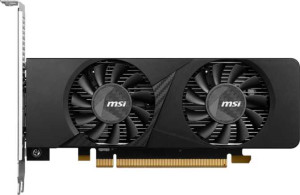
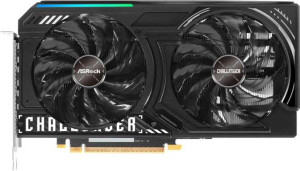
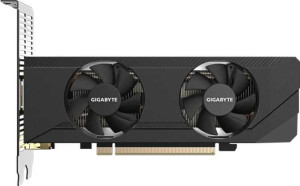
The MSI GeForce RTX 3050 Low Profile OC 6GB operates at a base GPU clock of 1042 MHz, boosting up to 1492 MHz under load, while the GPU memory runs at 1750 MHz. It delivers a floating-point throughput of 6.875 TFLOPS, paired with a pixel rate of 47.74 GPixel/s and a texture rate of 107.4 GTexels/s. The card features 2304 shading units, 72 texture mapping units (TMUs), and 32 render output units (ROPs), providing a well-rounded set of compute resources for its class. Double Precision Floating Point (DPFP) is supported, adding flexibility for workloads that require higher numerical precision.
This card is equipped with 6GB of GDDR6 VRAM, running at an effective memory speed of 14000 MHz across a 96-bit memory bus, which yields a maximum memory bandwidth of 168 GB/s. The 96-bit bus width is a notable constraint at this capacity, though the high effective clock rate helps sustain reasonable throughput. ECC memory support is included, which adds a layer of data integrity protection useful in workloads where memory error correction matters.
The card supports DirectX 12 Ultimate, OpenGL 4.6, and OpenCL 3, covering a broad range of graphics and compute workloads. Ray tracing and DLSS are both supported, as is stereoscopic 3D, while XeSS (XMX) is not available on this card. Multi-display output is supported, with compatibility for up to three simultaneous displays, and Intel Resizable BAR is included to help the CPU access GPU memory more efficiently. LHR (Lite Hash Rate) is not present, and the card does not feature RGB lighting.
The card's output configuration consists of two HDMI 2.1 ports and one DisplayPort, giving a total of three available display connections. There are no DVI outputs, no mini DisplayPort, and no USB-C ports on this card, keeping the bracket layout straightforward within its low-profile form factor.
Built on the Ampere architecture and fabricated on an 8 nm process, the GPU integrates 8700 million transistors within a compact physical footprint of 174 mm wide and 69 mm tall. It connects via PCIe 4 and carries a thermal design power of just 70W, making it well-suited for small-form-factor systems with limited power headroom. Cooling is handled without an air-water hybrid solution, as the card does not include that type of cooling configuration.