MSI GeForce RTX 3050 Ventus 2X 6GB specifications and in-depth review

MSI GeForce RTX 3050 Ventus 2X 6GB

Manufacturer: MSI

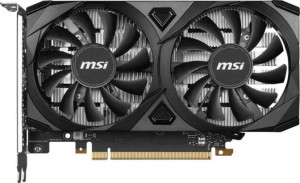
The MSI GeForce RTX 3050 Ventus 2X 6GB is a graphics card that fits into the standard desktop segment of the RTX 3050 lineup, stepping up in physical size from its low-profile sibling with dimensions of 189mm × 109mm. Built on NVIDIA's Ampere architecture using an 8nm fabrication process, it carries a dual-fan cooling setup suggested by its Ventus 2X designation and operates at a base clock of 1042 MHz with a boost up to 1470 MHz. The 70W TDP keeps power requirements manageable for a wide range of system configurations.

The card is equipped with 6GB of GDDR6 VRAM running at an effective 14,000 MHz across a 96-bit bus, providing up to 168 GB/s of memory bandwidth. Its 2,304 shading units, 72 TMUs, and 32 ROPs yield a floating-point throughput of 6.774 TFLOPS and a texture rate of 105.8 GTexels/s. Feature support includes DirectX 12 Ultimate, OpenGL 4.6, OpenCL 3, ray tracing, DLSS, stereoscopic 3D, ECC memory, and Intel Resizable BAR. Display output is handled by two HDMI 2.1 ports and one DisplayPort, allowing up to three monitors to be connected simultaneously.

Pros
  • A 70W TDP keeps power consumption low, making the card compatible with a wide range of system power supplies without requiring high-wattage units
  • The standard 189mm × 109mm form factor fits comfortably in most mid-tower and full-tower cases, avoiding the slot constraints of low-profile designs
  • Ray tracing and DLSS support bring access to modern rendering features within this performance tier
  • Two HDMI 2.1 ports alongside one DisplayPort allow up to three monitors to be connected simultaneously without adapters
  • ECC memory support adds data integrity benefits for users running compute-oriented workloads
  • Intel Resizable BAR support enables the CPU to access GPU memory more broadly, which can benefit certain usage scenarios
Cons
  • The 96-bit memory bus width limits total memory bandwidth headroom, which can become a bottleneck in memory-intensive tasks
  • 6GB of VRAM may prove insufficient for workloads or gaming scenarios that demand larger framebuffers
  • The card relies solely on air cooling with no air-water hybrid option, which may restrict sustained thermal performance under prolonged load
  • XeSS (XMX) is not supported, reducing flexibility for users who may want access to that upscaling technology
  • No RGB lighting is present, which may be a drawback for users building systems with coordinated illumination setups
Who is this for?

The MSI GeForce RTX 3050 Ventus 2X 6GB suits users building standard desktop systems who need a card with a manageable 70W TDP and a conventional form factor that fits comfortably in most mid-tower and full-tower cases. Its support for ray tracing, DLSS, and DirectX 12 Ultimate makes it a reasonable choice for users who want access to modern rendering features without demanding high power delivery from their system. The card also serves light compute and workstation-adjacent workloads reasonably well, given its ECC memory support, DPFP capability, and OpenCL 3 compatibility. Those needing multi-monitor output of up to three displays via HDMI 2.1 and DisplayPort will find the connectivity arrangement practical for productivity-oriented setups.

Who is this NOT for?

Users who regularly work with memory-intensive rendering, simulation, or GPU compute tasks will find the 6GB VRAM and 96-bit memory bus a meaningful constraint, as both limit the framebuffer capacity and sustained memory throughput available for demanding workloads. The card is also a poor fit for those looking to run modern titles at high resolutions with demanding graphics settings, where VRAM requirements and raw throughput both tend to outpace what this configuration can comfortably sustain. Additionally, users who need robust thermal headroom under prolonged continuous load may find the air-only cooling arrangement limiting, since no air-water hybrid option is available to assist with heat dissipation during extended sessions.

Performance:

GPU clock speed 1042 MHz
GPU turbo 1470 MHz
pixel rate 47.04 GPixel/s
floating-point performance 6.774 TFLOPS
texture rate 105.8 GTexels/s
GPU memory speed 1750 MHz
shading units 2304
texture mapping units (TMUs) 72
render output units (ROPs) 32
Has Double Precision Floating Point (DPFP)

The GPU operates at a base clock of 1042 MHz and scales up to a boost of 1470 MHz, with its 2,304 shading units working alongside 72 texture mapping units and 32 render output units to produce a texture rate of 105.8 GTexels/s and a pixel rate of 47.04 GPixel/s. Overall floating-point throughput sits at 6.774 TFLOPS, with GPU memory running at 1750 MHz. Double Precision Floating Point (DPFP) is supported, which extends the card's relevance to certain compute tasks beyond standard graphics rendering.

Memory:

effective memory speed 14000 MHz
maximum memory bandwidth 168 GB/s
VRAM 6GB
GDDR version GDDR6
memory bus width 96-bit
Supports ECC memory

Onboard memory consists of 6GB of GDDR6 VRAM operating at an effective speed of 14,000 MHz through a 96-bit bus, delivering a maximum bandwidth of 168 GB/s. The 96-bit interface is relatively narrow, which naturally constrains total throughput, though the GDDR6 standard helps maintain a reasonable data rate within that limitation. ECC memory support is also present, offering error correction capability that can benefit compute workloads where data accuracy is a priority.

Features:

DirectX version DirectX 12 Ultimate
OpenGL version 4.6
OpenCL version 3
Supports multi-display technology
supports ray tracing
Supports 3D
supports DLSS
has XeSS (XMX)
AMD SAM / Intel Resizable BAR Intel Resizable BAR
has LHR
has RGB lighting
supported displays 3

The card supports DirectX 12 Ultimate, OpenGL 4.6, and OpenCL 3, providing broad compatibility across modern graphics and compute workloads. Ray tracing and DLSS are both enabled, and stereoscopic 3D and multi-display technology are included, with support for up to three simultaneous displays. Intel Resizable BAR is present to facilitate broader CPU access to GPU memory. XeSS (XMX) and LHR are not supported, and the card does not feature RGB lighting.

Ports:

has an HDMI output
HDMI ports 2
HDMI version HDMI 2.1
DisplayPort outputs 1
USB-C ports 0
DVI outputs 0
mini DisplayPort outputs 0

Display connectivity is provided through two HDMI 2.1 ports and one DisplayPort, covering the card's three-display output capability without requiring any adapters for most common monitor setups. There are no USB-C, DVI, or mini DisplayPort outputs on this model, keeping the I/O bracket straightforward and focused on the most widely used connection standards.

General info:

GPU architecture Ampere
Thermal Design Power (TDP) 70W
PCI Express (PCIe) version 4
semiconductor size 8 nm
number of transistors 8700 million
Has air-water cooling
width 189 mm
height 109 mm

The card is based on the Ampere architecture, manufactured on an 8nm process node with 8,700 million transistors, and connects to the host system via a PCIe 4 interface. Its 70W TDP places it in a relatively low power consumption bracket, which suits a broad range of system builds. Physically, it measures 189mm × 109mm, giving it a standard dual-slot footprint suitable for most mid-tower and full-tower cases. Cooling is handled by air alone, as the card does not include an air-water hybrid cooling solution.
Final Verdict

The MSI GeForce RTX 3050 Ventus 2X 6GB is a straightforward graphics card that delivers a well-defined set of capabilities within a conventional desktop form factor. Its combination of modern feature support — including ray tracing, DLSS, and DirectX 12 Ultimate — alongside a 70W TDP and standard 189mm × 109mm footprint makes it a practical fit for system builders who prioritize compatibility and power efficiency over raw throughput. ECC memory and DPFP support add a degree of versatility for light compute use, though the 6GB VRAM and 96-bit bus mean users should remain realistic about its ceiling in more demanding scenarios. For those whose needs align with its design intent, the Ventus 2X 6GB represents a coherent and well-rounded option within its segment.

Popular Comparisons

MSI GeForce RTX 3050 Ventus 2X 6GB
VS
Nvidia GeForce RTX 3050 6GB