MSI GeForce RTX 4070 Super Ventus 2X White specifications and in-depth review

MSI GeForce RTX 4070 Super Ventus 2X White

Manufacturer: MSI

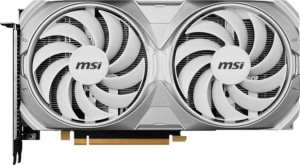
The MSI GeForce RTX 4070 Super Ventus 2X White is a graphics card built on NVIDIA's Ada Lovelace architecture, produced on a 5 nm process with 35,800 million transistors. It adopts a clean, no-frills aesthetic with no RGB lighting, and its compact dimensions of 242 mm in width and 125 mm in height make it one of the more case-friendly options in its class. Cooling relies entirely on air, and the card carries a 220W TDP, keeping power demands at a relatively contained level for this tier.

Performance is driven by 7,168 shading units, 224 texture mapping units, and 80 render output units, delivering a texture rate of 554.4 GTexels/s and 35.48 TFLOPS of floating-point performance at a boost clock of 2475 MHz. Memory consists of 12GB of GDDR6X on a 192-bit bus running at an effective 21,000 MHz, translating to 504.2 GB/s of bandwidth, with ECC memory support also present. Feature coverage includes DirectX 12 Ultimate, OpenGL 4.6, OpenCL 3, ray tracing, DLSS, stereoscopic 3D, and Intel Resizable BAR, while XeSS is not supported. Display connectivity is handled by one HDMI 2.1a port and three DisplayPort outputs, supporting up to four screens over a PCIe 4 interface.

Pros
  • At 242 mm wide and 125 mm tall, the card fits comfortably in a wide range of cases, including more compact builds where larger triple-fan cards would not
  • A 220W TDP keeps power consumption relatively contained for a card delivering 35.48 TFLOPS of floating-point performance
  • Both ray tracing and DLSS are supported, enabling hardware-accelerated rendering and AI-based upscaling within the same card
  • Intel Resizable BAR is included, allowing the CPU to access the full GPU frame buffer for more efficient data throughput
  • ECC memory support adds error detection and correction, extending the card's practical use to compute and precision-sensitive workloads
  • OpenCL 3 and DirectX 12 Ultimate are both supported, covering a broad range of modern graphics and compute API requirements
Cons
  • No RGB lighting is present, which may be a drawback for users building visually coordinated systems
  • Water cooling is not supported, limiting thermal management entirely to the included air cooling solution
  • 12GB of VRAM on a 192-bit bus may feel limiting for users working with very large textures or high-resolution compute datasets
  • XeSS (XMX) is not available, removing one AI-based upscaling option from the feature set
  • No USB-C, DVI, or mini DisplayPort outputs are available, which can restrict compatibility with certain monitors or display adapters
Who is this for?

The MSI GeForce RTX 4070 Super Ventus 2X White is well-suited to users who need a capable graphics card in a physically restrained package, as its 242 mm width and 125 mm height make it compatible with mid-tower and smaller cases where larger cards simply will not fit. The 220W TDP also makes it a practical choice for systems where power delivery is a real consideration, without sacrificing access to ray tracing, DLSS, and DirectX 12 Ultimate support. Users engaged in rendering, content creation, or compute tasks that benefit from ECC memory and OpenCL 3 compatibility will find the feature set well-aligned with those workflows.

Who is this NOT for?

Users who work with very large texture sets or high-resolution assets may find the 12GB VRAM ceiling a limiting factor over time, particularly as scene complexity increases. Those who prefer or require water cooling integration will need to look elsewhere, as this card supports air cooling only and offers no provision for liquid loops. Additionally, users who rely on XeSS upscaling or need USB-C, DVI, or mini DisplayPort connectivity will encounter gaps in this card's feature set that cannot be worked around without additional hardware.

Performance:

GPU clock speed 1980 MHz
GPU turbo 2475 MHz
pixel rate 198 GPixel/s
floating-point performance 35.48 TFLOPS
texture rate 554.4 GTexels/s
GPU memory speed 1313 MHz
shading units 7168
texture mapping units (TMUs) 224
render output units (ROPs) 80
Has Double Precision Floating Point (DPFP)

The GPU runs at a base clock of 1980 MHz and boosts up to 2475 MHz, supported by a memory clock of 1313 MHz. Its 7,168 shading units work alongside 224 texture mapping units and 80 render output units to produce a texture rate of 554.4 GTexels/s and a pixel rate of 198 GPixel/s. Floating-point performance reaches 35.48 TFLOPS, and Double Precision Floating Point (DPFP) is supported, making the card capable of handling workloads that require greater numerical precision.

Memory:

effective memory speed 21000 MHz
maximum memory bandwidth 504.2 GB/s
VRAM 12GB
GDDR version GDDR6X
memory bus width 192-bit
Supports ECC memory

Memory configuration consists of 12GB of GDDR6X running across a 192-bit bus at an effective speed of 21,000 MHz, producing a maximum bandwidth of 504.2 GB/s. ECC memory support is included, which provides error detection and correction for users working in compute or other precision-sensitive environments.

Features:

DirectX version DirectX 12 Ultimate
OpenGL version 4.6
OpenCL version 3
Supports multi-display technology
supports ray tracing
Supports 3D
supports DLSS
has XeSS (XMX)
AMD SAM / Intel Resizable BAR Intel Resizable BAR
has LHR
has RGB lighting
supported displays 4

The card supports DirectX 12 Ultimate, OpenGL 4.6, and OpenCL 3, covering a wide range of graphics and compute APIs. Ray tracing and DLSS are both enabled, and stereoscopic 3D is also supported, while XeSS (XMX) is not available on this model. Multi-display technology is supported for up to four simultaneous outputs, Intel Resizable BAR is included to improve CPU-to-GPU data transfer efficiency, and no LHR restrictions are in place. RGB lighting is not present on this card.

Ports:

has an HDMI output
HDMI ports 1
HDMI version HDMI 2.1a
DisplayPort outputs 3
USB-C ports 0
DVI outputs 0
mini DisplayPort outputs 0

Video output is handled through one HDMI 2.1a port and three DisplayPort outputs, giving a total of four connections for multi-monitor configurations. USB-C, DVI, and mini DisplayPort are not available on this card, so display connectivity is confined to the HDMI and DisplayPort options provided.

General info:

GPU architecture Ada Lovelace
Thermal Design Power (TDP) 220W
PCI Express (PCIe) version 4
semiconductor size 5 nm
number of transistors 35800 million
Has air-water cooling
width 242 mm
height 125 mm

This card is based on the Ada Lovelace architecture, built on a 5 nm process with 35,800 million transistors, and connects to the motherboard via a PCIe 4 interface. Its TDP sits at 220W, and cooling is handled entirely through air — water cooling is not supported. Physically, the card measures 242 mm in width and 125 mm in height, giving it a notably compact footprint for a card in this performance tier.
Final Verdict

The MSI GeForce RTX 4070 Super Ventus 2X White makes a clear case for itself as a compact, power-conscious graphics card that doesn't compromise on feature depth. Its 242 mm by 125 mm footprint combined with a 220W TDP makes it one of the more case- and system-friendly options at this performance level, while full support for ray tracing, DLSS, DirectX 12 Ultimate, and OpenCL 3 ensures it covers the rendering and compute bases that matter most to a wide range of users. The 12GB VRAM and absence of water cooling and XeSS support are worth factoring into the decision for specific use cases, but for users whose needs align with what this card offers — particularly those working within space or power constraints — the MSI GeForce RTX 4070 Super Ventus 2X White stands as a well-rounded and technically capable choice.