MSI GeForce RTX 4070 Super Gaming Slim MLG specifications and in-depth review

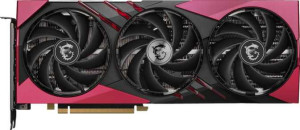
MSI GeForce RTX 4070 Super Gaming Slim MLG

Manufacturer: MSI

The MSI GeForce RTX 4070 Super Gaming Slim MLG is a graphics card that sits within NVIDIA's Ada Lovelace generation, offering a compact form factor at 307 mm in length and 125 mm in height. Built on a 5 nm semiconductor process with 35,800 million transistors, it targets users who need a capable card in a slimmer chassis without sacrificing modern feature support including ray tracing, DLSS, and RGB lighting.

On the technical side, the card operates at a base clock of 1980 MHz with a turbo frequency of 2475 MHz, and delivers 35.48 TFLOPS of floating-point performance alongside a texture rate of 554.4 GTexels/s. Its 12 GB of GDDR6X memory runs across a 192-bit bus at an effective speed of 21,000 MHz, providing up to 504.2 GB/s of memory bandwidth. Display connectivity includes one HDMI 2.1a port and three DisplayPort outputs, supporting up to four monitors simultaneously, while the card carries a rated TDP of 220W and connects via PCIe 4.0.

Pros
  • Supports up to four simultaneous displays through a combination of one HDMI 2.1a and three DisplayPort outputs
  • The slim form factor at 125 mm in height makes it more compatible with compact or space-constrained PC builds
  • ECC memory support adds a layer of data integrity useful in workloads where memory accuracy matters
  • Ray tracing and DLSS are both supported, expanding compatibility with modern rendering features in supported applications
  • Intel Resizable BAR support allows the CPU to access the full VRAM pool at once, which can improve frame delivery in compatible systems
  • RGB lighting is present for users who want visual customization within their build
Cons
  • The 192-bit memory bus width is narrower than what some higher-tier cards in this category offer, which limits memory bandwidth scaling
  • No USB-C output is available, which may be a drawback for users with monitors or devices that rely on that connection type
  • Air-water hybrid cooling is not supported, so users requiring liquid cooling integration will need third-party solutions
  • A TDP of 220W places moderate demands on the system power supply, requiring adequate headroom in the overall build
Who is this for?

This card is well-suited to users running demanding rendering workloads and modern gaming titles that take advantage of ray tracing and DLSS, given the hardware-level support for both features alongside a healthy 35.48 TFLOPS of floating-point throughput. The 12 GB of GDDR6X VRAM combined with ECC memory support also makes it a reasonable fit for content creators and technical compute users who need reliable memory integrity during long processing sessions. Additionally, its slim 125 mm height and four-display output capability make it a practical choice for multi-monitor setups inside compact or mid-tower builds where physical space is a consideration.

Who is this NOT for?

Users who require the highest possible memory bandwidth or bus width for large-scale data-intensive workloads may find the 192-bit bus limiting, as it restricts throughput scaling compared to wider configurations. The absence of a USB-C output makes this card a poor fit for users who depend on USB-C-connected displays or VR headsets that rely on that interface. Similarly, those looking to integrate a liquid cooling or air-water hybrid solution directly into the card will need to look elsewhere, as no such cooling option is supported on this model.

Performance:

GPU clock speed 1980 MHz
GPU turbo 2475 MHz
pixel rate 198 GPixel/s
floating-point performance 35.48 TFLOPS
texture rate 554.4 GTexels/s
GPU memory speed 1313 MHz
shading units 7168
texture mapping units (TMUs) 224
render output units (ROPs) 80
Has Double Precision Floating Point (DPFP)

The Performance section of this card centers on a base GPU clock of 1980 MHz that boosts up to 2475 MHz under load, supporting a floating-point throughput of 35.48 TFLOPS. Rasterization is handled by 7,168 shading units, 224 texture mapping units delivering a texture rate of 554.4 GTexels/s, and 80 render output units contributing to a pixel rate of 198 GPixel/s. GPU memory operates at 1313 MHz, and the card includes support for Double Precision Floating Point (DPFP), broadening its utility beyond standard rendering workloads.

Memory:

effective memory speed 21000 MHz
maximum memory bandwidth 504.2 GB/s
VRAM 12GB
GDDR version GDDR6X
memory bus width 192-bit
Supports ECC memory

The card is equipped with 12 GB of GDDR6X VRAM running across a 192-bit memory bus at an effective speed of 21,000 MHz, resulting in a maximum memory bandwidth of 504.2 GB/s. ECC memory support is also included, which helps detect and correct memory errors during operation.

Features:

DirectX version DirectX 12 Ultimate
OpenGL version 4.6
OpenCL version 3
Supports multi-display technology
supports ray tracing
Supports 3D
supports DLSS
has XeSS (XMX)
AMD SAM / Intel Resizable BAR Intel Resizable BAR
has LHR
has RGB lighting
supported displays 4

This card supports DirectX 12 Ultimate, OpenGL 4.6, and OpenCL 3, covering a broad range of graphics and compute APIs. Ray tracing and DLSS are both supported, alongside stereoscopic 3D and multi-display technology with a maximum of four simultaneous displays. Intel Resizable BAR is enabled for improved data throughput between the CPU and GPU, and RGB lighting is present on the card itself. XeSS (XMX) and LHR are not supported on this model.

Ports:

has an HDMI output
HDMI ports 1
HDMI version HDMI 2.1a
DisplayPort outputs 3
USB-C ports 0
DVI outputs 0
mini DisplayPort outputs 0

The card's output configuration consists of one HDMI 2.1a port and three DisplayPort outputs, providing a total of four available display connections. There are no USB-C, DVI, or mini DisplayPort outputs on this model.

General info:

GPU architecture Ada Lovelace
Thermal Design Power (TDP) 220W
PCI Express (PCIe) version 4
semiconductor size 5 nm
number of transistors 35800 million
Has air-water cooling
width 307 mm
height 125 mm

Built on the Ada Lovelace architecture using a 5 nm manufacturing process, this card packs 35,800 million transistors into dimensions of 307 mm wide and 125 mm tall. It connects via PCIe 4.0 and carries a Thermal Design Power of 220W. Cooling is handled without an air-water hybrid solution, and the card interfaces with the rest of the system exclusively through its PCIe slot at the specified power envelope.
Final Verdict

The MSI GeForce RTX 4070 Super Gaming Slim MLG presents a well-rounded specification profile built around NVIDIA's Ada Lovelace architecture, with its slim form factor and multi-display output capability making it particularly relevant for users who want modern rendering feature support — including ray tracing and DLSS — within a physically compact card. The 12 GB of GDDR6X memory with ECC support adds a degree of versatility that extends its appeal slightly beyond pure gaming into light compute and creative workloads, though those pushing the limits of memory-intensive pipelines will encounter the constraints of its 192-bit bus. Overall, the RTX 4070 Super Gaming Slim MLG is a technically coherent option for users who prioritize a capable, space-conscious card with broad display connectivity and up-to-date API support.