MSI GeForce RTX 4070 Super Gaming Slim White specifications and in-depth review

MSI GeForce RTX 4070 Super Gaming Slim White

Manufacturer: MSI

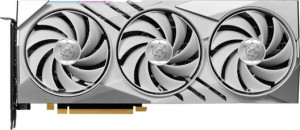
The MSI GeForce RTX 4070 Super Gaming Slim White is a graphics card built on NVIDIA's Ada Lovelace architecture, produced on a 5nm process with 35,800 million transistors. Its slim form factor — measuring 307 mm in width and just 125 mm in height — makes it a practical choice for builds where vertical clearance is a consideration, while the white aesthetic sets it apart visually from more conventional designs.

The card is equipped with 7,168 shading units, 224 texture mapping units, and 80 render output units, operating at a base clock of 1980 MHz and boosting up to 2475 MHz, with a floating-point throughput of 35.48 TFLOPS and a texture rate of 554.4 GTexels/s. It carries 12GB of GDDR6X VRAM on a 192-bit bus at an effective speed of 21,000 MHz, yielding up to 504.2 GB/s of memory bandwidth. ECC memory is supported, as are DirectX 12 Ultimate, OpenGL 4.6, OpenCL 3, ray tracing, DLSS, stereoscopic 3D, and Intel Resizable BAR. Output connectivity covers one HDMI 2.1a port and three DisplayPort outputs, supporting up to four simultaneous displays, with RGB lighting included and a TDP of 220W over PCIe 4.

Pros
  • A height of just 125 mm makes this card physically compatible with a wider range of cases, including builds where vertical clearance is restricted
  • DirectX 12 Ultimate, ray tracing, and DLSS are all supported, covering the key feature requirements of modern gaming and real-time rendering workloads
  • ECC memory support adds data reliability for users running compute-sensitive tasks alongside standard graphics use
  • Intel Resizable BAR is included, enabling the CPU to access the full GPU frame buffer which can improve rendering efficiency
  • No LHR restriction is present, so the card's full compute capacity is available without any imposed limitations
  • RGB lighting is integrated into the design for users who want visual customization within their build
Cons
  • The 192-bit memory bus limits total bandwidth to 504.2 GB/s, which may be a constraint in sustained bandwidth-intensive workloads
  • 12GB of GDDR6X VRAM offers less headroom than higher-capacity alternatives for very high-resolution texture workloads
  • XeSS (XMX) upscaling is not supported, removing that option for users who rely on it in compatible titles
  • Air-water hybrid cooling is absent, restricting thermal management to the air cooling solution alone
  • There are no USB-C, DVI, or mini DisplayPort outputs, which limits compatibility with certain display configurations
Who is this for?

This card is particularly well-suited to users building systems in cases where vertical space is limited, as its 125 mm height allows installation in a broader range of enclosures than taller dual or triple-slot designs typically permit. Support for DirectX 12 Ultimate, ray tracing, and DLSS makes it a practical fit for gamers and creators working with modern rendering pipelines who want a capable feature set in a more compact package. Users who also run light compute workloads alongside gaming will benefit from the included ECC memory support and DPFP capability without needing a dedicated professional card.

Who is this NOT for?

Users who regularly work with very large texture assets or high-resolution rendering workflows may find the 12GB VRAM ceiling limiting over time, particularly as memory demands in modern titles and creative applications continue to grow. The 192-bit memory bus, while adequate for general use, constrains peak bandwidth to 504.2 GB/s, which can become a bottleneck in sustained, bandwidth-intensive compute or rendering scenarios. Additionally, users who depend on XeSS upscaling or need USB-C display connectivity will find neither available here, making this card a less suitable fit for those specific technical requirements.

Performance:

GPU clock speed 1980 MHz
GPU turbo 2475 MHz
pixel rate 198 GPixel/s
floating-point performance 35.48 TFLOPS
texture rate 554.4 GTexels/s
GPU memory speed 1313 MHz
shading units 7168
texture mapping units (TMUs) 224
render output units (ROPs) 80
Has Double Precision Floating Point (DPFP)

The GPU operates at a base clock of 1980 MHz with a turbo frequency of 2475 MHz, supported by 7,168 shading units, 224 texture mapping units, and 80 render output units. These produce a texture rate of 554.4 GTexels/s, a pixel rate of 198 GPixel/s, and a floating-point throughput of 35.48 TFLOPS. GPU memory runs at 1313 MHz, and Double Precision Floating Point (DPFP) is supported, extending the card's usefulness to compute tasks that require 64-bit precision.

Memory:

effective memory speed 21000 MHz
maximum memory bandwidth 504.2 GB/s
VRAM 12GB
GDDR version GDDR6X
memory bus width 192-bit
Supports ECC memory

The card comes with 12GB of GDDR6X VRAM operating at an effective speed of 21,000 MHz across a 192-bit memory bus, resulting in a maximum memory bandwidth of 504.2 GB/s. ECC memory support is included, offering data integrity protection for workloads where memory accuracy is a relevant concern.

Features:

DirectX version DirectX 12 Ultimate
OpenGL version 4.6
OpenCL version 3
Supports multi-display technology
supports ray tracing
Supports 3D
supports DLSS
has XeSS (XMX)
AMD SAM / Intel Resizable BAR Intel Resizable BAR
has LHR
has RGB lighting
supported displays 4

Feature support covers DirectX 12 Ultimate, OpenGL 4.6, and OpenCL 3, alongside ray tracing, DLSS, and stereoscopic 3D, providing a broad foundation for modern gaming and compute applications. XeSS (XMX) is not supported on this model. Multi-display technology is included with support for up to four simultaneous outputs, and Intel Resizable BAR is present to help optimize CPU-to-GPU memory access. The card carries no LHR restriction, and RGB lighting is built into the design.

Ports:

has an HDMI output
HDMI ports 1
HDMI version HDMI 2.1a
DisplayPort outputs 3
USB-C ports 0
DVI outputs 0
mini DisplayPort outputs 0

The card offers one HDMI 2.1a port alongside three DisplayPort outputs, providing four display connections in total. USB-C, DVI, and mini DisplayPort outputs are not available on this model.

General info:

GPU architecture Ada Lovelace
Thermal Design Power (TDP) 220W
PCI Express (PCIe) version 4
semiconductor size 5 nm
number of transistors 35800 million
Has air-water cooling
width 307 mm
height 125 mm

Built on the Ada Lovelace architecture using a 5nm manufacturing process, this card integrates 35,800 million transistors and interfaces with the system via PCIe 4. It carries a thermal design power of 220W and is cooled exclusively by air, with no air-water hybrid cooling option available. The card's physical footprint comes in at 307 mm in width and 125 mm in height, placing it on the slimmer end of the full-size graphics card spectrum.
Final Verdict

The MSI GeForce RTX 4070 Super Gaming Slim White carves out a clear identity through its compact 125 mm height and slim profile, making it one of the more case-friendly options in its class without sacrificing a well-rounded feature set that includes DirectX 12 Ultimate, ray tracing, DLSS, and ECC memory support. The 12GB VRAM capacity and 192-bit bus do place some constraints on the most demanding workloads, and users with specific upscaling or display connectivity requirements should review those limitations carefully — but for builders prioritizing a space-efficient design that still covers the essentials of modern gaming and light compute use, this card presents a coherent and practical package worth serious consideration.