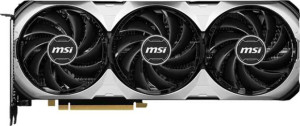
MSI GeForce RTX 4070 Ti Super Ventus 3X OC specifications and in-depth review

MSI GeForce RTX 4070 Ti Super Ventus 3X OC

Manufacturer: MSI

The MSI GeForce RTX 4070 Ti Super Ventus 3X OC is a graphics card from MSI based on NVIDIA's Ada Lovelace architecture, fabricated on a 5 nm process and housing 45,900 million transistors. It ships with a factory overclock, running a base clock of 2340 MHz and a turbo clock of 2640 MHz, and includes RGB lighting for users who want some visual customization in their build.

The card is equipped with 16GB of GDDR6X VRAM at an effective speed of 21000 MHz across a 256-bit memory bus, yielding a maximum bandwidth of 672.3 GB/s. Its 8448 shading units, 264 texture mapping units, and 96 render output units translate to 44.61 TFLOPS of floating-point throughput and a texture rate of 697 GTexels/s. Feature support covers DirectX 12 Ultimate, OpenGL 4.6, OpenCL 3, ray tracing, DLSS, stereoscopic 3D, ECC memory, and Intel Resizable BAR, while XeSS and LHR are absent. Output connectivity consists of one HDMI 2.1a port and three DisplayPort outputs, with no USB-C, DVI, or mini DisplayPort options. The card has a TDP of 285W, uses PCIe 4, and measures 308 mm in width and 120 mm in height.

Pros
  • Ray tracing and DLSS are both supported, enabling hardware-accelerated rendering and upscaling in compatible applications
  • 16GB of GDDR6X VRAM across a 256-bit bus provides substantial memory capacity and bandwidth for demanding workloads
  • ECC memory support adds data integrity protection for compute and workloads sensitive to memory errors
  • Double Precision Floating Point (DPFP) support extends usability to tasks requiring 64-bit numerical precision
  • RGB lighting is included for users who want visual customization as part of their system build
  • Up to four displays can be connected simultaneously, accommodating multi-monitor setups
Cons
  • At 308 mm in length, the card requires a case with sufficient clearance and may not fit in more compact enclosures
  • A 285W TDP demands a capable power supply and well-ventilated build to sustain stable operation
  • Air-water cooling is not supported, limiting options for users who want liquid or hybrid cooling integration
  • No USB-C, DVI, or mini DisplayPort outputs are available, which reduces compatibility with certain monitors and devices
  • XeSS (XMX) is not supported, narrowing the upscaling options available to the user
Who is this for?

This card is well suited to users who regularly work with ray tracing and DLSS-enabled applications, as both are fully supported and can have a meaningful impact on rendering output. The 16GB of GDDR6X VRAM on a 256-bit bus makes it a practical fit for workloads that place heavy demands on memory capacity and throughput, including content creation tasks and compute applications that benefit from ECC memory and Double Precision Floating Point support. Users running multi-monitor setups will also find the four-display output capability useful, and the inclusion of RGB lighting suits those who want some degree of visual customization in their build.

Who is this NOT for?

At 308 mm in length, this card is a poor fit for compact or small form factor builds where internal space is limited, as case clearance becomes a genuine constraint. The 285W TDP also means it is unsuitable for systems with modest power supplies or restricted airflow, since stable operation depends on adequate power delivery and thermal management. Users who require USB-C, DVI, or liquid cooling integration will find the card lacking in those areas, and anyone looking for XeSS upscaling support will need to look elsewhere as it is not available on this model.

Performance:

GPU clock speed 2340 MHz
GPU turbo 2640 MHz
pixel rate 253.4 GPixel/s
floating-point performance 44.61 TFLOPS
texture rate 697 GTexels/s
GPU memory speed 1313 MHz
shading units 8448
texture mapping units (TMUs) 264
render output units (ROPs) 96
Has Double Precision Floating Point (DPFP)

The GPU operates at a base clock of 2340 MHz, boosting up to a turbo clock of 2640 MHz, with memory running at 1313 MHz. The card's 8448 shading units are supported by 264 texture mapping units and 96 render output units, delivering a texture rate of 697 GTexels/s and a pixel rate of 253.4 GPixel/s. Floating-point throughput reaches 44.61 TFLOPS, and Double Precision Floating Point (DPFP) is supported, making the card capable of handling workloads that require full 64-bit precision.

Memory:

effective memory speed 21000 MHz
maximum memory bandwidth 672.3 GB/s
VRAM 16GB
GDDR version GDDR6X
memory bus width 256-bit
Supports ECC memory

The card comes with 16GB of GDDR6X VRAM operating at an effective speed of 21000 MHz over a 256-bit memory bus, resulting in a maximum bandwidth of 672.3 GB/s. ECC memory support is included, providing an added layer of data integrity for workloads where memory accuracy is a priority.

Features:

DirectX version DirectX 12 Ultimate
OpenGL version 4.6
OpenCL version 3
Supports multi-display technology
supports ray tracing
Supports 3D
supports DLSS
has XeSS (XMX)
AMD SAM / Intel Resizable BAR Intel Resizable BAR
has LHR
has RGB lighting
supported displays 4

The card supports DirectX 12 Ultimate, OpenGL 4.6, and OpenCL 3, addressing both graphics and general-purpose compute use cases. Ray tracing and DLSS are both enabled, while XeSS (XMX) is not present. Multi-display technology is supported, allowing up to four monitors to be connected at once, and stereoscopic 3D is also available. Intel Resizable BAR is supported, LHR is not included, and RGB lighting is present on the card.

Ports:

has an HDMI output
HDMI ports 1
HDMI version HDMI 2.1a
DisplayPort outputs 3
USB-C ports 0
DVI outputs 0
mini DisplayPort outputs 0

Output options consist of one HDMI 2.1a port and three DisplayPort outputs, providing a total of four display connections. No USB-C, DVI, or mini DisplayPort outputs are available on this card.

General info:

GPU architecture Ada Lovelace
Thermal Design Power (TDP) 285W
PCI Express (PCIe) version 4
semiconductor size 5 nm
number of transistors 45900 million
Has air-water cooling
width 308 mm
height 120 mm

Built on the Ada Lovelace architecture using a 5 nm process, the card integrates 45,900 million transistors and connects to the system through PCIe 4. It carries a Thermal Design Power of 285W and measures 308 mm in width and 120 mm in height, making it a relatively long card that requires adequate case clearance. Cooling is handled exclusively by air, as air-water cooling is not supported.

Final Verdict

The MSI GeForce RTX 4070 Ti Super Ventus 3X OC is a feature-complete graphics card that covers the needs of users who want capable memory capacity, hardware-accelerated rendering, and compute flexibility in a single package. Its 16GB of GDDR6X VRAM paired with 44.61 TFLOPS of floating-point throughput gives it a strong technical foundation, while support for ray tracing, DLSS, ECC memory, and Double Precision Floating Point rounds out a well-specified feature set. Its 308 mm length and 285W TDP do impose real constraints on compatible build configurations, and the absence of USB-C output and liquid cooling support will matter to some users. For those working in full-size cases with sufficient power headroom, however, the Ventus 3X OC represents a thoroughly capable option that holds up well across both graphics and compute-oriented workloads.

Popular Comparisons

MSI GeForce RTX 4070 Ti Super Ventus 3X OC
VS
MSI GeForce RTX 4070 Ti Super Gaming X Slim
MSI GeForce RTX 4070 Ti Super Ventus 3X OC
VS
Asus ROG Strix GeForce RTX 4070 Ti Super OC Edition
MSI GeForce RTX 4070 Ti Super Ventus 3X OC
VS
Sapphire Pulse Radeon RX 9070