MSI GeForce RTX 4070 Ti Super Gaming Slim White specifications and in-depth review

MSI GeForce RTX 4070 Ti Super Gaming Slim White

Manufacturer: MSI

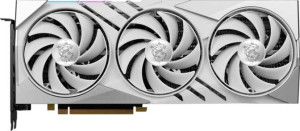
MSI's GeForce RTX 4070 Ti Super Gaming Slim White is a graphics card that combines a compact slim form factor with a white aesthetic and RGB lighting, built around NVIDIA's Ada Lovelace architecture on a 5 nm process node. With 44.1 TFLOPS of floating-point performance and 8,448 shading units, it targets demanding rendering workloads while fitting into a 307 mm x 125 mm physical footprint. The card supports ray tracing, DLSS, and DirectX 12 Ultimate, and includes Intel Resizable BAR support for optimized CPU-to-GPU data throughput.

On the memory side, the card carries 16GB of GDDR6X across a 256-bit bus, delivering a maximum bandwidth of 672.3 GB/s at an effective speed of 21,000 MHz. Display connectivity spans four outputs — three DisplayPort 3 and one HDMI 2.1a port — with no USB-C or DVI options present. The card has a rated TDP of 285W, connects via PCIe 4.0, and houses 45,900 million transistors. It supports up to four simultaneous displays and includes ECC memory support, though it does not feature air-water hybrid cooling.

Pros
  • 16GB of GDDR6X memory with a 672.3 GB/s bandwidth ceiling gives the card substantial headroom for texture-heavy and high-resolution workloads
  • The slim form factor at 125 mm tall keeps the card physically compact, making it easier to fit into cases with tighter vertical clearance
  • Four display outputs — three DisplayPort and one HDMI 2.1a — allow for a wide multi-monitor setup without additional hardware
  • Ray tracing and DLSS support are both present, enabling access to two significant rendering technologies in compatible titles
  • ECC memory support adds data integrity protection, which is useful for workloads where memory errors could cause meaningful problems
  • RGB lighting is built in, which suits builds where interior aesthetics are a consideration
Cons
  • A 285W TDP places a meaningful power draw demand on the system, requiring a capable PSU and good case airflow
  • No USB-C output is available, limiting direct connectivity options for monitors or devices that rely on that interface
  • Air-water hybrid cooling is absent, so thermal management depends entirely on the air cooler, which may be a constraint under sustained heavy loads
  • XeSS (XMX) is not supported, narrowing the upscaling options to DLSS only
  • The single HDMI port means users needing multiple HDMI connections will require adapters or alternative display solutions
Who is this for?

This card is well-matched to users running high-resolution or multi-monitor setups, given its four display outputs and 16GB of GDDR6X memory with 672.3 GB/s of bandwidth. The combination of ray tracing support, DLSS, and 44.1 TFLOPS of compute throughput makes it a solid fit for those working with demanding real-time rendering or GPU-accelerated compute tasks. Its slim 125 mm height also makes it a practical option for system builders working within cases that impose tighter vertical constraints, while the ECC memory support extends its relevance to users with error-sensitive professional workloads.

Who is this NOT for?

Users who need USB-C display output will find this card limiting, as no such port is present, which rules out direct connection to monitors or devices that depend on that interface. The 285W TDP means the card is not a good fit for compact or low-power builds where thermal headroom and PSU capacity are restricted, since it places a substantial demand on the entire system's cooling and power delivery. Additionally, those who rely on or prefer XeSS-based upscaling will find that option unavailable here, as only DLSS is supported among AI-driven upscaling technologies.

Performance:

GPU clock speed 2340 MHz
GPU turbo 2610 MHz
pixel rate 250.6 GPixel/s
floating-point performance 44.1 TFLOPS
texture rate 689 GTexels/s
GPU memory speed 1313 MHz
shading units 8448
texture mapping units (TMUs) 264
render output units (ROPs) 96
Has Double Precision Floating Point (DPFP)

The card runs a base GPU clock of 2340 MHz with a boost speed reaching 2610 MHz, underpinning a floating-point throughput of 44.1 TFLOPS and a texture rate of 689 GTexels/s. Rasterization is handled by 8,448 shading units, 264 texture mapping units, and 96 render output units, contributing to a pixel rate of 250.6 GPixel/s. GPU memory operates at 1313 MHz, and the card includes support for Double Precision Floating Point (DPFP), extending its utility beyond standard rasterization tasks.

Memory:

effective memory speed 21000 MHz
maximum memory bandwidth 672.3 GB/s
VRAM 16GB
GDDR version GDDR6X
memory bus width 256-bit
Supports ECC memory

This card is equipped with 16GB of GDDR6X VRAM running at an effective speed of 21,000 MHz across a 256-bit memory bus, yielding a maximum memory bandwidth of 672.3 GB/s. The wide bus and high-speed memory type work together to sustain substantial data throughput for texture-heavy and high-resolution workloads. ECC memory support is also present, adding a layer of data integrity protection for error-sensitive applications.

Features:

DirectX version DirectX 12 Ultimate
OpenGL version 4.6
OpenCL version 3
Supports multi-display technology
supports ray tracing
Supports 3D
supports DLSS
has XeSS (XMX)
AMD SAM / Intel Resizable BAR Intel Resizable BAR
has LHR
has RGB lighting
supported displays 4

The card supports DirectX 12 Ultimate, OpenGL 4.6, and OpenCL 3, covering a broad range of graphics and compute APIs. Ray tracing and DLSS are both supported, while XeSS (XMX) is not present. Multi-display technology is enabled with support for up to four simultaneous displays, and stereoscopic 3D is also included. Intel Resizable BAR is supported to allow the CPU more flexible access to GPU memory, though LHR is not active on this card. RGB lighting is built in, rounding out the feature set on the hardware side.

Ports:

has an HDMI output
HDMI ports 1
HDMI version HDMI 2.1a
DisplayPort outputs 3
USB-C ports 0
DVI outputs 0
mini DisplayPort outputs 0

The card's output configuration consists of three DisplayPort outputs and a single HDMI 2.1a port, providing four display connections in total. There are no USB-C, DVI, or mini DisplayPort outputs present on this model.

General info:

GPU architecture Ada Lovelace
Thermal Design Power (TDP) 285W
PCI Express (PCIe) version 4
semiconductor size 5 nm
number of transistors 45900 million
Has air-water cooling
width 307 mm
height 125 mm

Built on the Ada Lovelace architecture using a 5 nm manufacturing process, the GPU integrates 45,900 million transistors and connects to the system via PCIe 4.0. It carries a rated TDP of 285W and relies on air cooling, with no air-water hybrid cooling solution included. The card measures 307 mm in width and 125 mm in height, giving a clear picture of its physical footprint for case compatibility planning.
Final Verdict

The MSI GeForce RTX 4070 Ti Super Gaming Slim White brings together a well-rounded specification set built around Ada Lovelace architecture, with its 16GB of GDDR6X memory and 672.3 GB/s bandwidth standing out as particularly capable attributes for high-resolution and multi-display use cases. The slim physical profile and four display outputs add practical versatility, while ray tracing, DLSS, and ECC memory support broaden its appeal across both gaming and compute-oriented workloads. Its 285W TDP and absence of USB-C output do impose real constraints depending on the target system and connectivity requirements, so buyers should weigh those factors carefully against their specific setup. Overall, it is a well-specified card that suits builders who need substantial memory throughput and display flexibility within a compact form factor.