MSI GeForce RTX 4080 Super Gaming X Slim White specifications and in-depth review

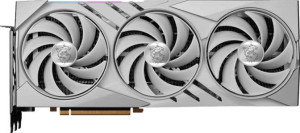
MSI GeForce RTX 4080 Super Gaming X Slim White

Manufacturer: MSI

The MSI GeForce RTX 4080 Super Gaming X Slim White is a graphics card based on NVIDIA's Ada Lovelace architecture, manufactured on a 5 nm process and housing 45,900 million transistors. It operates at a base clock of 2295 MHz, reaching a turbo frequency of 2610 MHz, and carries an RGB lighting setup along with support for up to four simultaneous displays. The card measures 322 mm in length and 136 mm in height, and draws up to 320W as specified by its thermal design power rating.

On the memory side, the card is equipped with 16GB of GDDR6X across a 256-bit bus, delivering an effective memory speed of 23,000 MHz and a peak bandwidth of 736.3 GB/s. Its 10,240 shading units, 320 texture mapping units, and 112 render output units contribute to a texture rate of 835.2 GTexels/s and a floating-point throughput of 53.45 TFLOPS. Feature support includes DirectX 12 Ultimate, OpenGL 4.6, OpenCL 3, ray tracing, DLSS, Intel Resizable BAR, and ECC memory, with connectivity provided through two HDMI 2.1a ports and two DisplayPort outputs.

Pros
  • The 16GB of GDDR6X memory running across a 256-bit bus delivers 736.3 GB/s of bandwidth, giving the card substantial headroom for memory-intensive workloads
  • With 10,240 shading units, 320 texture mapping units, and 112 ROPs, the card offers a dense compute configuration suited to demanding rendering tasks
  • Support for ray tracing and DLSS together allows for more realistic lighting in compatible titles alongside AI-assisted frame generation
  • Up to four displays can be connected simultaneously using the two HDMI 2.1a and two DisplayPort outputs, offering flexible multi-monitor setups
  • ECC memory support adds a layer of error correction that benefits users running precision-sensitive or professional GPU workloads
  • Intel Resizable BAR support allows the CPU broader access to GPU memory, which can reduce data transfer bottlenecks during rendering
Cons
  • A 320W TDP places significant demands on system power delivery and cooling infrastructure, requiring a capable PSU and well-ventilated case
  • At 322 mm in length and 136 mm in height, the card occupies considerable physical space and may not fit in compact or mid-tower enclosures
  • There are no USB-C, DVI, or mini DisplayPort outputs, which limits compatibility with certain monitors or adapters without additional hardware
  • Air-water cooling is not included, meaning users relying on liquid cooling solutions will need to source third-party options separately
  • XeSS (XMX) is not supported, restricting access to that particular upscaling technology for users who may prefer it
Who is this for?

This card is well-suited to users running demanding rendering and compute workloads that benefit from 16GB of GDDR6X memory, high bandwidth, and ECC memory support for error-sensitive tasks. It also fits those building high-output workstations or gaming setups that take advantage of ray tracing, DLSS, and multi-display support across up to four screens simultaneously. The inclusion of Intel Resizable BAR and a dense shader configuration makes it a practical choice for users who need consistent throughput across both graphics and general-purpose GPU tasks.

Who is this NOT for?

Users working within compact or small form factor builds will likely find the 322 mm length and 136 mm height too large to accommodate without significant case constraints. The 320W TDP also makes this card a poor fit for systems with modest power supplies or limited airflow, as it places considerable strain on both the PSU and chassis cooling. Additionally, users whose workflows or display setups depend on USB-C output or liquid cooling integration will find this card lacking in those specific areas.

Performance:

GPU clock speed 2295 MHz
GPU turbo 2610 MHz
pixel rate 292.3 GPixel/s
floating-point performance 53.45 TFLOPS
texture rate 835.2 GTexels/s
GPU memory speed 1438 MHz
shading units 10240
texture mapping units (TMUs) 320
render output units (ROPs) 112
Has Double Precision Floating Point (DPFP)

The GPU operates at a base clock of 2295 MHz, with a turbo frequency of 2610 MHz, supported by 10,240 shading units, 320 texture mapping units, and 112 render output units. These translate into a texture rate of 835.2 GTexels/s, a pixel rate of 292.3 GPixel/s, and a floating-point throughput of 53.45 TFLOPS, reflecting the card's raw computational capacity. The GPU memory runs at 1438 MHz, and the card includes support for Double Precision Floating Point (DPFP), making it capable of handling workloads that require high numerical precision.

Memory:

effective memory speed 23000 MHz
maximum memory bandwidth 736.3 GB/s
VRAM 16GB
GDDR version GDDR6X
memory bus width 256-bit
Supports ECC memory

The card is equipped with 16GB of GDDR6X VRAM running across a 256-bit memory bus, achieving an effective memory speed of 23,000 MHz and a maximum bandwidth of 736.3 GB/s. ECC memory support is also included, which helps detect and correct memory errors during operation, adding a layer of reliability for precision-sensitive workloads.

Features:

DirectX version DirectX 12 Ultimate
OpenGL version 4.6
OpenCL version 3
Supports multi-display technology
supports ray tracing
Supports 3D
supports DLSS
has XeSS (XMX)
AMD SAM / Intel Resizable BAR Intel Resizable BAR
has LHR
has RGB lighting
supported displays 4

The card supports DirectX 12 Ultimate, OpenGL 4.6, and OpenCL 3, covering a broad range of graphics and compute APIs. Ray tracing and DLSS are both supported, alongside stereoscopic 3D and multi-display technology allowing up to four simultaneous outputs. Intel Resizable BAR is included to help the CPU access GPU memory more efficiently, while RGB lighting is present on the card itself. XeSS (XMX) and LHR are not supported, and the card does not feature hardware-limited hash rate functionality.

Ports:

has an HDMI output
HDMI ports 2
HDMI version HDMI 2.1a
DisplayPort outputs 2
USB-C ports 0
DVI outputs 0
mini DisplayPort outputs 0

The card provides four video outputs in total, consisting of two HDMI 2.1a ports and two DisplayPort outputs. There are no USB-C, DVI, or mini DisplayPort connections available on this model.

General info:

GPU architecture Ada Lovelace
Thermal Design Power (TDP) 320W
PCI Express (PCIe) version 4
semiconductor size 5 nm
number of transistors 45900 million
Has air-water cooling
width 322 mm
height 136 mm

Built on the Ada Lovelace architecture and fabricated using a 5 nm process, the GPU integrates 45,900 million transistors and connects via PCIe 4. It carries a Thermal Design Power rating of 320W and does not include an air-water cooling solution. The card measures 322 mm in width and 136 mm in height, giving a clear indication of the physical space it requires within a system.
Final Verdict

The MSI GeForce RTX 4080 Super Gaming X Slim White is a well-specified graphics card that brings together a high shader count, 736.3 GB/s of memory bandwidth from its 16GB GDDR6X configuration, and a broad feature set including ray tracing, DLSS, and ECC memory support — making it a capable option for users with demanding rendering, compute, or multi-display requirements. Its physical footprint and 320W power draw do impose real constraints on system compatibility, so it suits purpose-built, well-provisioned setups rather than compact or power-limited environments. For users whose systems can accommodate it, the card delivers a thorough and technically complete package within the Ada Lovelace generation.

Popular Comparisons

MSI GeForce RTX 4080 Super Gaming X Slim White
VS
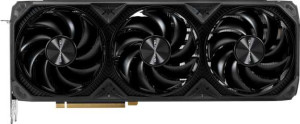
Gainward GeForce RTX 4080 Super Panther OC