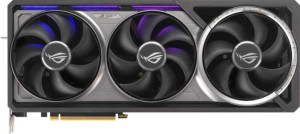
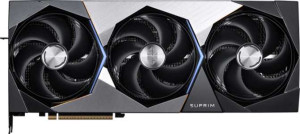
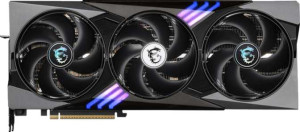
MSI GeForce RTX 5090 Suprim Liquid SOC specifications and in-depth review

MSI GeForce RTX 5090 Suprim Liquid SOC

Manufacturer: MSI

The MSI GeForce RTX 5090 Suprim Liquid SOC is a flagship-tier graphics card from MSI, designed around NVIDIA's Blackwell GPU architecture. It ships with a 5nm semiconductor process, 21,760 shading units, and a liquid cooling solution integrated directly into the card's design. With a base clock of 2017 MHz and a boost frequency reaching 2527 MHz, it targets demanding rendering and compute workloads that require sustained high-frequency operation.

On the memory side, the card carries 32GB of GDDR7 VRAM across a 512-bit bus, delivering a maximum bandwidth of 1790 GB/s at an effective speed of 28,000 MHz. Floating-point throughput is rated at 110 TFLOPS, complemented by a texture rate of 1718 GTexels/s and a pixel rate of 444.8 GPixels/s. Display output consists of one HDMI 2.1b port and three DisplayPort connections, supporting up to four monitors simultaneously. The card includes support for DirectX 12 Ultimate, OpenGL 4.6, OpenCL 3, ray tracing, DLSS, and Intel Resizable BAR, and connects to the host system via a PCIe 5 interface.

Pros
  • The 32GB of GDDR7 VRAM across a 512-bit bus provides substantial memory capacity and bandwidth for memory-intensive workloads
  • Air-water cooling is included, helping manage the thermal demands of a high-TDP card without requiring a separate cooling solution
  • Support for up to four simultaneous display outputs offers flexibility for multi-monitor setups
  • ECC memory support adds a layer of data integrity for workloads sensitive to memory errors
  • DLSS and ray tracing support are both present, enabling access to advanced rendering features
  • Intel Resizable BAR support allows the CPU to access the full GPU memory pool, which can improve data transfer efficiency
Cons
  • A 575W TDP places significant demands on system power delivery and case airflow planning
  • The card measures 280mm wide and 148mm tall, which may not fit in smaller or compact chassis
  • There are no USB-C or DVI outputs, limiting compatibility with older displays or certain peripherals without adapters
  • The absence of XeSS (XMX) support means this upscaling technology is not available as an alternative to DLSS
Who is this for?

This card is well-suited to users running demanding rendering, simulation, or compute workloads that benefit from high floating-point throughput and large VRAM capacity. The 32GB of GDDR7 memory combined with ECC support makes it a practical choice for professional environments where data integrity matters, such as scientific computing or machine learning workflows. Those building high-end multi-monitor workstations will also find the four-display output support and Intel Resizable BAR useful, while the included air-water cooling system suits users who need sustained performance without sourcing a separate thermal solution.

Who is this NOT for?

The 575W TDP makes this card a poor fit for users with compact or small-form-factor builds, where power delivery and airflow are constrained. Its physical dimensions — 280mm wide and 148mm tall — further limit compatibility with tighter chassis. Users who rely on USB-C or DVI display connections will find the port selection restrictive, as neither is available on this model. It is also not a practical choice for anyone whose workflow depends on XeSS upscaling, since that technology is not supported here.

Performance:

GPU clock speed 2017 MHz
GPU turbo 2527 MHz
pixel rate 444.8 GPixel/s
floating-point performance 110 TFLOPS
texture rate 1718 GTexels/s
GPU memory speed 1750 MHz
shading units 21760
texture mapping units (TMUs) 680
render output units (ROPs) 176
Has Double Precision Floating Point (DPFP)

The MSI GeForce RTX 5090 Suprim Liquid SOC operates at a base GPU clock of 2017 MHz, rising to 2527 MHz in turbo mode, while the GPU memory runs at 1750 MHz. With 21,760 shading units, 680 texture mapping units, and 176 render output units, the card delivers a floating-point throughput of 110 TFLOPS, a texture rate of 1718 GTexels/s, and a pixel fill rate of 444.8 GPixels/s. Double Precision Floating Point (DPFP) is supported, extending its suitability to workloads that depend on high-accuracy numerical computation.

Memory:

effective memory speed 28000 MHz
maximum memory bandwidth 1790 GB/s
VRAM 32GB
GDDR version GDDR7
memory bus width 512-bit
Supports ECC memory

The card is equipped with 32GB of GDDR7 VRAM running across a 512-bit memory bus, achieving an effective memory speed of 28,000 MHz and a maximum bandwidth of 1790 GB/s. ECC memory is supported, which helps detect and correct data errors during operation — a useful characteristic for workloads where memory integrity is a priority.

Features:

DirectX version DirectX 12 Ultimate
OpenGL version 4.6
OpenCL version 3
Supports multi-display technology
supports ray tracing
Supports 3D
supports DLSS
has XeSS (XMX)
AMD SAM / Intel Resizable BAR Intel Resizable BAR
has LHR
has RGB lighting
supported displays 4

The card supports DirectX 12 Ultimate, OpenGL 4.6, and OpenCL 3, covering a broad range of graphics and compute API requirements. Ray tracing and DLSS are both supported, alongside stereoscopic 3D and multi-display technology for up to four simultaneous outputs. Intel Resizable BAR is included to allow the CPU broader access to GPU memory, while LHR and XeSS (XMX) are not present on this card. RGB lighting is built in, rounding out the feature set on the hardware side.

Ports:

has an HDMI output
HDMI ports 1
HDMI version HDMI 2.1b
DisplayPort outputs 3
USB-C ports 0
DVI outputs 0
mini DisplayPort outputs 0

The card's output configuration consists of one HDMI 2.1b port and three DisplayPort outputs, providing a total of four display connections. There are no USB-C, DVI, or mini DisplayPort outputs on this model.

General info:

GPU architecture Blackwell
Thermal Design Power (TDP) 575W
PCI Express (PCIe) version 5
semiconductor size 5 nm
number of transistors 92200 million
Has air-water cooling
width 280 mm
height 148 mm

Built on the Blackwell architecture using a 5nm semiconductor process, the GPU integrates 92,200 million transistors and connects to the host system via PCIe 5. It carries a Thermal Design Power of 575W and is cooled through an air-water cooling solution. The card measures 280mm in width and 148mm in height, and operates over a PCIe 5 interface.
Final Verdict

The MSI GeForce RTX 5090 Suprim Liquid SOC is a specification-dense graphics card built around NVIDIA's Blackwell architecture, designed for users whose workloads push well beyond what mid-range or mainstream hardware can accommodate. Its 32GB of GDDR7 VRAM with 1790 GB/s of memory bandwidth stands out as the defining characteristic of this card, making it particularly relevant for high-resolution rendering, compute-intensive tasks, and professional environments where memory capacity and data integrity are non-negotiable. The integrated air-water cooling and four-display output support add genuine practical value, though the 575W power requirement and large physical footprint mean it demands a system built to accommodate it. For users whose requirements align with what this card offers, it represents a well-specified option within the upper end of the graphics card category.

Popular Comparisons

MSI GeForce RTX 5090 Suprim Liquid SOC
VS
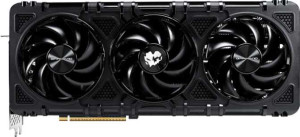
Gigabyte GeForce RTX 5090 Gaming OC
MSI GeForce RTX 5090 Suprim Liquid SOC
VS
Gainward GeForce RTX 5090 Phantom GS
MSI GeForce RTX 5090 Suprim Liquid SOC
VS
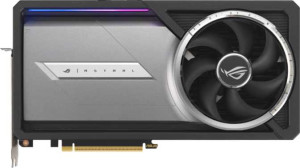
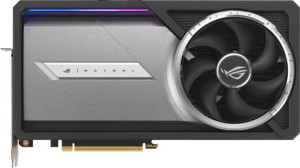
Asus ROG Astral LC GeForce RTX 5090
MSI GeForce RTX 5090 Suprim Liquid SOC
VS
Asus ROG Astral LC GeForce RTX 5090 OC Edition
MSI GeForce RTX 5090 Suprim Liquid SOC
VS
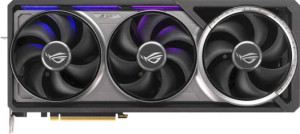
Asus ROG Astral GeForce RTX 5090 OC Edition
MSI GeForce RTX 5090 Suprim Liquid SOC
VS
Asus ROG Astral GeForce RTX 5090
MSI GeForce RTX 5090 Suprim Liquid SOC
VS
MSI GeForce RTX 5090 Suprim SOC
MSI GeForce RTX 5090 Suprim Liquid SOC
VS
MSI GeForce RTX 5090 Vanguard SOC