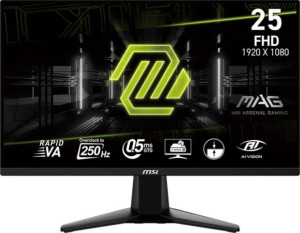
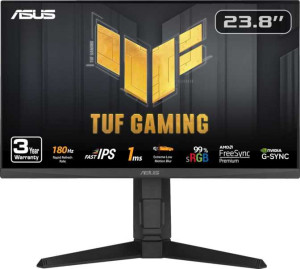
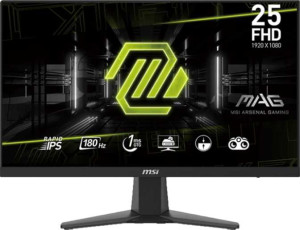
The display is built on a VA panel measuring 24.5 inches, delivering a resolution of 1920 x 1080 pixels at a pixel density of 89 ppi. It runs at a 250Hz refresh rate with a 0.5ms response time, and supports VESA Adaptive Sync for smoother frame delivery. Both horizontal and vertical viewing angles reach 178 degrees, and an anti-glare coating is applied to reduce reflections. The panel is not classified as matte or glossy, and does not support touch input.
Classified as a gaming monitor, this display measures 557mm wide, 326mm tall, and 66mm thick, with a weight of 3240g and a total volume of 11984.412 cm³. The stand supports tilt adjustment, and the monitor is compatible with VESA mounting, allowing it to be used with third-party arms or wall brackets. However, it does not include a swivel stand and does not support portrait mode orientation.
The display supports 10-bit color depth with a total of 1070 million colors, a typical brightness of 250 nits, and a contrast ratio of 3000:1, which is a characteristic strength of VA panel technology. Color space coverage stands at 100% sRGB and 82% Adobe RGB, providing a reasonably wide gamut for a gaming-oriented display. Color calibration is not supported, meaning out-of-box color accuracy cannot be adjusted through a built-in calibration process.
Video input options consist of two HDMI 2.0b ports and one DisplayPort output, covering the most common connection types for desktop and console use. A 3.5mm audio jack is also present for headset or speaker connectivity. The monitor includes no USB ports of any kind, and does not support USB Type-C, DVI, VGA, or mini DisplayPort. On the wireless and networking side, there is no support for Wi-Fi, Ethernet, Thunderbolt, or AirPlay.
The monitor draws 18W during normal operation and drops to 0.5W in standby mode, reflecting a modest power footprint across both active and idle states.
The MSI MAG 255XFV does not include stereo speakers or any audio processing features, with no support for Dolby Digital, Dolby Digital Plus, or DTS Surround. It also lacks Picture-in-Picture functionality, a remote control, an ambient light sensor, a front camera, and built-in smart TV capabilities, keeping the feature set focused purely on display output without supplementary multimedia additions.