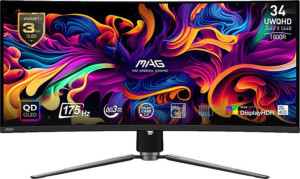
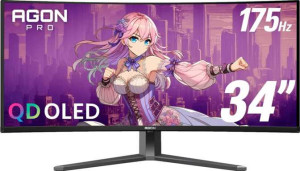
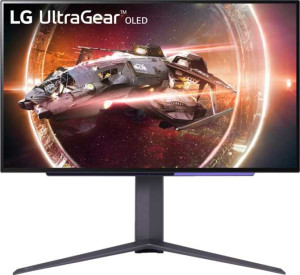
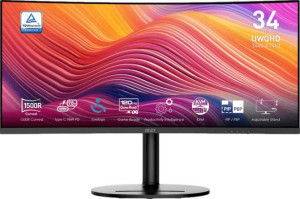
The display uses an OLED/AMOLED panel at a 34-inch screen size, delivering a resolution of 3440 x 1440 px at a pixel density of 109 ppi. A 175Hz refresh rate combined with a 0.03ms response time makes it well-suited for fast-moving content, and AMD FreeSync Premium Pro adaptive sync is supported to help reduce screen tearing. Both horizontal and vertical viewing angles reach 178 degrees, and an anti-glare coating is present to manage reflections. The panel is neither matte nor glossy in the traditional classification sense, and it does not support touch input.
Classified as an ultrawide gaming monitor, the MSI MAG 341CQP QD-OLED measures 812 mm wide, 361 mm tall, and 130 mm deep, with a total weight of 8,800 g. The stand offers tilt and swivel adjustment, providing a reasonable degree of positional flexibility, and the monitor is compatible with VESA mounting for users who prefer a third-party arm or wall mount. Portrait mode is not supported, so the panel is fixed to landscape orientation only.
The panel renders 1.07 billion colors at a 10-bit depth, backed by a contrast ratio of 1000:1 and a typical brightness of 250 nits. Color space coverage is broad, with 97.8% Adobe RGB and 139.1% sRGB figures indicating a wide gamut output that extends well beyond the standard sRGB range. Factory color calibration is not supported, so any calibration would need to be performed independently by the user.
Video input options consist of two HDMI 2.1 ports and one DisplayPort 1.4 output, covering the most commonly used modern connection standards while omitting DVI, VGA, and mini DisplayPort entirely. A USB Type-C port is included alongside four USB 2.0 ports, making it straightforward to connect peripherals directly through the monitor. A 3.5mm headset jack is also present for audio output. The monitor does not support Thunderbolt, Ethernet, Wi-Fi, or AirPlay, so all connectivity is limited to its wired physical ports.
The MSI MAG 341CQP QD-OLED is stripped back in terms of supplementary features. It includes no built-in speakers, no Dolby Digital or DTS Surround audio support, and no remote control, meaning audio and input management rely entirely on external devices. There is no Picture-in-Picture functionality, no ambient light sensor, no front camera, and no built-in smart TV platform, keeping the monitor focused purely on its role as a display output device.
The stand provides a height adjustment range of 10 cm, allowing the display to be raised or lowered to suit different seating positions and desk setups.