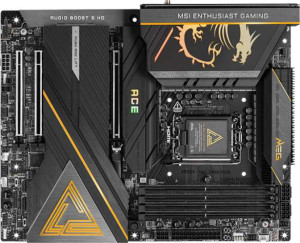
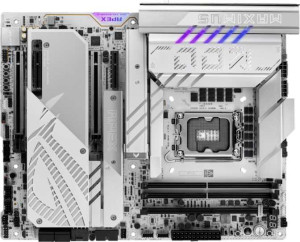
MSI MEG Z890 Unify-X specifications and in-depth review

MSI MEG Z890 Unify-X

Manufacturer: MSI

The MSI MEG Z890 Unify-X is a full-size ATX motherboard built around the Z890 chipset and the LGA 1851 socket, targeting users who need a well-connected platform with broad expansion options. It ships with onboard Wi-Fi 7 and Bluetooth 5.4, and includes RGB lighting alongside a clear CMOS button for straightforward BIOS resets. The board carries a three-year warranty and supports easy overclocking without requiring manual voltage adjustments.

On the connectivity side, the rear panel provides eight USB 3.2 Gen 2 Type-A ports, two USB 3.2 Gen 2 Type-C ports, two USB 4 40Gbps ports, and two Thunderbolt 4 ports, complemented by a pair of PS/2 connectors and a single RJ45 jack. Internally, six M.2 sockets and six SATA 3 connectors offer substantial storage flexibility, with RAID 0, 1, 5, and 10 all supported. The board accommodates two PCIe 5.0 x16 slots and one PCIe 4.0 x16 slot for graphics and add-in cards, while the audio subsystem delivers a 120 dB signal-to-noise ratio with 7.1-channel output and S/PDIF. DDR5 memory is supported across two slots with a maximum capacity of 128 GB and an overclocked speed ceiling of 9600 MHz.

Pros
  • Supports Wi-Fi 7 alongside all previous Wi-Fi generations down to Wi-Fi 4, covering the full range of current wireless standards
  • Six M.2 sockets provide extensive high-speed storage expansion without relying on SATA slots
  • Two PCIe 5.0 x16 slots allow for current-generation graphics and add-in card installations
  • Eight USB 3.2 Gen 2 Type-A ports on the rear panel offer broad high-speed peripheral connectivity
  • DDR5 memory can be overclocked up to 9600 MHz, with a ceiling of 128 GB across two slots
  • RAID 0, 1, 5, and 10 support gives meaningful flexibility in storage configuration
Cons
  • Only two memory slots limit upgrade flexibility and require high-capacity modules to reach the 128 GB maximum
  • No dual BIOS means there is no built-in fallback if a firmware update causes issues
  • The absence of any onboard display output makes the board entirely dependent on a discrete GPU
  • ECC memory is not supported, ruling out use cases that require error-correcting RAM
  • Only two analog audio connectors on the rear panel may be limiting for users with multi-jack audio setups
Who is this for?

This board is well matched to users building high-end desktop systems around current Intel hardware, particularly those who need extensive storage expansion through six M.2 sockets and six SATA 3 connectors alongside full RAID support. The dual PCIe 5.0 x16 slots and broad USB connectivity — including Thunderbolt 4 and USB 4 40Gbps — make it a strong fit for content creators and power users who rely on fast peripheral throughput and multi-device workflows. The inclusion of Wi-Fi 7 and Bluetooth 5.4 also suits those who prefer a cable-free networking setup without adding separate adapters.

Who is this NOT for?

Users who require ECC memory support for workstation-grade reliability — such as those running data-sensitive applications or light server tasks — will find this board unsuitable, as that capability is absent. The two-slot memory configuration also makes it a poor fit for builders who prefer four-module setups for easier incremental upgrades or those who want to maximize channel redundancy. Additionally, anyone needing onboard display output for integrated graphics use will find no such option here, as there are no HDMI, DisplayPort, DVI, or VGA outputs available.

General info:

CPU socket LGA 1851
chipset Z890
form factor ATX
supports Wi-Fi
Wi-Fi version Wi-Fi 4 (802.11n), Wi-Fi 5 (802.11ac), Wi-Fi 6 (802.11ax), Wi-Fi 6E (802.11ax), Wi-Fi 7 (802.11be)
Has Bluetooth
Bluetooth version 5.4
Easy to overclock
has RGB lighting
Easy to reset BIOS
Has dual BIOS
has aptX
CPU sockets 1
Has integrated graphics
warranty period 3 years
height 243.8 mm
width 304.8 mm
Has integrated CPU

The MSI MEG Z890 Unify-X uses the LGA 1851 socket and is compatible with the Z890 chipset, housed in a standard ATX form factor measuring 304.8 mm wide by 243.8 mm tall with a single CPU socket. It supports a broad range of wireless standards through its built-in Wi-Fi, spanning Wi-Fi 4 through Wi-Fi 7 (802.11be), and pairs this with Bluetooth 5.4, though aptX is not included. The board features RGB lighting and allows for easy overclocking as well as straightforward BIOS resets via a clear CMOS function, while dual BIOS is not present. There is no integrated CPU or integrated graphics on this board, and it does not support aptX audio over Bluetooth. MSI backs the board with a 3-year warranty.

Memory:

maximum memory amount 128GB
RAM speed (max) 4800 MHz
overclocked RAM speed 9600 MHz
memory slots 2
DDR memory version 5
memory channels 2
Supports ECC memory

The board supports DDR5 memory across two slots in a dual-channel configuration, with a maximum capacity of 128 GB. The native RAM speed tops out at 4800 MHz, while overclocking can push that figure up to 9600 MHz. ECC memory is not supported.

Ports:

USB 3.2 Gen 2 ports (USB-A) 8
USB 3.2 Gen 1 ports (USB-A) 0
USB 3.2 Gen 2 ports (USB-C) 2
USB 3.2 Gen 1 ports (USB-C) 0
USB 2.0 ports 0
USB 3.2 Gen 2x2 ports 0
USB 4 40Gbps ports 2
USB 4 20Gbps ports 0
Thunderbolt 4 ports 2
Thunderbolt 3 ports 0
has an HDMI output
DisplayPort outputs 0
RJ45 ports 1
Has USB Type-C
eSATA ports 0
DVI outputs 0
has a VGA connector
PS/2 ports 2

The rear I/O panel offers a substantial USB lineup, led by eight USB 3.2 Gen 2 Type-A ports alongside two USB 3.2 Gen 2 Type-C ports, while USB 3.2 Gen 1, USB 2.0, and USB 3.2 Gen 2x2 ports are absent. High-bandwidth connectivity is further covered by two USB 4 40Gbps ports and two Thunderbolt 4 ports, with no Thunderbolt 3 or USB 4 20Gbps ports present. A single RJ45 port handles wired networking, and two PS/2 ports are included for legacy peripherals. There are no display outputs of any kind — HDMI, DisplayPort, DVI, and VGA are all absent — and there are no eSATA ports.

Connectors:

USB 3.2 Gen 1 ports (through expansion) 4
USB 2.0 ports (through expansion) 4
SATA 3 connectors 6
fan headers 7
USB 3.0 ports (through expansion) 4
M.2 sockets 6
Has TPM connector
U.2 sockets 0
Has mSATA connector
SATA 2 connectors 0

Internal storage connectivity is well covered, with six M.2 sockets and six SATA 3 connectors available, while SATA 2, U.2, and mSATA are not present. USB expansion headers include four USB 3.2 Gen 1 ports, four USB 3.0 ports, and four USB 2.0 ports through internal connectors. The board provides seven fan headers for cooling management and includes a TPM connector for security module support.

Expansion slots:

PCIe 4.0 x16 slots 1
PCIe 5.0 x16 slots 2
PCIe 3.0 x16 slots 0
PCIe x1 slots 1
PCI slots 0
PCIe 2.0 x16 slots 0
PCIe x4 slots 0
PCIe x8 slots 0

The board features two PCIe 5.0 x16 slots for high-bandwidth add-in cards, complemented by one PCIe 4.0 x16 slot and a single PCIe x1 slot. Older slot types — including PCIe 3.0 x16, PCIe 2.0 x16, PCIe x4, PCIe x8, and legacy PCI — are not present.

Audio:

Signal-to-Noise ratio (DAC) 120 dB
audio channels 7.1
Has S/PDIF Out port
audio connectors 2

The onboard audio supports 7.1-channel output and delivers a 120 dB signal-to-noise ratio from the DAC, indicating a clean audio signal. Two analog audio connectors are available on the board, and a S/PDIF Out port is included for digital audio output.

Storage:

Supports RAID 1
Supports RAID 10 (1+0)
Supports RAID 5
Supports RAID 0
Supports RAID 0+1

The board supports RAID 0, 1, 5, and 10 configurations, offering a range of options for balancing performance and redundancy across connected storage drives. RAID 0+1 is not supported.

Final Verdict

The MSI MEG Z890 Unify-X is a capable ATX motherboard built around the LGA 1851 socket and Z890 chipset, designed to serve users who demand broad connectivity and substantial storage flexibility. Its six M.2 sockets paired with dual PCIe 5.0 x16 slots reflect a clear focus on high-throughput workloads, while the inclusion of Wi-Fi 7, Thunderbolt 4, and USB 4 40Gbps rounds out a rear I/O that covers virtually all current peripheral and networking needs. The absence of ECC support and the two-slot memory layout do place some limits on its versatility, but for power users and content creators building a demanding single-CPU desktop system, this board delivers a well-specified and feature-rich platform.

Popular Comparisons

MSI MEG Z890 Unify-X
VS
Gigabyte Z890 Aorus Tachyon Ice
MSI MEG Z890 Unify-X
VS
MSI MEG Z890 Ace
MSI MEG Z890 Ace
MSI MEG Z890 Unify-X
VS
Asus ROG Maximus Z890 Apex
MSI MEG Z890 Unify-X
VS
Asus ROG Maximus Z890 Hero
MSI MEG Z890 Unify-X
VS
Gigabyte Z890 Aorus Master