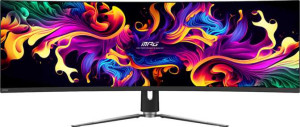
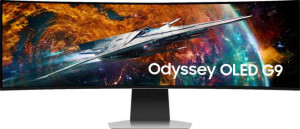
The panel uses QD-OLED technology across a 49-inch screen, resolving content at 5120 x 1440 px with a pixel density of 108 ppi. A refresh rate of 144Hz is paired with a 0.03ms response time, and VESA Adaptive Sync support is included to help maintain consistent frame delivery. Both horizontal and vertical viewing angles extend to 178 degrees, and an anti-glare coating is applied to the display surface. The panel is classified as neither matte nor glossy, and touch input is not supported.
Classified as an ultrawide, gaming, and curved monitor, the MSI MPG 491CQP QD-OLED has a substantial physical footprint, measuring 1195 mm wide, 372 mm tall, and 190 mm deep, with a total weight of 10,300 g. The stand supports both tilt and swivel movement, and VESA mounting is available for users who prefer to use a monitor arm or wall bracket. Portrait mode is not supported, so the display is fixed to landscape orientation only.
The display renders 1.07 billion colors at a 10-bit depth, with a typical brightness of 250 nits and a contrast ratio of 1,500,000:1 — a figure that reflects the deep black levels characteristic of OLED-based panels. Factory color calibration is not supported, meaning any calibration workflow would need to be handled independently by the user.
Video input is handled through two HDMI 2.1 ports and one DisplayPort output, covering the primary modern connection standards while omitting DVI, VGA, mini DisplayPort, and USB Type-C video input entirely. Three USB ports are available for peripheral connectivity, and a 3.5mm headset jack is included for audio output. The monitor does not support Thunderbolt, Ethernet, Wi-Fi, or AirPlay, so all connections are limited to its onboard wired ports.
The MSI MPG 491CQP QD-OLED carries no supplementary features in this category. It has no built-in speakers and no support for Dolby Digital, Dolby Digital Plus, or DTS Surround, so audio relies entirely on external devices. There is no Picture-in-Picture functionality, no remote control, no ambient light sensor, no front camera, and no built-in smart TV platform, keeping the unit strictly focused on its role as a display.
The stand offers a height adjustment range of 10 cm, allowing the display to be raised or lowered to better suit different desk heights and seating positions.