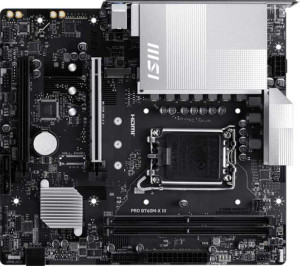
The MSI Pro B760M-X III is built around the LGA 1700 socket and is compatible with the B760 chipset, housed in a Micro-ATX form factor measuring 220 x 243.8 mm. It accommodates a single CPU and does not include an integrated CPU or integrated graphics, meaning a discrete GPU is required for display output — though it does offer an HDMI 2.1 port. The board includes RGB lighting and carries a 3-year warranty, while features such as Wi-Fi, Bluetooth, dual BIOS, easy CMOS reset, and overclocking support are not present.
This board supports DDR5 memory across two slots in a dual-channel configuration, with a maximum capacity of 128 GB. The standard rated speed tops out at 5600 MHz, while overclocked profiles can reach up to 8000 MHz. ECC memory is not supported.
The rear I/O panel provides four USB 3.2 Gen 1 Type-A ports alongside four USB 2.0 ports, while USB Type-C, USB 3.2 Gen 2, USB 4, Thunderbolt 3, and Thunderbolt 4 are all absent. Display output is covered by one HDMI port and one DisplayPort output, with no DVI or VGA connectivity present. Networking is handled by a single RJ45 port, and there are no eSATA or PS/2 ports on this board.
For internal connectivity, the board offers two USB 3.2 Gen 1 headers and four USB 2.0 headers for front-panel expansion, while USB 3.2 Gen 2, Gen 2x2, and USB-C Gen 2 expansion headers are not included. Storage is served by four SATA 3 connectors and a single M.2 socket, with no SATA 2, mSATA, or U.2 sockets present. Cooling is managed through three fan headers, and a TPM connector is also available on the board.
The board provides two full-length PCIe slots: one PCIe 5.0 x16 and one PCIe 4.0 x16, covering the primary expansion needs for discrete graphics and other high-bandwidth cards. There are no PCIe 3.0, 2.0, x8, x4, or x1 slots, and no legacy PCI slots are present.
The board supports 7.1-channel audio output through three analog audio connectors on the rear panel. A S/PDIF Out port is not included.
The board supports RAID 0, 1, 5, and 10 configurations, offering a reasonable spread of options for both performance and redundancy setups. RAID 0+1 is not supported.