MSI Pro X870E-S Evo Wi-Fi specifications and in-depth review

MSI Pro X870E-S Evo Wi-Fi

Manufacturer: MSI

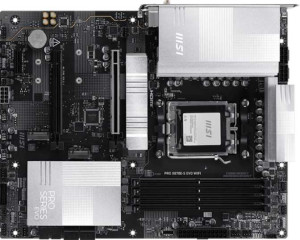
The MSI Pro X870E-S Evo Wi-Fi is an ATX-form-factor motherboard built around the AMD AM5 socket and X870 chipset, targeting users who need a capable platform for current-generation Ryzen processors. It ships with Wi-Fi 7 (802.11be) and Bluetooth 5.4 integrated, alongside a dual BIOS design that simplifies recovery from failed firmware updates. RGB lighting and a dedicated clear-CMOS mechanism round out the usability-oriented features on the board.

On the memory side, the board provides four DDR5 slots across two channels, supporting speeds up to 5600 MHz natively and up to 8200 MHz with overclocking, with a maximum capacity of 256 GB. Storage connectivity includes three M.2 sockets, four SATA 3 connectors, and full RAID 0, 1, 5, and 10 support. The rear I/O includes a USB 4 40 Gbps port, a Thunderbolt 4 port, two USB 3.2 Gen 2 Type-A ports, four USB 2.0 ports, an HDMI 2.1 output, and a single RJ45 network jack, while expansion is handled by one PCIe 5.0 x16 slot alongside a PCIe x4 and a PCIe x1 slot.

Pros
  • Dual BIOS adds a useful safety net when a firmware update goes wrong, reducing the risk of a bricked board
  • Wi-Fi 7 support covers every major wireless generation from 802.11n through 802.11be, ensuring long-term wireless compatibility
  • A USB 4 40Gbps port and a Thunderbolt 4 port on the rear I/O provide high-bandwidth options for fast external devices and displays
  • DDR5 memory can be overclocked up to 8200 MHz across four slots, with a generous 256 GB ceiling
  • Eight fan headers give significant flexibility when building systems with multiple cooling components
  • RAID 0, 1, 5, and 10 support accommodates a variety of storage redundancy and performance configurations
Cons
  • No USB 3.2 Gen 2 or Gen 2x2 internal headers limit high-speed front-panel USB options for compatible cases
  • ECC memory is not supported, ruling out the board for workloads that require error-correcting RAM
  • No S/PDIF Out port means digital audio passthrough to external receivers is unavailable
  • Only three M.2 sockets may feel limiting for builds that rely heavily on NVMe storage expansion
  • No DisplayPort output on the rear I/O restricts video connectivity to HDMI alone
Who is this for?

This board is well-matched for enthusiast desktop builders targeting AMD's AM5 platform who want room to grow — particularly those planning to push memory performance, given DDR5 support with overclocking headroom up to 8200 MHz and a 256 GB capacity ceiling. The inclusion of a PCIe 5.0 x16 slot, USB 4 40Gbps, and Thunderbolt 4 makes it a strong fit for users working with high-bandwidth peripherals or fast external storage. The dual BIOS, clear-CMOS button, and broad RAID support also make it practical for users who tinker with firmware or run multi-drive storage configurations requiring redundancy or striping.

Who is this NOT for?

Users who require ECC memory support for error-sensitive workloads such as scientific computing or financial data processing will find this board unsuitable, as that capability is absent. Similarly, those building compact systems will be constrained by the full ATX form factor. The lack of a S/PDIF Out port makes it a poor fit for home theater PC setups that rely on digital optical audio passthrough to AV receivers, and the single HDMI video output with no DisplayPort limits flexibility for users who need multi-monitor video connectivity directly from the board's rear I/O.

General info:

CPU socket AM5
chipset X870
form factor ATX
release date December 2025
supports Wi-Fi
Wi-Fi version Wi-Fi 4 (802.11n), Wi-Fi 5 (802.11ac), Wi-Fi 6 (802.11ax), Wi-Fi 6E (802.11ax), Wi-Fi 7 (802.11be)
Has Bluetooth
Bluetooth version 5.4
HDMI version HDMI 2.1
Easy to overclock
has RGB lighting
Easy to reset BIOS
Has dual BIOS
has aptX
CPU sockets 1
Has integrated graphics
warranty period 3 years
height 243.8 mm
width 304.8 mm
Has integrated CPU

The MSI Pro X870E-S Evo Wi-Fi is built around the AM5 socket with a single CPU socket configuration, pairing with the X870 chipset in a standard ATX form factor measuring 304.8 mm wide and 243.8 mm tall. Wireless connectivity is handled by an integrated module supporting Wi-Fi 7 (802.11be) and all previous generations back to Wi-Fi 4, complemented by Bluetooth 5.4, though aptX audio codec support is not included. The board features dual BIOS for straightforward firmware recovery, an easy BIOS reset via a dedicated clear-CMOS mechanism, RGB lighting, and overclocking-friendly design. Video output is provided through an HDMI 2.1 port, while there is no integrated or onboard CPU on the board itself. A three-year warranty is included, and the board does not carry integrated graphics.

Memory:

maximum memory amount 256GB
RAM speed (max) 5600 MHz
overclocked RAM speed 8200 MHz
memory slots 4
DDR memory version 5
memory channels 2
Supports ECC memory

The board supports DDR5 memory across four slots in a dual-channel configuration, with a maximum capacity of 256 GB. Native RAM speeds reach up to 5600 MHz, while overclocking allows that ceiling to climb to 8200 MHz for users looking to push memory performance further. ECC memory is not supported on this board.

Ports:

USB 3.2 Gen 2 ports (USB-A) 2
USB 3.2 Gen 1 ports (USB-A) 2
USB 3.2 Gen 2 ports (USB-C) 0
USB 3.2 Gen 1 ports (USB-C) 0
USB 2.0 ports 4
USB 3.2 Gen 2x2 ports 1
USB 4 40Gbps ports 1
USB 4 20Gbps ports 0
Thunderbolt 4 ports 1
Thunderbolt 3 ports 0
has an HDMI output
DisplayPort outputs 0
RJ45 ports 1
Has USB Type-C
eSATA ports 0
DVI outputs 0
has a VGA connector
PS/2 ports 0

The rear I/O offers a broad range of USB connectivity, including two USB 3.2 Gen 2 Type-A ports, two USB 3.2 Gen 1 Type-A ports, four USB 2.0 ports, one USB 3.2 Gen 2x2 port, and a USB 4 40Gbps port, with USB Type-C present on the panel. A Thunderbolt 4 port is also included, while Thunderbolt 3 and USB 4 20Gbps are absent. Video output is limited to a single HDMI port, with no DisplayPort, DVI, or VGA connectors available. Networking is covered by one RJ45 port, and there are no eSATA or PS/2 ports on this board.

Connectors:

USB 3.2 Gen 1 ports (through expansion) 4
USB 3.2 Gen 2 ports (through expansion) 0
USB 3.2 Gen 2x2 ports (through expansion) 0
USB-C 3.2 Gen 2 ports (through expansion) 1
USB 2.0 ports (through expansion) 6
SATA 3 connectors 4
fan headers 8
M.2 sockets 3
Has TPM connector
U.2 sockets 0
Has mSATA connector
SATA 2 connectors 0

For internal expansion, the board provides four USB 3.2 Gen 1 headers and one USB-C 3.2 Gen 2 header, along with six USB 2.0 ports accessible through expansion connectors; USB 3.2 Gen 2 and Gen 2x2 internal headers are not present. Storage is served by three M.2 sockets and four SATA 3 connectors, with no SATA 2, U.2, or mSATA connectivity on offer. A TPM connector is included on the board, and eight fan headers provide ample thermal management options for system cooling.

Expansion slots:

PCIe 4.0 x16 slots 0
PCIe 5.0 x16 slots 1
PCIe 3.0 x16 slots 0
PCIe x1 slots 1
PCI slots 0
PCIe 2.0 x16 slots 0
PCIe x4 slots 1
PCIe x8 slots 0

The board's expansion layout is anchored by a single PCIe 5.0 x16 slot for the primary graphics card or other high-bandwidth devices, with no PCIe 4.0, 3.0, or 2.0 x16 slots present. Alongside it sit one PCIe x4 slot and one PCIe x1 slot, while PCIe x8 and legacy PCI slots are absent from the design entirely.

Audio:

audio channels 7.1
Has S/PDIF Out port
audio connectors 3

The board supports 7.1 surround sound output and includes three audio connectors on the rear panel. There is no S/PDIF Out port available for digital audio passthrough.

Storage:

Supports RAID 1
Supports RAID 10 (1+0)
Supports RAID 5
Supports RAID 0
Supports RAID 0+1

The board supports RAID 0, 1, 5, and 10 configurations, covering a range of performance and redundancy needs. RAID 0+1 is not supported.
Final Verdict

The MSI Pro X870E-S Evo Wi-Fi presents a well-rounded AM5 platform for desktop builders who prioritize connectivity and headroom over niche workstation needs. Its combination of Wi-Fi 7, USB 4 40Gbps, and Thunderbolt 4 gives the board a forward-looking I/O profile, while DDR5 overclocking support up to 8200 MHz and a PCIe 5.0 x16 slot ensure the platform can accommodate demanding hardware without immediately hitting ceilings. The absence of ECC support and limited front-panel USB header options do narrow its appeal for certain professional or enthusiast case configurations, but for the core audience of AM5 desktop builders who want a stable, feature-complete ATX board with modern wireless and high-speed peripheral connectivity, this board covers the essentials without obvious gaps.