General info:
| SSD storage capacity |
2000GB |
| form factor |
ATX |
| Is an NVMe SSD |
✓ |
| volume |
103831.455 cm³ |
| thickness |
559 mm |
| height |
609 mm |
| width |
305 mm |
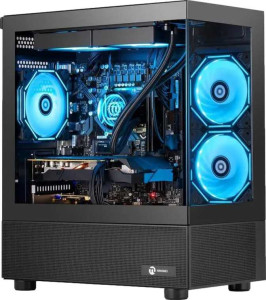
The NINGMEI R7 9700X / RTX 5070 follows an ATX form factor and occupies a total volume of 103,831.455 cm³, with physical dimensions of 609 mm in height, 305 mm in width, and 559 mm in depth. Storage is provided by a 2TB NVMe SSD, offering fast read and write access compared to traditional SATA-based drives within its class of internal solid-state storage.
Graphics card:
| VRAM |
12GB |
| floating-point performance |
30.84 TFLOPS |
| effective memory speed |
28000 MHz |
| GPU clock speed |
2330 MHz |
| GPU memory speed |
1750 MHz |
| GPU turbo |
2510 MHz |
| GDDR version |
GDDR7 |
| DirectX version |
DirectX 12 Ultimate |
| PCI Express (PCIe) version |
5 |
| supports ray tracing |
✓ |
| texture rate |
481.9 GTexels/s |
| pixel rate |
200.8 GPixel/s |
| maximum memory bandwidth |
672 GB/s |
| memory bus width |
192-bit |
| supports DLSS |
✓ |
| supported displays |
4 |
| semiconductor size |
5 nm |
| texture mapping units (TMUs) |
192 |
| shading units |
6144 |
| render output units (ROPs) |
80 |
| OpenGL version |
4.6 |
| OpenCL version |
3 |
| has LHR |
✕ |
| Supports multi-display technology |
✓ |
| Has Double Precision Floating Point (DPFP) |
✓ |
| Supports 3D |
✓ |
| has RGB lighting |
✕ |
| number of transistors |
31100 million |
The graphics card is equipped with 12GB of GDDR7 VRAM running across a 192-bit memory bus, with an effective memory speed of 28,000 MHz and a maximum memory bandwidth of 672 GB/s. The GPU operates at a base clock of 2,330 MHz and boosts up to 2,510 MHz, delivering a floating-point performance of 30.84 TFLOPS, a texture rate of 481.9 GTexels/s, and a pixel rate of 200.8 GPixel/s. Built on a 5 nm semiconductor process, it houses 31,100 million transistors alongside 6,144 shading units, 192 texture mapping units, and 80 render output units. The card connects via PCIe 5 and supports DirectX 12 Ultimate, OpenGL 4.6, and OpenCL 3, while also featuring ray tracing, DLSS, and double precision floating point capabilities. Multi-display and stereoscopic 3D output are both supported across up to four displays, though the card does not include LHR or RGB lighting.
CPU:
| CPU speed |
8 x 3.8 GHz |
| Has integrated graphics |
✓ |
| Has an unlocked multiplier |
✓ |
| L1 cache |
512 KB |
| L2 cache |
8 MB |
| L3 cache |
32 MB |
| turbo clock speed |
5.5GHz |
| CPU threads |
16 threads |
| uses multithreading |
✓ |
| clock multiplier |
38 |
| L2 core |
1 MB/core |
| L3 core |
4 MB/core |
| Supports 64-bit |
✓ |
| CPU temperature |
95 °C |
The CPU runs eight cores at a base speed of 3.8 GHz per core, with a turbo clock reaching 5.5 GHz, and exposes 16 threads through multithreading support. It carries a clock multiplier of 38 and an unlocked multiplier, allowing for manual frequency adjustments. Cache is structured as 512 KB of L1, 8 MB of L2 at 1 MB per core, and 32 MB of L3 at 4 MB per core, providing a reasonable amount of fast on-chip memory across the core stack. The processor includes integrated graphics, supports 64-bit computing, and has a maximum rated operating temperature of 95 °C.
Benchmarks:
| Geekbench 6 result (multi) |
17000 |
| Geekbench 6 result (single) |
3353 |
| PassMark result |
37163 |
| PassMark result (single) |
4654 |
| PassMark result (overclocked) |
38543 |
| Cinebench R20 (single) result |
866 |
| Cinebench R20 (multi) result |
8890 |
In Geekbench 6, the CPU scores 3,353 in the single-core test and 17,000 in the multi-core test, reflecting the processor's threading capability across all eight cores. PassMark results come in at 4,654 for single-threaded workloads, 37,163 in the standard multi-threaded run, and 38,543 when overclocked. Cinebench R20 figures follow a similar pattern, with a single-core result of 866 and a multi-core result of 8,890, rounding out a consistent set of benchmark data across both lightly and heavily threaded scenarios.
Memory:
| RAM |
32GB |
| RAM speed |
6000 MHz |
| DDR memory version |
5 |
The system comes fitted with 32GB of DDR5 RAM running at a speed of 6,000 MHz, covering the memory needs of demanding applications and multitasking workloads within the system's configuration.
Connectivity:
| supports Wi-Fi |
✕ |
| USB 2.0 ports |
4 |
| USB 3.2 Gen 2 ports (USB-A) |
0 |
| USB 3.2 Gen 1 ports (USB-A) |
2 |
| USB 3.2 Gen 2 ports (USB-C) |
2 |
| USB 4 40Gbps ports |
0 |
| USB 4 20Gbps ports |
0 |
| USB 3.2 Gen 2x2 ports |
0 |
| USB 3.2 Gen 1 ports (USB-C) |
1 |
| RJ45 ports |
1 |
| Thunderbolt 4 ports |
0 |
| Thunderbolt 3 ports |
0 |
| DisplayPort outputs |
3 |
| HDMI version |
HDMI 2.1b |
| HDMI ports |
1 |
| Has Bluetooth |
✕ |
| has an external memory slot |
✕ |
| DVI outputs |
0 |
| Has S/PDIF Out port |
✓ |
| has a socket for a 3.5 mm audio jack |
✓ |
| has a VGA connector |
✕ |
USB connectivity is handled through four USB 2.0 ports, two USB 3.2 Gen 1 Type-A ports, two USB 3.2 Gen 2 Type-C ports, and one USB 3.2 Gen 1 Type-C port, while USB 3.2 Gen 2 Type-A, Gen 2x2, USB 4, and Thunderbolt 3 and 4 ports are absent. Video output is covered by three DisplayPort connections and one HDMI 2.1b port, with no DVI or VGA connectors present. Wired networking is available via a single RJ45 port, though the system does not include Wi-Fi or Bluetooth. Audio connectivity includes a 3.5 mm headset jack and an S/PDIF output, and there is no external memory card slot.
Miscellaneous:
| has an HDMI output |
✓ |
| AMD SAM / Intel Resizable BAR |
Intel Resizable BAR |
| GPU architecture |
Blackwell |
| USB-C ports |
0 |
| Has air-water cooling |
✕ |
| Thermal Design Power (TDP) |
250W |
| mini DisplayPort outputs |
0 |
| Supports ECC memory |
✓ |
| has XeSS (XMX) |
✕ |
| Type |
Desktop |
| CPU socket |
AM5 |
| chipset |
X670, B650, X870, B840, B850 |
| Uses big.LITTLE technology |
✕ |
| instruction sets |
MMX, F16C, FMA3, AES, AVX, AVX2, SSE 4.1, SSE 4.2 |
| GPU execution units |
2 |
| memory channels |
2 |
| RAM speed (max) |
5600 MHz |
| maximum memory amount |
192GB |
| Has NX bit |
✓ |
The desktop CPU sits in an AM5 socket and is compatible with X670, B650, X870, B840, and B850 chipsets, carrying a thermal design power rating of 250W without using big.LITTLE heterogeneous core technology. It supports the NX bit for hardware-level execution protection and handles instruction sets including MMX, F16C, FMA3, AES, AVX, AVX2, SSE 4.1, and SSE 4.2. Memory support extends to a maximum of 192GB across two channels, with a maximum rated RAM speed of 5,600 MHz, and ECC memory is also supported. The GPU is based on the Blackwell architecture and includes 2 execution units, while Intel Resizable BAR is enabled for optimized data transfer between the CPU and GPU. The system includes an HDMI output, no mini DisplayPort outputs, no USB-C ports in this section's scope, and does not feature air-water cooling or XeSS support.