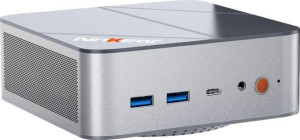
The Ninkear L12 Pro follows a Micro-ATX form factor and occupies a compact footprint of 130 mm wide, 52 mm tall, and 128 mm thick, resulting in a total volume of 865.28 cm³. Storage is handled by a 1TB NVMe SSD, combining solid capacity with the faster transfer speeds that the NVMe interface provides over traditional SATA drives.
The CPU operates at a 45W TDP with a hybrid clock configuration of six cores running at 2.5 GHz and eight cores at 1.8 GHz, reaching a turbo frequency of up to 5 GHz under peak load. It provides 20 threads through multithreading support and carries a 24MB L3 cache, alongside a clock multiplier of 25 that is unlocked, allowing for frequency adjustments. The processor supports 64-bit computing, includes integrated graphics, and has a maximum rated temperature of 100 °C.
The integrated graphics solution runs at a turbo clock of 1450 MHz and is built on a 10 nm semiconductor process, featuring 768 shading units, 48 texture mapping units, and 24 render output units. It connects via PCIe 4 and can drive up to 4 displays simultaneously. On the API side, it supports DirectX 12, OpenGL 4.6, and OpenCL 3, covering a broad range of compute and rendering workloads.
The system comes equipped with 32GB of DDR4 RAM running at a speed of 3200 MHz, providing a solid amount of memory for handling multitasking and memory-intensive workloads within a compact Mini PC form factor.
Wireless connectivity covers Wi-Fi 6E, Wi-Fi 6, Wi-Fi 5, and Wi-Fi 4, complemented by Bluetooth 5.2 for short-range peripherals. On the wired side, the unit provides two RJ45 ports for dual Ethernet connections, while USB options include three USB 2.0 ports, one USB 3.2 Gen 1 Type-A port, one USB 3.2 Gen 2 Type-C port, and one USB 4 40Gbps port, alongside a single Thunderbolt 4 port. Display output is handled through one HDMI 2.0 port and one DisplayPort, and a 3.5 mm audio jack is present for headsets. There is no VGA connector, no S/PDIF output, no USB 3.2 Gen 2 Type-A, no USB 3.2 Gen 2x2, no USB 3.2 Gen 1 Type-C, no USB 4 20Gbps, and no Thunderbolt 3 port.
In multi-threaded testing, the CPU achieves a PassMark score of 27,346, rising to 28,390 when overclocked, while the single-threaded PassMark result sits at 3,645. Cinebench R20 results follow a similar pattern, with a multi-core score of 6,892 and a single-core score of 710.
The system uses a laptop-class CPU paired with the Iris Xe Graphics 96EU, which features 96 execution units. Memory can be expanded up to 64GB across two channels, with a maximum supported RAM speed of 5200 MHz, though ECC memory is not supported. The processor does not use big.LITTLE technology but does include NX bit support for hardware-level memory protection, and it is compatible with instruction sets including SSE 4.1, SSE 4.2, AVX, AES, FMA3, F16C, and MMX. The product is covered by a 3-year warranty.