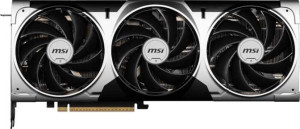
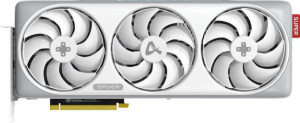
The RTX 4080 Super runs at a base GPU clock of 2290 MHz, rising to 2550 MHz in turbo mode, while its GPU memory operates at 1438 MHz. The card houses 10,240 shading units backed by 320 texture mapping units and 112 render output units, translating to a texture rate of 816 GTexels/s and a pixel rate of 285.6 GPixel/s. Floating-point performance is rated at 52.22 TFLOPS, and the GPU also supports Double Precision Floating Point (DPFP), making it capable of handling workloads that require higher numerical precision.
The RTX 4080 Super is equipped with 16GB of GDDR6X VRAM running across a 256-bit memory bus, with an effective memory speed of 23,000 MHz that yields a maximum memory bandwidth of 736.3 GB/s. The card also supports ECC memory, which enables error detection and correction for workloads where data integrity is a priority.
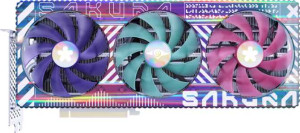
The RTX 4080 Super supports DirectX 12 Ultimate, OpenGL 4.6, and OpenCL 3, covering a broad range of graphics and compute APIs. Ray tracing and DLSS are both supported, alongside stereoscopic 3D and multi-display technology, with the card capable of driving up to four displays simultaneously. It includes Intel Resizable BAR support, but does not feature XeSS (XMX), LHR, or RGB lighting.
The RTX 4080 Super offers a total of four video outputs, consisting of three DisplayPort connectors and one HDMI 2.1 port. There are no USB-C, DVI, or mini DisplayPort outputs on this card.
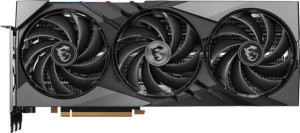
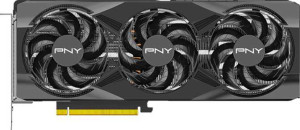
The RTX 4080 Super is built on the Ada Lovelace architecture, using a 5 nm manufacturing process that integrates 45,900 million transistors onto the die. It connects via PCIe 4.0 and carries a Thermal Design Power (TDP) of 320W. The card does not include air-water cooling, and its physical dimensions come in at 304 mm wide and 137 mm tall.